The Civil War in France
Contents
Contents · 14 chapters
- Introduction
- [The Begining of the Franco-Prussian War]
- [Prussian Occupation of France]
- [France Capitulates & the Government of Thiers]
- [Paris Workers’ Revolution & Thiers’ Reactionary Massacres]
- [The Paris Commune]
- [The Fall of Paris]
- Engels 1891 Postscript
- News stories
- Picture Gallery
- [First and Second Drafts] — The First Draft
- [First and Second Drafts] — The Second Draft
- [First and Second Drafts] — Notes
- Notes on Publication
Read as one page (to print or save)
Introduction
Frederick Engels: The Civil War in France
Introduction
Written by Karl Marx as an address to the General Council of the International, with the aim of distributing to workers of all countries a clear understanding of the character and world-wide significance of the heroic struggle of the Communards and their historical experience to learn from. The book was widely circulated by 1872 it was translated into several languages and published throughout Europe and the United States.
The first address was delivered on July 23rd, 1870, five days after the beginning of the Franco-Prussian War. The second address, delivered on September 9, 1870, gave a historical overview of the events a week after the army of Bonaparte was defeated. The third address, delivered on May 30, 1871, two days after the defeat of the Paris Commune – detailed the significance and the underlining causes of the first workers government ever created.
1891 Introduction by Frederick Engels
On the 20th Anniversary of the Paris Commune[Historical Background &
Overview of the Civil War]
Thanks to the economic and political development of France since [the French Revolution of] 1789, for 50 years the position of Paris has been such that no revolutions could break out there without assuming a proletarian character, that is to say, the proletariat, which had bought victory with its blood, would advance its own demands after victory. These demands were more or less unclear and even confused, corresponding to the state of evolution reached by the workers of Paris at the particular period, but in the last resort they all amounted to the abolition of the class antagonism between capitalist and workers. It is true that no one knew how this was to be brought about. But the demand itself, however indefinite it still was in its formulation, contained a threat to the existing order of society; the workers who put it forward were still armed; therefore the disarming of the workers was the first commandment for the bourgeois at the helm of the state. Hence, after every revolution won by the workers, a new struggle, ending with the defeat of the workers.
This happened for the first time in 1848. The liberal bourgeoisie of the parliamentary opposition held banquets for securing reform of the franchise, which was to ensure supremacy for their party. Forced more and more, in their struggle with the government, to appeal to the people, they had to allow the radical and republican strata of the bourgeoisie and petty bourgeoisie gradually to take the lead. But behind these stood the revolutionary workers, and since 1830,[A] these had acquired far more political independence than the bourgeoisie, and even the republicans, suspected. At the moment of the crisis between the government and the opposition, the workers opened battle on the streets; [King] Louis Philippe vanished, and with him the franchise reform; and in its place arose the republic, and indeed one which the victorious workers themselves designated as a “social” republic. No one, however, was clear as to what this social republic was to imply; not even the workers themselves. But they now had arms in their hands, and were a power in the state. Therefore, as soon as the bourgeois republicans in control felt something like firm ground under their feet, their first aim was to disarm the workers. This took place by driving them into the insurrection of June 1848 by direct breach of faith, by open defiance and the attempt to banish the unemployed to a distant province. The government had taken care to have an overwhelming superiority of force. After five days’ heroic struggle, the workers were defeated. And then followed a blood-bath of the defenceless prisoners, the likes of which as not been seen since the days of the civil wars which ushered in the downfall of the Roman republic. It was the first time that the bourgeoisie showed to what insane cruelties of revenge it will be goaded the moment the proletariat dares to take its stand against them as a separate class, with its own interests and demands. And yet 1848 was only child’s play compared with their frenzy in 1871.
Punishment followed hard at heel. If the proletariat was not yet able to rule France, the bourgeoisie could no longer do so. At least not at that period, when the greater part of it was still monarchically inclined, and it was divided into three dynastic parties [Legitimists, Orleanists and Bonapartists] and a fourth republican party. Its internal dissensions allowed the adventurer Louis Bonaparte to take possession of all the commanding points – army, police, administrative machinery – and, on December 2, 1851,[B] to explode the last stronghold of the bourgeoisie, the National Assembly. The Second Empire opened the exploitation of France by a gang of political and financial adventurers, but at the same time also an industrial development such as had never been possible under the narrow-minded and timorous system of Louis Philippe, with its exclusive domination by only a small section of the big bourgeoisie. Louis Bonaparte took the political power from the capitalists under the pretext of protecting them, the bourgeoisie, from the workers, and on the other hand the workers from them; but in return his rule encouraged speculation and industrial activity – in a word the rise and enrichment of the whole bourgeoisie to an extent hitherto unknown. To an even greater extent, it is true, corruption and mass robbery developed, clustering around the imperial court, and drawing their heavy percentages from this enrichment.
But the Second Empire was the appeal to the French chauvinism, the demand for the restoration of the frontiers of the First Empire, which had been lost in 1814, or at least those of the First Republic.[C] A French empire within the frontiers of the old monarchy and, in fact, within the even more amputated frontiers of 1815 – such a thing was impossible for any long duration of time. Hence the necessity for brief wars and extension of frontiers. But no extension of frontiers was so dazzling to the imagination of the French chauvinists as the extension to the German left bank of the Rhine. One square mile on the Rhine was more to them than ten in the Alps or anywhere else. Given the Second Empire, the demand for the restoration to France of the left bank of the Rhine, either all at once or piecemeal, was merely a question of time. The time came with the Austro-Prussian War of 1866; cheated of the anticipated “territorial compensation” by Bismarck, and by his own over-cunning, hesitating policy, there was now nothing left for Napoleon but war, which broke out in 1870 and drove him first to Sedan, and then to Wilhelmshohe [prison].
The inevitable result was the Paris Revolution of September 4, 1870. The empire collapsed like a house of cards, and the republic was again proclaimed. But the enemy was standing at the gates [of Paris]; the armies of the empire were either hopelessly beleaguered in Metz or held captive in Germany. In this emergency the people allowed the Paris Deputies to the former legislative body to constitute themselves into a “Government of National Defence.” This was the more readily conceded, since, for the purpose of defence, all Parisians capable of bearing arms had enrolled in the National Guard and were armed, so that now the workers constituted a great majority. But almost at once the antagonism between the almost completely bourgeois government and the armed proletariat broke into open conflict. On October 31, workers’ battalions stormed the town hall, and captured some members of the government. Treachery, the government’s direct breach of its undertakings, and the interventions of some petty-bourgeois battalions set them free again, and in order not to occasion the outbreak of civil war inside a city which was already beleaguered by a foreign power, the former government was left in office.
At last on January 28, 1871, Paris, almost starving, capitulated but with honors unprecedented in the history of war. The forts were surrendered, the outer wall disarmed, the weapons of the regiments of the line and of the Mobile Guard were handed over, and they themselves considered prisoners of war. But the National Guard kept its weapons and guns, and only entered into an armistice with the victors, who themselves did not dare enter Paris in triumph. They only dared to occupy a tiny corner of Paris, which, into the bargain, consisted partly of public parks, and even this they only occupied for a few days! And during this time they, who had maintained their encirclement of Paris for 131 days, were themselves encircled by the armed workers of Paris, who kept a sharp watch that no “Prussian” should overstep the narrow bounds of the corner ceded to the foreign conquerors. Such was the respect which the Paris workers inspired in the army before which all the armies of the empire had laid down their arms; and the Prussian Junkers, who had come to take revenge at the very centre of the revolution, were compelled to stand by respectfully, and salute just precisely this armed revolution!
During the war the Paris workers had confined themselves to demanding the vigorous prosecution of the fight. But now, when peace had come after the capitulation of Paris,[D] now, Thiers, the new head of government, was compelled to realize that the supremacy of the propertied classes – large landowners and capitalists – was in constant danger so long as the workers of Paris had arms in their hands. His first action was to attempt to disarm them. On March 18, he sent troops of the line with orders to rob the National Guard of the artillery belonging to it, which had been constructed during the siege of Paris and had been paid for by public subscription. The attempt failed; Paris mobilized as one man in defence of the guns, and war between Paris and the French government sitting at Versailles was declared. On March 26 the Paris Commune was elected and on March 28 it was proclaimed. The Central Committee of the National Guard, which up to then had carried on the government, handed in its resignation to the National Guard, after it had first decreed the abolition of the scandalous Paris “Morality Police.” On March 30 the Commune abolished conscription and the standing army, and declared that the National Guard, in which all citizens capable of bearing arms were to be enrolled, was to be the sole armed force. It remitted all payments of rent for dwelling houses from October 1870 until April, the amounts already paid to be reckoned to a future rental period, and stopped all sales of articles pledged in the municipal pawnshops. On the same day the foreigners elected to the Commune were confirmed in office, because “the flag of the Commune is the flag of the World Republic.”
On April 1 it was decided that the highest salary received by any employee of the Commune, and therefore also by its members themselves, might not exceed 6,000 francs. On the following day the Commune decreed the separation of the Church from the State, and the abolition of all state payments for religious purposes as well as the transformation of all Church property into national property; as a result of which, on April 8, a decree excluding from the schools all religious symbols, pictures, dogmas, prayers – in a word, “all that belongs to the sphere of the individual’s conscience” – was ordered to be excluded from the schools, and this decree was gradually applied. On the 5th, in reply to the shooting, day after day, of the Commune’s fighters captured by the Versailles troops, a decree was issued for imprisonment of hostages, but it was never carried into effect. On the 6th, the guillotine was brought out by the 137th battalion of the National Guard, and publicly burnt, amid great popular rejoicing. On the 12th, the Commune decided that the Victory Column on the Place Vendôme, which had been cast from guns captured by Napoleon after the war of 1809, should be demolished as a symbol of chauvinism and incitement to national hatred. This decree was carried out on May 16. On April 16 the Commune ordered a statistical tabulation of factories which had been closed down by the manufacturers, and the working out of plans for the carrying on of these factories by workers formerly employed in them, who were to be organized in co-operative societies, and also plans for the organization of these co-operatives in one great union. On the 20th the Commune abolished night work for bakers, and also the workers’ registration cards, which since the Second Empire had been run as a monopoly by police nominees – exploiters of the first rank; the issuing of these registration cards was transferred to the mayors of the 20 arrondissements of Paris. On April 30, the Commune ordered the closing of the pawnshops, on the ground that they were a private exploitation of labor, and were in contradiction with the right of the workers to their instruments of labor and to credit. On May 5 it ordered the demolition of the Chapel of Atonement, which had been built in expiation of the execution of Louis XVI.
Thus, from March 18 onwards the class character of the Paris movement, which had previously been pushed into the background by the fight against the foreign invaders, emerged sharply and clearly. As almost without exception, workers, or recognized representatives of the workers, sat in the Commune, its decision bore a decidedly proletarian character. Either they decreed reforms which the republican bourgeoisie had failed to pass solely out of cowardice, but which provided a necessary basis for the free activity of the working class – such as the realization of the principle that in relation to the state, religion is a purely private matter – or they promulgated decrees which were in the direct interests of the working class and to some extent cut deeply into the old order of society. In a beleaguered city, however, it was possible at most to make a start in the realization of all these measures. And from the beginning of May onwards all their energies were taken up by the fight against the ever-growing armies assembled by the Versailles government.
On April 7, the Versailles troops had captured the Seine crossing at Neuilly, on the western front of Paris; on the other hand, in an attack on the southern front on the 11th they were repulsed with heavy losses by General Eudes. Paris was continually bombarded and, moreover, by the very people who had stigmatized as a sacrilege the bombardment of the same city by the Prussians. These same people now begged the Prussian government for the hasty return of the French soldiers taken prisoner at Sedan and Metz, in order that they might recapture Paris for them. From the beginning of May the gradual arrival of these troops gave the Versailles forces a decided ascendancy. This already became evident when, on April 23, Thiers broke off the negotiations for the exchange, proposed by Commune, of the Archbishop of Paris [Georges Darboy] and a whole number of other priests held hostages in Paris, for only one man, Blanqui, who had twice been elected to the Commune but was a prisoner in Clairvaux. And even more from the changed language of Thiers; previously procrastinating and equivocal, he now suddenly became insolent, threatening, brutal. The Versailles forces took the redoubt of Moulin Saquet on the southern front, on May 3; on the 9th, Fort Issy, which had been completely reduced to ruins by gunfire; and on the 14th, Fort Vanves. On the western front they advanced gradually, capturing the numerous villages and buildings which extended up to the city wall, until they reached the main wall itself; on the 21st, thanks to treachery and the carelessness of the National Guards stationed there, they succeeded in forcing their way into the city. The Prussians who held the northern and eastern forts allowed the Versailles troops to advance across the land north of the city, which was forbidden ground to them under the armistice, and thus to march forward and attack on a long front, which the Parisians naturally thought covered by the armistice, and therefore held only with weak forces. As a result of this, only a weak resistance was put up in the western half of Paris, in the luxury city proper; it grew stronger and more tenacious the nearer the incoming troops approached the eastern half, the real working class city.
It was only after eight days’ fighting that the last defender of the Commune were overwhelmed on the heights of Belleville and Menilmontant; and then the massacre of defenceless men, women, and children, which had been raging all through the week on an increasing scale, reached its zenith. The breechloaders could no longer kill fast enough; the vanquished workers were shot down in hundred by mitrailleuse fire [over 30,000 citizens of Paris were massacred]. The “Wall of the Federals” [aka Wall of the Communards] at the Pere Lachaise cemetery, where the final mass murder was consummated, is still standing today, a mute but eloquent testimony to the savagery of which the ruling class is capable as soon as the working class dares to come out for its rights. Then came the mass arrests [38,000 workers arrested]; when the slaughter of them all proved to be impossible, the shooting of victims arbitrarily selected from the prisoners’ ranks, and the removal of the rest to great camps where they awaited trial by courts-martial. The Prussian troops surrounding the northern half of Paris had orders not to allow any fugitives to pass; but the officers often shut their eyes when the soldiers paid more obedience to the dictates of humanity than to those of the General Staff; particularly, honor is due to the Saxon army corps, which behaved very humanely and let through many workers who were obviously fighters for the Commune.
Frederick Engels
A. The revolution of July 1830 in France.
B. The coup d’etat, by Louis Bonaparte on December 2, 1851, which marked the beginning of the Bonapartist regime of the Second Empire.
C. The first republic was proclaimed in 1792 and was replaced by the First Empire of Napoleon I (1804-14), which expanded the borders of France as far east as to include most of Northern Italy and stopped short of Denmark. Further, Napoleon established a series of satellite states that stretched throughout central and Eastern Europe, up through Poland. His attempt to spread his empire into Russia was met with bitter failure, by the hand of the extremely courageous and the bold resistance of the Russian land and peasantry.
D. The preliminary peace treaty between France and Germany signed at Versailles on February 26, 1871 by Thiers and Jules Favre, on the one hand, and Bismarck, on the other. According to the terms of this treaty, France ceded Alsace and East Lorraine to Germany and paid it indemnities to the sum of 5 billion francs. The final peace treaty was signed in Frankfort-on-Main on May 10, 1871.
[The Begining of the Franco-Prussian War]
Karl Marx: The Civil War in France
The First Address[1]
July 23, 1870[The Beginning of the Franco-Prussian War]
In the Inaugural Address of the International Working Men’s Association, of November 1864, we said:
“If the emancipation of the working classes requires their fraternal concurrence, how are they to fulfill that great mission with a foreign policy in pursuit of criminal designs, playing upon national prejudices, and squandering in piratical wars the people’s blood and treasure?”
We defined the foreign policy aimed at by the International in these words:
“Vindicate the simple laws of morals and justice, which ought to govern the relations of private individuals, as the laws paramount of the intercourse of nations.”
No wonder that Louis Bonaparte, who usurped power by exploiting the war of classes in France, and perpetuated it by periodical wars abroad, should, from the first, have treated the International as a dangerous foe. On the eve of the plebiscite[A] he ordered a raid on the members of the Administrative Committee of the International Working Men’s Association throughout France, at Paris, Lyons, Rouen, Marseilles, Brest, etc., on the pretext that the International was a secret society dabbling in a complot for his assassination, a pretext soon after exposed in its full absurdity by his own judges. What was the real crime of the French branches of the International? They told the French people publicly and emphatically that voting the plebiscite was voting despotism at home and war abroad. It has been, in fact, their work that in all the great towns, in all the industrial centres of France, the working class rose like one man to reject the plebiscite. Unfortunately, the balance was turned by the heavy ignorance of the rural districts. The stock exchanges, the cabinets, the ruling classes, and the press of Europe celebrated the plebiscite as a signal victory of the French emperor over the French working class; and it was the signal for the assassination, not of an individual, but of nations.
The war plot of July [19] 1870[B] is but an amended edition of the coup d’etat of December 1851. At first view, the thing seemed so absurd that France would not believe in its real good earnest. It rather believed the deputy denouncing the ministerial war talk as a mere stock-jobbing trick. When, on July 15, war was at last officially announced to the Corps Legislatif, the whole Opposition refused to vote the preliminary subsidies – even Thiers branded it as “detestable”; all the independent journals of Paris condemned it, and, wonderful to relate, the provincial press joined in almost unanimously.
Meanwhile, the Paris members of the International had again set to work. In the Reveil of July 12, they published their manifesto “to the Workmen of all Nations,” from which we extract the following few passages:
“Once more,” they say, “on the pretext of European equilibrium, of national honor, the peace of the world is menaced by political ambitions. French, German, Spanish workmen! Let our voices unite in one cry of reprobation against war!
[...]
“War for a question of preponderance or a dynasty can, in the eyes of workmen, be nothing but a criminal absurdity. In answer to the warlike proclamations of those who exempt themselves from the blood tax, and find in public misfortunes a source of fresh speculations, we protest, we who want peace, labor, and liberty!
[...]
“Brothers in Germany! Our division would only result in the complete triumph of the despotism on both sides of the Rhine...
“Workmen of all countries! Whatever may for the present become of our common efforts, we, the members of the International Working Men’s Association, who know of no frontiers, we send you, as a pledge of indissoluble solidarity, the good wishes and the salutations of the workmen of France.”
This manifesto of our Paris section was followed by numerous similar French addresses, of which we can here only quote the declaration of Neuilly-sur-Seine, published in the Marseillaise of July 22:
“The war, is it just? No! The war, is it national? No! It is merely dynastic. In the name of humanity, or democracy, and the true interests of France, we adhere completely and energetically to the protestation of the International against the war.”
These protestations expressed the true sentiments of the French working people, as was soon shown by a curious incident. The Band of the 10th of December, first organized under the presidency of Louis Bonaparte, having been masqueraded into blouses [i.e., to appear as common workers] and let loose on the streets of Paris, there to perform the contortions of war fever, the real workmen of the Faubourgs [suburbs, workers’ districts] came forward with public peace demonstrations so overwhelming that Pietri, the Prefect of Police, thought it prudent to stop at once all further street politics, on the plea that the real Paris people had given sufficient vent to their pent-up patriotism and exuberant war enthusiasm.
Whatever may be the incidents of Louis Bonaparte’s war with Prussia, the death-knell of the Second Empire has already sounded at Paris. It will end, as it began, by a parody. But let us not forget that it is the governments and the ruling classes of Europe who enabled Louis Bonaparte to play during 18 years the ferocious farce of the Restored Empire.
On the German side, the war is a war of defence; but who put Germany to the necessity of defending herself? Who enabled Louis Bonaparte to wage war upon her? Prussia! It was Bismarck who conspired with that very same Louis Bonaparte for the purpose of crushing popular opposition at home, and annexing Germany to the Hohenzollern dynasty. If the battle of Sadowa had been lost instead of being won, French battalions would have overrun Germany as the allies of Prussia. After her victory, did Prussia dream one moment of opposing a free Germany to an enslaved France? Just the contrary. While carefully preserving all the native beauties of her old system, she super-added all the tricks of the Second Empire, its real despotism, and its mock democratism, its political shams and its financial jobs, its high-flown talk and its low legerdemains. The Bonapartist regime, which till then only flourished on one side of the Rhine, had now got its counterfeit on the other. From such a state of things, what else could result but war?
If the German working class allows the present war to lose its strictly defensive character and to degenerate into a war against the French people, victory of defeat will prove alike disastrous. All the miseries that befell Germany after her wars of independence will revive with accumulated intensity.
The principles of the International are, however, too widely spread and too firmly rooted amongst the German working class to apprehend such a sad consummation. The voices of the French workmen had re-echoed from Germany. A mass meeting of workmen, held at Brunswick on July 16, expressed its full concurrence with the Paris manifesto, spurned the idea of national antagonism to France, and wound up its resolutions with these words:
“We are the enemies of all wars, but above all of dynastic wars. ... With deep sorrow and grief we are forced to undergo a defensive war as an unavoidable evil; but we call, at the same time, upon the whole German working class to render the recurrence of such an immense social misfortune impossible by vindicating for the peoples themselves the power to decide on peace and war, and making them masters of their own destinies.”
At Chemnitz, a meeting of delegates, representing 50,000 Saxon workmen, adopted unanimously a resolution to this effect:
“In the name of German Democracy, and especially of the workmen forming the Democratic Socialist Party, we declare the present war to be exclusively dynastic.... We are happy to grasp the fraternal hand stretched out to us by the workmen of France.... Mindful of the watchword of the International Working Men’s Association: Proletarians of all countries, unite, we shall never forget that the workmen of all countries are our friends and the despots of all countries our enemies.”
The Berlin branch of the International has also replied to the Paris manifesto:
“We,” they say, “join with heart and hand your protestation.... Solemnly, we promise that neither the sound of the trumpets, nor the roar of the cannon, neither victory nor defeat, shall divert us from our common work for the union of the children of toil of all countries.”
Be it so!
In the background of this suicidal strike looms the dark figure of Russia. It is an ominous sign that the signal for the present war should have been given at the moment when the Moscovite government had just finished its strategic lines of railway and was already massing troops in the direction of the Prut.[C] Whatever sympathy the Germans may justly claim in a war of defense against Bonapartist aggression, they would forfeit at once by allowing the Prussian government to call for, or accept the help of, the Cossack. Let them remember that after their war of independence against the first Napoleon, Germany lay for generations prostrate at the feet of the tsar.
The English working class stretch the hand of fellowship to the French and German working people. They feel deeply convinced that whatever turn the impending horrid war may take, the alliance of the working classes of all countries will ultimately kill war. The very fact that while official France and Germany are rushing into a fratricidal feud, the workmen of France and Germany send each other messages of peace and goodwill; this great fact, unparalleled in the history of the past, opens the vista of a brighter future. It proves that in contrast to old society, with its economical miseries and its political delirium, a new society is springing up, whose International rule will be Peace, because its national ruler will be everywhere the same – Labour! The pioneer of that new society is the International Working Men’s Association.
[A] A plebiscite is a direct vote by an electorate of a nation to decide a question of national importance, such as governmental policy. Conducted by Napoleon III in May 1870 the questions were so worded that it was impossible to express disapproval of the policy of the Second Empire without declaring opposition to all democratic reforms for the working class. The sections of the First International in France argued that their members should not participate in the vote. On the eve of the plebiscite members of the Paris Federation were arrested on a charge of conspiring against Napoleon III. This pretext was further used by the government to launch a campaign of persecution of the members of the International throughout France. At the trial of the Paris Federation members (June 22 to July 5, 1870), the charge of conspiracy was clearly exposed as without any basis. Nevertheless a number of the International’s members were sentenced to imprisonment based solely on their socialistic beliefs. The working class of France responded to these political persecutions with mass protests.
[B] The date when Napoleon III declared war on Prussia.
[C] The river Prut, rising in the southwestern Ukraine and flowing southeast, forming part of the border between Roumania (within an autonomous part of Austria-Hungary) and Russia (later to join the river Danube). Length: 853 kilometers.
[Prussian Occupation of France]
Karl Marx: The Civil War in France
The Second Address[2]
September 9, 1870[Prussian Occupation of France]
In our first manifesto of the 23rd of July, we said:
“The death-knell of the Second Empire has already sounded at Paris. It will end, as it began, by a parody. But let us not forget that it is the governments and the ruling classes of Europe who enabled Louis Bonaparte to play during 18 years the ferocious farce of the Restored Empire.”
Thus, even before war operations had actually set in, we treated the Bonapartist bubble as a thing of the past.
If we were not mistaken as to the vitality of the Second Empire, we were not wrong in our apprehension lest the German war should “lose its strictly defensive character and degenerate into a war against the French people.” The war of defense ended, in point of fact, with the surrender of Louis Bonaparte, the Sedan capitulation, and the proclamation of the republic at Paris. But long before these events, the very moment that the utter rottenness of the imperialist arms became evident, the Prussian military camarilla had resolved upon conquest. There lay an ugly obstacle in their way – [Prussian] King William’s own proclamations at the commencement of the war.
In a speech from the throne to the North German Diet, he had solemnly declared to make war upon the emperor of the French and not upon the French nation, where he said:
“The Emperor Napoleon having made by land and sea an attack on the German nation, which desired and still desires to live in peace with the French people, I have assumed the command of the German armies to repel his aggression, and I have been led by military events to cross the frontiers of France.”
Not content to assert the defensive character of the war by the statement that he only assumed the command of the German armies “to repel aggression", he added that he was only “led by military events” to cross the frontiers of France. A defensive war does, of course, not exclude offensive operations, dictated by military events.
Thus, the pious king stood pledged before France and the world to a strictly defensive war. How to release him from his solemn pledge? The stage managers had to exhibit him as reluctantly yielding to the irresistible behest of the German nation. They at once gave the cue to the liberal German middle class, with its professors, its capitalists, its aldermen, and its penmen. That middle class, which, in its struggles for civil liberty, had, from 1846 to 1870, been exhibiting an unexampled spectacle of irresolution, incapacity and cowardice, felt, of course, highly delighted to bestride the European scene as the roaring lion of German patriotism. It re-vindicated its civic independence by affecting to force upon the Prussian government the secret designs of that same government. It does penance for its long-continued, and almost religious, faith in Louis Bonaparte’s infallibility, but shouting for the dismemberment of the French republic. Let us, for a moment, listen to the special pleadings of those stout-hearted patriots!
They dare not pretend that the people of Alsace and Lorraine pant for the German embrace; quite the contrary. To punish their French patriotism, Strasbourg, a town with an independent citadel commanding it, has for six days been wantonly and fiendishly bombarded by “German” explosive shells, setting it on fire, and killing great numbers of its defenceless inhabitants! Yet, the soil of those provinces once upon a time belonged to the whilom German empire.[A] Hence, it seems, the soil and the human beings grown on it must be confiscated as imprescriptible German property. If the map of Europe is to be re-made in the antiquary’s vein, let us by no means forget that the Elector of Brandenburg, for his Prussian dominions, was the vassal of the Polish republic.[B]
The more knowing patriots, however, require Alsace and the German-speaking Lorraine as a “material guarantee” against French aggression. As this contemptible plea has bewildered many weak-minded people, we are bound to enter more fully upon it.
There is no doubt that the general configuration of Alsace, as compared with the opposite bank of the Rhine, and the presence of a large fortified town like Strasbourg, about halfway between Basle and Germersheim, very much favour a French invasion of South Germany, while they offer peculiar difficulties to an invasion of France from South Germany. There is, further, no doubt that the addition of Alsace and German-speaking Lorraine would give South Germany a much stronger frontier, inasmuch as she would then be the master of the crest of the Vosges mountains in its whole length, and of the fortresses which cover its northern passes. If Metz were annexed as well, France would certainly for the moment be deprived of her two principal bases of operation against Germany, but that would not prevent her from concentrating a fresh one at Nancy or Verdun. While Germany owns Coblenz, Mayence [i.e., Mainz], Germersheim, Rastatt, and Ulm, all bases of operation against France, and plentifully made use of in this war, with what show of fair play can she begrudge France Strasbourg and Metz, the only two fortresses of any importance she has on that side? Moreover, Strasbourg endangers South Germany only while South Germany is a separate power from North Germany. From 1792 to 1795, South Germany was never invaded from that direction, because Prussia was a party to the war against the French Revolution; but as soon as Prussia made a peace of her own[C] in 1795, and left the South to shift for itself, the invasions of South Germany with Strasbourg as a base began and continued till 1809. The fact is, a united Germany can always render Strasbourg and any French army in Alsace innocuous by concentrating all her troops, as was done in the present war, between Saarlouis and Landau, and advancing, or accepting battle, on the line of road between Mayence and Metz. While the mass of the German troops is stationed there, any French army advancing from Strasbourg into South Germany would be outflanked, and have its communication threatened. If the present campaign has proved anything, it is the facility of invading France from Germany.
But, in good faith, is it not altogether an absurdity and an anachronism to make military considerations the principle by which the boundaries of nations are to be fixed? If this rule were to prevail, Austria would still be entitled to Venetia and the line of the Minicio, and France to the line of the Rhine, in order to protect Paris, which lies certainly more open to an attack from the northeast than Berlin does from the southwest. If limits are to be fixed by military interests, there will be no end to claims, because every military line is necessarily faulty, and may be improved by annexing some more outlying territory; and, moreover, they can never be fixed finally and fairly, because they always must be imposed by the conqueror upon the conquered, and consequently carry within them the seed of fresh wars.
Such is the lesson of all history.
Thus with nations as with individuals. To deprive them of the power of offence, you must deprive them of the means of defence. You must not only garrote, but murder. If every conqueror took “material guarantees" for breaking the sinews of a nation, the first Napoleon did so by the Tilsit Treaty, and the way he executed it against Prussia and the rest of Germany. Yet, a few years later, his gigantic power split like a rotten reed upon the German people. What are the “material guarantees” Prussia, in her wildest dreams, can or dare imposes upon France, compared to the “material guarantees” the first Napoleon had wrenched from herself? The result will not prove the less disastrous. History will measure its retribution, not by the intensity of the square miles conquered from France, but by the intensity of the crime of reviving, in the second half of the 19th century, the policy of conquest!
But, say the mouthpieces of Teutonic [German] patriotism, you must not confound Germans with Frenchmen. What we want is not glory, but safety. The Germans are an essentially peaceful people. In their sober guardianship, conquest itself changes from a condition of future war into a pledge of perpetual peace. Of course, it is not Germans that invaded France in 1792, for the sublime purpose of bayonetting the revolution of the 18th century. It is not Germans that befouled their hands by the subjugation of Italy, the oppressions of Hungary, and the dismemberment of Poland. Their present military system, which divides the whole able-bodied male population into two parts – one standing army on service, and another standing army on furlough, both equally bound in passive obedience to rulers by divine right – such a military system is, of course, “a material guarantee,” for keeping the peace and the ultimate goal of civilizing tendencies! In Germany, as everywhere else, the sycophants of the powers that be poison the popular mind by the incense of mendacious self-praise.
Indignant as they pretend to be at the sight of French fortresses in Metz and Strasbourg, those German patriots see no harm in the vast system of Moscovite fortifications at Warsaw, Modlin, and Ivangorod [All strongholds of the Russian Empire] . While gloating at the terrors of imperialist invasion, they blink at the infamy of autocratic tutelage.
As in 1865, promises were exchanged between Gorchakov and Bismarck. As Louis Bonaparte flattered himself that the War of 1866, resulting in the common exhaustion of Austria and Prussia, would make him the supreme arbiter of Germany, so Alexander [II of Russia] flattered himself that the War of 1870, resulting in the common exhaustion of Germany and France, would make him the supreme arbiter of the Western continent. As the Second Empire thought the North German Confederation incompatible with its existence, so autocratic Russia must think herself endangered by a German empire under Prussian leadership. Such is the law of the old political system. Within its pale the gain of one state is the loss of the other. The tsar’s paramount influence over Europe roots in his traditional hold on Germany. At a moment when in Russia herself volcanic social agencies threaten to shake the very base of autocracy, could the tsar afford to bear with such a loss of foreign prestige? Already the Moscovite journals repeat the language of the Bonapartist journals of the War of 1866. Do the Teuton patriots really believe that liberty and peace will be guaranteed to Germany by forcing France into the arms of Russia? If the fortune of her arms, the arrogance of success, and dynastic intrigue lead Germany to a dismemberment of French territory, there will then only remain two courses open to her. She must at all risks become the avowed tool of Russian aggrandizement, or, after some short respite, make again ready for another “defensive” war, not one of those new-fangled “localized” wars, but a war of races – a war with the Slavonic and Roman races.[D]
The German working class have resolutely supported the war, which it was not in their power to prevent, as a war for German independence and the liberation of France and Europe from that pestilential incubus, the Second Empire. It was the German workmen who, together with the rural laborers, furnished the sinews and muscles of heroic hosts, leaving behind their half-starved families. Decimated by the battles abroad, they will be once more decimated by misery at home. In their turn, they are now coming forward to ask for “guarantees” – guarantees that their immense sacrifices have not been bought in vain, that they have conquered liberty, that the victory over the imperialist armies will not, as in 1815, be turned into the defeat of the German people[E]; and, as the first of these guarantees, they claim an honorable peace for France, and the recognition of the French republic.
The Central Committee of the German Social-Democratic Workmen’s Party issued, on September 5, a manifesto, energetically insisting upon these guarantees.
“We,” they say, “protest against the annexation of Alsace and Lorraine. And we are conscious of speaking in the name of the German working class. In the common interest of France and Germany, in the interest of western civilization against eastern barbarism, the German workmen will not patiently tolerate the annexation of Alsace and Lorraine.... We shall faithfully stand by our fellow workmen in all countries for the common international cause of the proletariat!”
Unfortunately, we cannot feel sanguine of their immediate success. If the French workmen amidst peace failed to stop the aggressor, are the German workmen more likely to stop the victor amidst the clamour of arms? The German workmen’s manifesto demands the extradition of Louis Bonaparte as a common felon to the French republic. Their rulers are, on the contrary, already trying hard to restore him to the Tuileries[F] as the best man to ruin France. However that may be, history will prove that the German working class are not made of the same malleable stuff as the German middle class. They will do their duty.
Like them, we hail the advent of the republic in France, but at the same time we labor under misgivings which we hope will prove groundless. That republic has not subverted the throne, but only taken its place, become vacant. It has been proclaimed, not as a social conquest, but as a national measure of defence. It is in the hands of a Provisional Government composed partly of notorious Orleanists, partly of middle class republicans, upon some of whom the insurrection of June 1848 has left its indelible stigma. The division of labor amongst the members of that government looks awkward. The Orleanists have seized the strongholds of the army and the police, while to the professed republicans have fallen the talking departments. Some of their acts go far to show that they have inherited from the empire, not only ruins, but also its dread of the working class. If eventual impossibilities are, in wild phraseology, promised in the name of the republic, is it not with a view to prepare the cry for a “possible” government? Is the republic, by some of its middle class undertakers, not intended to serve as a mere stop-gap and bridge over an Orleanist restoration?
The French working class moves, therefore, under circumstances of extreme difficulty. Any attempt at upsetting the new government in the present crisis, when the enemy is almost knocking at the doors of Paris, would be a desperate folly. The French workmen must perform their duties as citizens; but, at the same time, they must not allow themselves to be swayed by the national souvenirs of 1792, as the French peasant allowed themselves to be deluded by the national souvenirs of the First Empire. They have not to recapitulate the past, but to build up the future. Let them calmly and resolutely improve the opportunities of republican liberty, for the work of their own class organization. It will gift them with fresh herculean powers for the regeneration of France, and our common task – the emancipation of labor. Upon their energies and wisdom hinges the fate of the republic.
The English workmen have already taken measures to overcome, by a wholesome pressure from without, the reluctance of their government to recognize the French republic.[G] The present dilatoriness of the British government is probably intended to atone for the Anti-Jacobin war [1792] and the former indecent haste in sanctioning the coup d’etat.[H] The English workmen call also upon their government to oppose by all its power the dismemberment of France, which a part of the English press is shameless enough to howl for. It is the same press that for 20 years deified Louis Bonaparte as the providence of Europe, that frantically cheered on the slaveholders’ rebellion.[I] Now, as then, it drudges for the slaveholder.
Let the sections of the International Working Men’s Association in every country stir the working classes to action. If they forsake their duty, if they remain passive, the present tremendous war will be but the harbinger of still deadlier international feuds, and lead in every nation to a renewed triumph over the workman by the lords of the sword, of the soil, and of capital.
Vive la Republique!
[A] The Holy Roman Empire of the German nation, founded in the 10th century and constituting a union of feudal principalities and free towns which recognized the supreme of authority of an emperor.
[B] In 1618 the Electorate of Brandenburg united with the Prussian Dutchy (East Prussia), which had been formed early in the 16th century out of the Teutonic Order possessions and which was still a feudal vessel of the Kingdom of Poland. The Elector of Brandenburg, a Prussian Duke at the same time, remained a Polish vassal until 1657 when, taking advantage of Poland’s difficulties in the war against Sweden, he secured sovereign rights to Prussian possessions.
[C] The Treaty of Basle concluded by Prussia, a member of the first anti-French coalition of the European states, with the French Republic on April 5, 1795.
[D] Marx’s clear assessment of Germany’s historical position took some time to completely fulfill itself, but when it did Germany’s war on races occurred in full force.
[E] Marx refers here to the triumph of feudal reaction in Germany after the downfall of Napoleon. The feudalist unity of Germany was restored, the feudal-monarchist system was established in the German states, which retained all the privileges of the nobility and intensified the semi-feudal exploitation of the peasantry.
[F] The Tuileries Palace in Paris, a residence of Napoleon III.
[G] Campaigns by English workers to secure recognition of the French Republic proclaimed on Sept. 4, 1870. On Sept. 5 a series of meetings and demonstrations began in London and other big cities, at which resolutions and petitions were passed demanding that the British Government immediately recognize the French Republic. The General Council of the First International took a direct part in the organization of this movement.
[H] Marx is alluding to England’s active part in forming a coalition of feudal monarchies which started a war against revolutionary France in 1792, and also to the fact that the English oligarchy was the first in Europe to recognize the Bonapartist regime in France, established as a result of the coup d’etat, by Louis Bonaparte on December 2, 1851.
[I] During the American Civil War (1861-65) between the industrial North and the slave-owning South, the English bourgeois press took the side of the South.
[France Capitulates & the Government of Thiers]
Karl Marx: The Civil War in France
The Third Address
May, 1871[France Capitulates & the Government of Thiers]
In September 4, 1870, when the working men of Paris proclaimed the republic, which was almost instantaneously acclaimed throughout France, without a single voice of dissent, a cabal of place-hunting barristers, with Thiers for their statesman, and Trochu for their general, took hold of the Hotel de Ville. At that time they were imbued with so fanatical a faith in the mission of Paris to represent France in all epochs of historical crisis that, to legitimate their usurped titles as governors of France, they thought it quite sufficient to produce their lapsed mandates as representatives of Paris.
In our second address on the late war, five days after the rise of these men, we told you who they were. Yet, in the turmoil of surprise, with the real leaders of the working class still shut up in Bonapartist prisons and the Prussians already marching on Paris, Paris bore with their assumption of power, on the express condition that it was to be wielded for the single purpose of national defence. Paris, however, was not to be defended without arming its working class, organizing them into an effective force, and training their ranks by the war itself. But Paris armed was the revolution armed. A victory of Paris over the Prussian aggressor would have been a victory of the French workmen over the French capitalist and his state parasites. In this conflict between national duty and class interest, the Government of National Defence did not hesitate one moment to turn into a Government of National Defection.
The first step they took was to send Thiers on a roving tour to all the courts of Europe, there to beg mediation by offering the barter of the republic for a king. Four months after the commencement of the siege [of Paris], when they thought the opportune moment came for breaking the first word of capitulation, Trochu, in the presence of Jules Favre, and others of his colleagues, addressed the assembled mayors of Paris in these terms:
“The first question put to me by my colleagues on the very evening of the 4th of September was this: Paris, can it, with any chance of success, stand a siege by the Prussian army? I did not hesitate to answer in the negative. Some of my colleagues here present will warrant the truth of my words and the persistence of my opinion. I told them, in these very terms, that, under the existing state of things, the attempt of Paris to hold out a siege by the Prussian army would be a folly. Without doubt, I added, it would be an heroic folly; but that would be all.... The events [managed by himself] have not given the lie to my prevision.”
This nice little speech of Trochu was afterwards published by M. Carbon, one of the mayors present.
Thus, on the very evening of the proclamation of the republic, Trochu’s “plan” was known to his colleagues to be the capitulation of Paris. If national defence has been more than a pretext for the personal government of Thiers, Favre, and Co., the upstarts of September 4 would have abdicated on the 5th – would have initiated the Paris people into Trochu’s “plan,” and called upon them to surrender at once, or to take their own fate into their own hands. Instead of this, the infamous impostors resolved upon curing the heroic folly of Paris by a regimen of famine and broken heads, and to dupe her in the meanwhile by ranting manifestos, holding forth that Trochu, “the governor of Paris, will never capitulate", and Jules Favre, the foreign minister, will “not cede an inch of our territory, nor a stone of our fortresses.”
In a letter to Gambetta, the very same Jules Favre avows that what they were “defending” against were not the Prussian soldiers, but the working men of Paris. During the whole continuance of the siege, the Bonapartist cut-throats, whom Trochu had wisely entrusted with the command of the Paris army, exchanged, in their intimate correspondence, ribald jokes at the well-understood mockery of defence. (See, for instance, the correspondence of Alphonse Simon Guiod, supreme commander of the artillery of the Army of Defence of Paris and Grand Cross of the Legion of Honor, to Suzanne, general of division of artillery, a correspondence published by the Journal officiel of the Commune.) The mask of the true heroism was at last dropped on January 28, 1871. With the true heroism of utter self-debasement, the Government of National Defence, in their capitulation, came out as the government of France by Bismarck’s prisoners – a part so base that Louis Bonaparte himself had, at Sedan, shrunk from accepting it. After the events of March 18 on their wild flight to Versailles, the capitulards left in the hands of Paris the documentary evidence of their treason, to destroy which, as the Commune says in its manifesto to the provinces, “those men would not recoil from battering Paris into a heap of ruins washed by a sea of blood."
To be eagerly bent upon such a consummation, some of the leading members of the Government of Defence had, besides, most peculiar reasons of their own.
Shortly after the conclusion of the armistice, M. Milliere, one of the representatives of Paris to the National Assembly, now shot by express orders of Jules Favre, published a series of authentic legal documents in proof that Jules Favre, living in concubinage with the wife of a drunken resident at Algiers, had, by a most daring concoction of forgeries, spread over many years, contrived to grasp, in the name of the children of his adultery, a large succession, which made him a rich man, and that, in a lawsuit undertaken by the legitimate heirs, he only escaped exposure by the connivance of the Bonapartist tribunals. As these dry legal documents were not to be got rid of by any amount of rhetorical horse-power, Jules Favre, for the first time in his life, held his tongue, quietly awaiting the outbreak of the civil war, in order, then, frantically to denounce the people of Paris as a band of escaped convicts in utter revolt against family, religion, order, and property. This same forger had hardly got into power, after September 4, when he sympathetically let loose upon society Pic and Taillefer, convicted, even under the empire, of forgery in the scandalous affair of “Etendard.” One of these men, Taillefer, having dared to return to Paris under the Commune, was at once reinstated in prison; and then Jules Favre exclaimed, from the tribune of the National Assembly, that Paris was setting free all her jailbirds!
Ernest Picard, the Joe Miller of the Government of National Defence, who appointed himself Finance Minister of the republic after having in vain striven to become home minister of the empire, is the brother of one Arthur Picard, an individual expelled from the Paris Bourse as a blackleg (see report of the Prefecture of Police, dated July 13, 1867), and convicted, on his own confession, of theft of 300,000 francs, while manager of one of the branches of the Societe Generale,[A] Rue Palestro, No.5 (see report of the Prefecture of Police, dated December 11, 1868). This Arthur Picard was made by Ernest Picard the editor of his paper, l’Electeur Libre. While the common run of stockjobbers were led astray by the official lies of this finance office paper, Arthur was running backwards and forwards between the finance office and the Bourse, there to discount the disasters of the French army. The whole financial correspondence of that worthy pair of brothers fell into the hands of the Commune.
Jules Ferry, a penniless barrister before September 4, contrived, as mayor of Paris during the siege, to job a fortune out of famine. The day on which he would have to give an account of his maladministration would be the day of his conviction.
These men, then, could find in the ruins of Paris only their tickets-of-leave[1]; they were the very men Bismarck wanted. With the help of some shuffling of cards, Thiers, hitherto the secret prompter of the government, now appeared at its head, with the tickets-of-leave men for his ministers.
Theirs, that monstrous gnome, has charmed the French bourgeoisie for almost half a century, because he is the most consummate intellectual expression of their own class corruption. Before he became a statesman, he had already proved his lying powers as an historian. The chronicle of his public life is the record of the misfortunes of France. Banded, before 1830, with the republicans, he slipped into office under Louis Philippe by betraying his protector Lafitte, ingratiating himself with the king by exciting mob riots against the clergy, during which the church of Saint Germain l’Auxerrois and the Archbishop’s palace were plundered, and by acting the minister-spy upon, and the jail-accoucheur of the Duchess de Berry.[B] The massacre of the republicans in the Rue Transnonian, and the subsequent infamous laws of September against the press and the right of association, were his work.[C] Reappearing as the chief of the cabinet in March 1840, he astonished France with his plan for fortifying France.[D] To the republicans, who denounced this plan as a sinister plot against the liberty of Paris, he replied from the tribune of the Chamber of Deputies:
“What! To fancy that any works of fortification could ever endanger liberty! And first of all you calumniate any possible government in supposing that it could some day attempt to maintain itself by bombarding the capital; [...] but that the government would be a hundred times more impossible after its victory than before.”
Indeed, no government would ever have dared to bombard Paris from the forts, save that government which had previously surrendered these forts to the Prussians.
When King Bomba [Ferdinand II of Spain] tried his hand at Palermo, in January 1848, Thiers, then long since out of office, again rose in the Chamber of Deputies:
“You know, gentlemen, what is happening at Palermo. You, all of you, shake with horror [in the parliamentary sense] on hearing that during 48 hours a large town has been bombarded – by whom? Was it a foreign enemy exercising the rights of war? No, gentlemen, it was by its own government. And why? Because the unfortunate town demanded its rights. Well, then, for the demand of its rights it has got 48 hours of bombardment.... Allow me to appeal to the opinion of Europe. It is doing a service to mankind to arise, and to make reverberate, from what is perhaps the greatest tribune in Europe, some words [indeed words] of indignation against such acts.... When the Regent Espartero, who had rendered services to his country [which M. Thiers never did] intended bombarding Barcelona, in order to suppress its insurrection, there arose from all parts of the world a general outcry of indignation.”
Eighteen months afterwards, M. Thiers was amongst the fiercest defenders of the bombardment of Rome by a French army.[E] In fact, the fault of King Bomba seems to have consisted in this only – that he limited his bombardment to 48 hours.
A few days before the February Revolution, fretting at the long exile from place and pelf to which Guizot had condemned him, and sniffing in the air the scent of an approaching popular commotion, Thiers, in that pseudo-heroic style which won him the nickname Mirabeau-mouche [Mirabeau the fly], declared, to the Chamber of Deputies:
“I am of the party of revolution, not only in France, but in Europe. I wish the government of the revolution to remain in the hands of moderate men... but if that government should fall into the hand of ardent minds, even into those of radicals, I shall, for all that, not desert my cause. I shall always be of the party of the revolution.”
The February Revolution came. Instead of displacing the Guizot Cabinet by the Thiers Cabinet, as the little man had dreamt, it superseded Louis Philippe by the republic. On the first day of the popular victory, he carefully hid himself, forgetting that the contempt of the working men screened him from their hatred. Still, with his legendary courage, he continued to shy the public stage, until the June [1848] massacres had cleared it for his sort of action. Then he became the leading mind of the “Party of Order”[F] and its parliamentary republic, that anonymous interregnum, in which all the rival factions of the ruling class conspired together to crush the people, and conspired against each other to restore to each of them its own monarchy. Then, as now, Thiers denounced the republicans as the only obstacle to the consolidation of the republic; then, as now, he spoke to the republic as the hangman spoke to Don Carlos: “I shall assassinate thee, but for thy own good.” Now, as then, he will have to exclaim on the day after his victory: L’Empire est fait – the empire is consummated.
Despite his hypocritical homilies about the necessary liberties and his personal grudge against Louis Bonaparte, who had made a dupe of him, and kicked out parliamentarism – and, outside of its factitious atmosphere, the little man is conscious of withering into nothingness – he had a hand in all the infamies of the Second Empire, from the occupation of Rome by French troops to the war with Prussia, which he incited by his fierce invective against German unity – not as a cloak of Prussian despotism, but as an encroachment upon the vested right of France in German disunion. Fond of brandishing, with his dwarfish arms in the face of Europe, the sword of the first Napoleon, whose historical shoeblack he had become, his foreign policy always culminated in the utter humiliation of France – from the London convention[G] of 1840 to the Paris capitulation of 1871, and the present civil war, where he hounds on the prisoners of Sedan and Metz[H] against Paris by special permission of Bismarck.
Despite his versatility of talent and shiftiness of purpose, this man has his whole lifetime been wedded to the most fossil routine. It is self-evident that to him the deeper undercurrents of modern society remained forever hidden; but even the most palpable changes on its surface were abhorrent to a brain (all the vitality of which) had fled to the tongue. Thus, he never tired of denouncing as a sacrilege any deviation from the old French protective system.
When a minister of Louis Philippe, he railed at railways as a wild chimera; and when in opposition under Louis Bonaparte, he branded as a profanation every attempt to reform the rotten French army system. Never in his long political career has he been guilty of a single – even the smallest – measure of any practical use. Thiers was consistent only in his greed for wealth and his hatred of the men that produce it. Having entered his first ministry, under Louis Philippe, poor as Job, he left it a millionaire. His last ministry under the same king (of March 1, 1840) exposed him to public taunts of peculation in the Chamber of Deputies, to which he was content to reply by tears – a commodity he deals in as freely as Jules Favre, or any other crocodile. At Bordeaux, his first measure for saving France from impending financial ruin was to endow himself with three millions a year, the first and the last word of the “Economical Republic,” the vista of which he had opened to his Paris electors in 1869. One of his former colleagues of the Chamber of Deputies of 1830, himself a capitalist and, nevertheless, a devoted member of the Paris Commune, M. Beslay, lately addressed Thiers thus in a public placard:
“The enslavement of labor by capital has always been the cornerstone of your policy, and from the very day you saw the Republic of Labor installed at the Hotel de Ville, you have never ceased to cry out to France: ‘These are criminals!’”
A master in small state roguery, a virtuoso in perjury and treason, a craftsman in all the petty strategems, cunning devices, and base perfidies of parliamentary warfare; never scrupling, when out of office, to fan a revolution, and to stifle it in blood when at the helm of the state; with class prejudices standing him in the place of ideas, and vanity in the place of a heart; his private life as infamous as his public life is odious – even now, when playing the part of a French Sulla, he cannot help setting off the abomination of his deeds by the ridicule of his ostentation.
The capitulation of Paris, by surrendering to Prussia not only Paris, but all France, closed the long-continued intrigues of treason with the enemy, which the usurpers of September 4 had begun, as Trochu himself said, on the very same day. On the other hand, it initiated the civil war they were now to wage, with the assistance of Prussia, against the republic and Paris. The trap was laid in the very terms of the capitulation. At that time, above one-third of the territory was in the hands of the enemy, the capital was cut off from the provinces, all communications were disorganized. To elect, under such circumstances, a real representation of France was impossible, unless ample time were given for preparation. In view of this, the capitulation stipulated that a National Assembly must be elected within eight days; so that in many parts of France the news of the impending election arrived on its eve only. This assembly, moreover, was, by an express clause of the capitulation, to be elected for the sole purpose of deciding on peace or war, and, eventually, to conclude a treaty of peace. The population could not but feel that the terms of the armistice rendered the continuation of the war impossible, and that for sanctioning the peace imposed by Bismarck, the worst men in France were the best. But not content with these precautions, Thiers even before the secret of the armistice had been broached to Paris, set out for an electioneering tour through the provinces, there to galvanize back into life the Legitimist party, which now, along with the Orleanists, had to take the place of the then impossible Bonapartists. He was not afraid of them. Impossible as a government of modern France, and, therefore, contemptible as rivals, what party were more eligible as tools of counter-revolution than the party whose action, in the words of Thiers himself (Chamber of Deputies, January 5, 1833), “Had always been confined to the three resources of foreign invasion, civil war, and anarchy”? They verily believed in the advent of their long-expected retrospective millennium. There were the heels of foreign invasion trampling upon France; there was the downfall of an empire, and the captivity of Bonaparte; and there they were themselves. The wheel of history had evidently rolled back to stop at the “Chambers introuvable” of 1816.[I] In the assemblies of the republic, 1848 to 1851, they had been represented by their educated and trained parliamentary champions; it was the rank-and-file of the party which now rushed in – all the Pourceaugnacs of France. [a character in one of Molière’s comedies, typifying the dull-witted, narrow-minded petty landed gentry.]
As soon as this Assembly of “Rurals"[J] had met at Bordeaux, Thiers made it clear to them that the peace preliminaries must be assented to at once, without even the honors of a parliamentary debate, as the only conditions on which Prussia would permit them to open the war against the republic and Paris, its stronghold. The counter-revolution had, in fact, no time to lose. The Second Empire had more than doubled the national debt, and plunged all the large towns into heavy municipal debts. The war had fearfully swelled the liabilities, and mercilessly ravaged the resources of the nation. To complete the ruin, the Prussian Shylock was there with his bond for the keep of half a million of his soldiers on French soil, his indemnity for five milliards[K], and interest at 5 per cent on the unpaid instalments thereof. Who was to pay this bill? It was only by the violent overthrow of the republic that the appropriators of wealth could hope to shift onto the shoulders of its producers the cost of a war which they, the appropriators, had themselves originated. Thus, the immense ruin of France spurred on these patriotic representatives of land and capital, under the very eyes and patronage of the invader, to graft upon the foreign war a civil war – a slaveholders’ rebellion.
There stood in the way of this conspiracy one great obstacle – Paris. To disarm Paris was the first condition of success. Paris was therefore summoned by Thiers to surrender its arms. Then Paris was exasperated by the frantic anti-republican demonstrations of the “Rural” Assembly and by Thiers’ own equivocations about the legal status of the republic; by the threat to decapitate and decapitalize Paris; the appointment of Orleanist ambassadors; Dufaure’s laws on over-due commercial bills and house rents[L], inflicting ruin on the commerce and industry of Paris; Pouyer-Quertier’s tax of two centimes upon every copy of every imaginable publication; the sentences of death against Blanqui and Flourens; the suppression of the republican journals; the transfer of the National Assembly to Versailles; the renewal of the state of siege declared by Palikao, and expired on September 4; the appointment of Vinoy, the Décembriseur[M], as governor of Paris – of Valentin, the imperialist gendarme, as its prefect of police – and of D’Aurelles de Paladine, the Jesuit general, as the commander-in-chief of its National Guard.
And now we have to address a question to M. Thiers and the men of national defence, his under-strappers. It is known that, through the agency of M. Pouyer-Quertier, his finance ministers, Thiers had contracted a loan of two milliards. Now, is it true or not –
1. That the business was so managed that a consideration of several hundred millions was secured for the private benefit of Thiers, Jules Favre, Ernest Picard, Pouyer-Quertier, and Jules Simon? and –
2. That no money was to be paid down until after the “pacification” of Paris?[N]
At all events, there must have been something very pressing in the matter, for Thiers and Jules Favre, in the name of the majority of the Bordeaux Assembly, unblushingly solicited the immediate occupation of Paris by Prussian troops. Such, however, was not the game of Bismarck, as he sneeringly, and in public, told the admiring Frankfort philistines on his return to Germany.
(1) In England common criminals are often discharged on parole after serving the greater part of their term, and are placed under police surveillance. On such discharge they receive a certificate called ticket-of-leave, their possessor is being referred to as ticket-of-leave-men.
[A] Société Générale du Credit Mobilier – A large French joint-stock bank founded in 1852. Its main source of income was speculation in securities. The bank was closely linked with the government circles of the Second Empire. In 1867 it went bankrupt and was liquidated in 1871.
[B] On February 14 and 15, 1831 the Paris mob plundered the church of St. Germain l’ Auxerroisand Archbishop Quélen’s palace in protest against the Legitimist demonstration during the Requiem mass for the Duke de Barry. Thiers, who was present among the rioting crowd while it was committing excesses in the church and in the Archbishop’s palace, persuaded the French National Guards not to interfere.
In 1832, by the order of Thiers, who was at that time minister of the Interior, the Duchesse de Berry (mother of the Comte de Chambord) – the Legitimist pretender to the French throne – was arrested and subjected to a humiliating medical examination aimed at giving publicity to her secret marriage and in this way ruling her political career.
[C] An allusion to the ignominious role of Thiers, then Minister of the Interior, in suppressing the people’s insurrection in Paris against the July monarchy on April 13-14, 1834. The insurrection was put down with savage brutality by the military who, for example, massacred the inhabitants of one of the houses on Rue Transnonain.
September Laws – reactionary laws against the press introduced by the French Government in September 1835. They provided for imprisonment and large fines for publications criticizing the existing social and political system.
[D] In January 1841, Thiers submitted to the Chamber of Deputies a plan for building a range of military fortifications around Paris. Revolutionary-democratic sections saw this move as a preparatory step for the crushing of popular demonstrations. The plan provided for the building of particularly strong fortifications in the vicinity of the workers districts.
[E] In April 1849 France, in conjunction with Austria and Naples, organized an intervention campaign against the republic of Rome in order to crush it and restore the pope’s temporal power. French troops severely bombarded Rome. Despite heroic resistance, the Republic was crushed and Rome occupied by French troops.
[F] Party of Order – A party of the influential conservative bourgeoisie founded in 1848. It was a coalition of the two French monarchist factions – the Legitimists and Orleanists; from 1849 until the coup d’etat of December 2, 1851, it held the leading position in the Legislative Assembly of the Second Republic.
[G] On July 15, 1840, England, Russia, Prussia, Austria and Turkey signed the London Convention, without the participation of France, on rendering aid to the Turkish Sultan against the Egyptian ruler Mohammed Ali, who had the support of France. As a result, a threat of war arose between France and the coalition of European powers, but King Louis Philippe did not dare begin hostilities and abandoned his support of Mohammed Ali.
[H] In order to suppress the Paris Commune Thiers appealed to Bismarck for permission to supplement the Versailles Army with French prisoners of war, most of whom had been serving in the armies that surrendered at Sedan and Metz.
[I] Chamber of Deputies in France in 1815 and 1816 (during the early years of the Restoration), which consisted of extreme reactionaries.
[J] Landlord Chamber, the Assembly of “Rurals” – A nickname of the National Assembly of 1871, which met in Bordeaux and was largely made up of reactionary monarchists, provincial landlords, officials, rentiers and traders “elected” in rural districts. There were about 430 monarchists among the Assembly’s 630 deputies.
[K] The preliminary peace treaty between France and Germany signed at Versailles on February 26, 1871 by Thiers and Jules Favre, on the one hand, and Bismarck, on the other. According to the terms of this treaty, France ceded Alsace and East Lorraine to Germany and paid it indemnities to the sum of 5 billion francs. The final peace treaty was signed in Frankfort-on-Main on May 10, 1871.
[L] On March 10, 1871, the National Assembly passed a law on the deferred payment of overdue bills; under this law the payment of debts on obligations concluded between August 13 and November 12, 1870 could be deferred. Thus, law led to the bankruptcy of many petty bourgeoisie.
[M] Décembriseur – a participant in the Bonapartist coup d’etat of December 2, 1851 and supporter of acts in the spirit of this coup.
[N] According to the newspapers, the internal loan, which the Thiers government wanted to float, gave Thiers and members of his government over 300 million francs “commission.” On June 20, 1871, after the suppression of the Paris Commune, the law on the loan was passed.
[Paris Workers’ Revolution & Thiers’ Reactionary Massacres]
Karl Marx: The Civil War in France
The Third Address
May, 1871[Paris Workers’ Revolution
& Thiers’ Reactionary Massacres]
Armed Paris was the only serious obstacle in the way of the counter-revolutionary conspiracy. Paris was, therefore, to be disarmed.
On this point, the Bordeaux Assembly [National Assembly] was sincerity itself. If the roaring rant of its Rurals had not been audible enough, the surrender of Paris by Thiers to the tender mercies of the triumvirate of Vinoy the Decembriseur, Valentin the Bonapartist gendarme, and Aurelles de Paladine the Jesuit general, would have cut off even the last subterfuge of doubt.
But while insultingly exhibiting the true purpose of the disarmament of Paris, the conspirators asked her to lay down her arms on a pretext which was the most glaring, the most barefaced of lies. The artillery of the Paris National Guard, said Thiers, belonged to the state, and to the state it must be returned. The fact was this: From the very day of the capitulation, by which Bismarck’s prisoners had signed the surrender of France, but reserved to themselves a numerous bodyguard for the express purpose of cowing Paris, Paris stood on the watch. The National Guard reorganized themselves and entrusted their supreme control to a Central Committee elected by their whole body, save some fragments of the old Bonapartist formations. On the eve of the entrance of the Prussians into Paris, the Central Committee took measures for the removal to Montmartre, Belleville, and La Villette, of the cannon and mitrailleuses treacherously abandoned by the capitulards in and about the very quarters the Prussians were to occupy. That artillery had been furnished by the subscriptions of the National Guard. As their private property, it was officially recognized in the capitulation of January 28, and on that very title exempted from the general surrender, into the hands of the conqueror, or arms belonging to the government. And Thiers was so utterly destitute of even the flimsiest pretext for initiating the war against Paris, that he had to resort to the flagrant lie of the artillery of the National Guard being state property!
The seizure of her artillery was evidently but to serve as the preliminary to the general disarmament of Paris, and, therefore, of the Revolution of September 4. But that revolution had become the legal status of France. The republic, its work, was recognized by the conqueror in the terms of the capitulation. After the capitulation, it was acknowledged by all foreign powers, and in its name, the National Assembly had been summoned. The Paris working men’s revolution of September 4 was the only legal title of the National Assembly seated at Bordeaux, and of its executive. Without it, the National Assembly would at once have to give way to the Corps Legislatif elected in 1869 by universal suffrage under French, not under Prussian, rule, and forcibly dispersed by the arm of the revolution. Thiers and his ticket-of-leave men would have had to capitulate for safe conducts signed by Louis Bonaparte, to save them from a voyage to Cayenne[A]. The National Assembly, with its power of attorney to settle the terms of peace with Prussia, was but an incident of that revolution, the true embodiment of which was still armed Paris, which had initiated it, undergone for it a five-months’ siege, with its horrors of famine, and made her prolonged resistance, despite Trochu’s plan, the basis of an obstinate war of defence in the provinces. And Paris was now either to lay down her arms at the insulting behest of the rebellious slaveholders of Bordeaux, and acknowledge that her Revolution of September 4 meant nothing but a simple transfer of power from Louis Bonaparte to his royal rivals; or she had to stand forward as the self-sacrificing champion of France, whose salvation from ruin and whose regeneration were impossible without the revolutionary overthrow of the political and social conditions that had engendered the Second Empire, and under its fostering care, matured into utter rottenness. Paris, emaciated by a five-months’ famine, did not hesitate one moment. She heroically resolved to run all the hazards of a resistance against French conspirators, even with Prussian cannon frowning upon her from her own forts. Still, in its abhorrence of the civil war into which Paris was to be goaded, the Central Committee continued to persist in a merely defensive attitude, despite the provocations of the Assembly, the usurpations of the Executive, and the menacing concentration of troops in and around Paris.
Thiers opened the civil war by sending Vinoy, at the head of a multitude of sergents-de-ville, and some regiments of the line, upon a nocturnal expedition against Montmartre, there to seize, by surprise, the artillery of the National Guard. It is well known how this attempt broke down before the resistance of the National Guard and the fraternization of the line with the people. Aurelles de Paldine had printed beforehand his bulletin of victory, and Thiers held ready the placards announcing his measures of coup d’etat. Now these had to be replaced by Thiers’ appeals, imparting his magnanimous resolve to leave the National Guard in the possession of their arms, with which, he said, he felt sure they would rally round the government against the rebels. Out of 300,000 National guards, only 300 responded to this summons to rally around little Thiers against themselves. The glorious working men’s Revolution of March 18 took undisputed sway of Paris. The Central Committee was its provisional government. Europe seemed, for a moment, to doubt whether its recent sensational performances of state and war had any reality in them, or whether they were the dreams of a long bygone past.
From March 18 to the entrance of the Versailles troops into Paris, the proletarian revolution remained so free from the acts of violence in which the revolutions – and still more the counter-revolutions – of the “better classes” abound, that no facts were left to its opponents to cry out about, but the executions of Generals Lecomte and Clement Thomas, and the affair of the Place Vendome.
One of the Bonapartist officers engaged in the nocturnal attempt against Montmartre, General Lecomte, had four times ordered the 81st line regiment to fire at an unarmed gathering in the Place Pigalle, and on their refusal fiercely insulted them. Instead of shooting women and children, his own men shot him. The inveterate habits acquired by the soldiery under the training of the enemies of the working class are, of course, not likely to change the very moment these soldiers change sides. The same men executed Clement Thomas.
“General” Clement Thomas, a malcontent ex-quartermaster-sergeant, had, in the latter times of Louis Philippe’s reign, enlisted at the office of the republican newspaper Le National, there to serve in the double capacity of responsible man-of-straw (gerant responsable) and of duelling bully to that very combative journal. After the February Revolution, the men of the National having got into power, they metamorphosed this old quarter-master-sergeant into a general on the eve of the butchery of June – of which he, like Jules Favre, was one of the sinister plotters, and became one of the most dastardly executioners. Then he and his generalship disappeared for a long time, to again rise to the surface on November 1, 1870. The day before, the Government of National Defence, caught at the Hotel de Ville, had solemnly pledged their parole to Blanqui, Flourens, and other representatives of the working class, to abdicate their usurped power into the hands of a commune to be freely elected by Paris.[B] Instead of keeping their word, they let loose on Paris the Bretons of Trochu, who now replaced the Corsicans of Bonaparte.[C] General Tamisier alone, refusing to sully his name by such a breach of faith, resigned the commandership-in-chief of the National Guard, and in his place Clement Thomas for once became again a general. During the whole of his tenure of command, he made war, not upon the Prussians, but upon the Paris National Guard. He prevented their general armament, pitted the bourgeois battalions against the working men’s battalions, weeded out officers hostile to Trochu’s “plan,” and disbanded, under the stigma of cowardice, the very same proletarian battalions whose heroism has now astonished their most inveterate enemies. Clement Thomas felt quite proud of having reconquered his June pre-eminence as the personal enemy of the working class of Paris. Only a few days before March 18, he laid before the War Minister, Leflo, a plan of his own for “finishing off la fine fleur [the cream] of the Paris canaille.” After Vinoy’s rout, he must needs appear upon the scene of action in the quality of an amateur spy. The Central Committee and the Paris working men were as much responsible for the killing of Clement Thomas and Lecomte as the Princess of Wales for the fate of the people crushed to death on the day of her entrance into London.
The massacre of unarmed citizens in Place Vendome is a myth which M. Thiers and the Rurals persistently ignored in the Assembly, entrusting its propagation exclusively to the servants’ hall of European journalism. “The men of order,” the reactionists of Paris, trembled at the victory of March 18. To them, it was the signal of popular retribution at last arriving. The ghosts of the victims assassinated at their hands from the days of June 1848, down to January 22, 1871,[D] arose before their faces. Their panic was their only punishment. Even the sergents-de-ville, instead of being disarmed and locked up, as ought to have been done, had the gates of Paris flung open wide for their safe retreat to Versailles. The men of order were left not only unharmed, but allowed to rally and quietly seize more than one stronghold in the very centre of Paris. This indulgence of the Central Committee – this magnanimity of the armed working men – so strangely at variance with the habits of the “Party of Order,” the latter misinterpreted as mere symptoms of conscious weakness. Hence their silly plan to try, under the cloak of an unarmed demonstration, what Vinoy had failed to perform with his cannon and mitrailleuses. On March 22, a riotous mob of swells started from the quarters of luxury, all the petits creves in their ranks, and at their head the notorious familiars of the empire – the Heeckeren, Coetlogon, Henri de Pene, etc. Under the cowardly pretence of a pacific demonstration, this rabble, secretly armed with the weapons of the bravo [i.e. hired assassin], fell into marching order, ill-treated and disarmed the detached patrols and sentries of the National Guard they met with on their progress, and, on debouching from the Rue de la Paix, with the cry of “Down with the Central Committee! Down with the assassins! The National Assembly forever!” attempted to break through the line drawn up there, and thus to carry by surprise the headquarters of the National Guard in the Place Vendome. In reply to their pistol-shots, the regular sommations (the French equivalent of the English Riot Act)[E] were made, and, proving ineffective, fire was commanded by the general [Bergeret] of the National Guard. One volley dispersed into wild flight the silly coxcombs, who expected that the mere exhibition of their “respectability” would have the same effect upon the Revolution of Paris as Joshua’s trumpets upon the walls of Jericho. The runaways left behind them two National Guards killed, nine severely wounded (among them a member of the Central Committee [Maljournal]), and the whole scene of their exploit strewn with revolvers, daggers, and sword-canes, in evidence of the “unarmed” character of their “pacific” demonstration. When, on June 13, 1849, the National Guard made a really pacific demonstration in protest against the felonious assault of French troops upon Rome, Changarnier, then general of the Party of Order, was acclaimed by the National Assembly, and especially by M. Thiers, as the savior of society, for having launched his troops from all sides upon these unarmed men, to shoot and sabre them down, and to trample them under their horses’ feet. Paris, then was placed under a state of siege. Dufaure hurried through the Assembly new laws of repression. New arrests, new proscriptions – a new reign of terror set in. But the lower orders manage these things otherwise. The Central Committee of 1871 simply ignored the heroes of the “pacific demonstration"; so much so, that only two days later, they were enabled to muster under Admiral Saisset, for that armed demonstration, crowned by the famous stampede to Versailles. In their reluctance to continue the civil war opened by Thiers’ burglarious attempt on Montmartre, the Central Committee made themselves, this time, guilty of a decisive mistake in not at once marching upon Versailles, then completely helpless, and thus putting an end to the conspiracies of Thiers and his Rurals. Instead of this, the Party of Order was again allowed to try its strength at the ballot box, on March 26, the day of the election of the Commune. Then, in the mairies of Paris, they exchanged bland words of conciliation with their too generous conquerors, muttering in their hearts solemn vows to exterminate them in due time.
Now, look at the reverse of the medal. Thiers opened his second campaign against Paris in the beginning of April. The first batch of Parisian prisoners brought into Versailles was subjected to revolting atrocities, while Ernest Picard, with his hands in his trousers’ pockets, strolled about jeering them, and while Mesdames Thiers and Favre, in the midst of their ladies of honor (?) applauded, from the balcony, the outrages of the Versailles mob. The captured soldiers of the line were massacred in cold blood; our brave friend, General Duval, the iron-founder, was shot without any form of trial. Galifet, the kept man of his wife, so notorious for her shameless exhibitions at the orgies of the Second Empire, boasted in a proclamation of having commanded the murder of a small troop of National Guards, with their captain and lieutenant, surprised and disarmed by his Chasseurs. Vinoy, the runaway, was appointed by Thiers, Grand Cross of the Legion of Honor, for his general order to shoot down every soldier of the line taken in the ranks of the Federals. Desmaret, the Gendarme, was decorated for the treacherous butcher-like chopping in pieces of the high-souled and chivalrous Flourens, who had saved the heads of the Government of Defence on October 31, 1870.[F] “The encouraging particulars” of his assassination were triumphantly expatiated upon by Thiers in the National Assembly. With the elated vanity of a parliamentary Tom Thumb permitted to play the part of a Tamerlane, he denied the rebels the right of neutrality for ambulances. Nothing more horrid than that monkey allowed for a time to give full fling to his tigerish instincts, as foreseen by Voltaire.[Candide, Ch. 22](See news articles)
After the decree of the Commune of April 7, ordering reprisals and declaring it to be the duty “to protect Paris against the cannibal exploits of the Versailles banditti, and to demand an eye for an eye, a tooth for a tooth,” [G] Thiers did not stop the barbarous treatment of prisoners, moreover, insulting them in his bulletins as follows: “Never have more degraded countenances of a degraded democracy met the afflicted gazes of honest men” – honest, like Thiers himself and his ministerial ticket-of-leave men. Still, the shooting of prisoners was suspended for a time. Hardly, however, had Thiers and his Decembrist generals [of the December 2, 1851 coup by Louis Bonaparte] become aware that the Communal decree of reprisals was but an empty threat, that even their gendarme spies caught in Paris under the disguise of National Guards, that even sergents-de-ville, taken with incendiary shells upon them, were spared – when the wholesale shooting of prisoners was resumed and carried on uninterruptedly to the end. Houses to which National Guards had fled were surrounded by gendarmes, inundated with petroleum (which here occurs for the first time in this war), and then set fire to, the charred corpses being afterwards brought out by the ambulance of the Press at the Ternes. Four National Guards having surrendered to a troop of mounted Chasseurs at Belle Epine, on April 25, were afterwards shot down, one after another, by the captain, a worthy man of Gallifet’s. One of his four victims, left for dead, Scheffer, crawled back to the Parisian outposts, and deposed to this fact before a commission of the Commune. When Tolain interpellated the War Minister upon the report of this commission, the Rurals drowned his voice and forbade Leflo to answer. It would be an insult to their “glorious” army to speak of its deeds. The flippant tone in which Thiers’ bulletin announced the bayoneting of the Federals, surprised asleep at Moulin Saquet, and the wholesale fusillades at Clamart shocked the nerves even of the not over-sensitive London Times. But it would be ludicrous today to attempt recounting the merely preliminary atrocities committed by the bombarders of Paris and the fomenters of a slaveholders’ rebellion protected by foreign invasion. Amidst all these horrors, Thiers, forgetful of his parliamentary laments on the terrible responsibility weighing down his dwarfish shoulders, boasts in his bulletins that l’Assemblee siege paisiblement (the Assembly continues meeting in peace), and proves by his constant carousals, now with Decembrist generals, now with German princes, that his digestion is not troubled in the least, not even by the ghosts of Lecomte and Clement Thomas.
[A] A town in French Guiana (Northern South America), penal settlement and place of exile.
[B] On October 31, 1870, upon the receipt of news that the Government of National Defense had decided to start negotiations with the Prussians, the Paris workers and revolutionary sections of the National Guard rose up in revolt. They seized the town hall and set up their revolutionary government – the Committee of Public Safety, headed by Blanqui. Under pressure from the workers the Government of National Defense promised to resign and schedule national elections to the Commune for November 1. The government then, with the aid of some loyal battalions of the National Guard, seized the town hall by force of arms and re-established its domination.
[C] Bretons – Breton Mobile Guard which Trochu used as gendarmes to put down the revolutionary movement in Paris.
Corsicans – constituted a considerable part of the gendarmes corps during the Second Empire.[D] On January 22, 1871, the Paris proletariat and the National Guards held a revolutionary demonstration initiated by the Blanquists. They demanded the overthrow of the government and the establishment of a Commune. By order of the Government of National Defense, the Breton Mobile Guard, which was defending the town hall, opened fire on the demonstrators. After massacring the workers, the government began preparations to surrender Paris to the Germans.
[E] Sommations (a preliminary demand to disburse) – under the laws of most bourgeois states, this demand is repeated three times, following which the armed police are entitled to resort to force. The Riot Act was introduced in England in 1715. It prohibited “rebel gatherings” of more than 12 people in a group, giving the authorities the right to use force if the crowd did not disperse within an hour after the reading out of the sommations three times.
[F] On October 31, Flourens prevented the members of the Government of National Defense from being shot, as had been demanded by one of the insurrectionists.
[G] A reference to the decree on hostages adopted by the Commune on April 5, 1871. (Marx gives the date of its publication in the English press.) Under this decree, all persons found guilty of being in contact with Versailles were declared hostages. By this decree the Commune sought to prevent Communards from being shot by the Versaillists.
[The Paris Commune]
Karl Marx: The Civil War in France
The Third Address
May, 1871[The Paris Commune]
On the dawn of March 18, Paris arose to the thunder-burst of “Vive la Commune!” What is the Commune, that sphinx so tantalizing to the bourgeois mind?
“The proletarians of Paris,” said the Central Committee in its manifesto of March 18, “amidst the failures and treasons of the ruling classes, have understood that the hour has struck for them to save the situation by taking into their own hands the direction of public affairs.... They have understood that it is their imperious duty, and their absolute right, to render themselves masters of their own destinies, by seizing upon the governmental power.”
But the working class cannot simply lay hold of the ready-made state machinery, and wield it for its own purposes.
The centralized state power, with its ubiquitous organs of standing army, police, bureaucracy, clergy, and judicature – organs wrought after the plan of a systematic and hierarchic division of labor – originates from the days of absolute monarchy, serving nascent middle class society as a mighty weapon in its struggle against feudalism. Still, its development remained clogged by all manner of medieval rubbish, seignorial rights, local privileges, municipal and guild monopolies, and provincial constitutions. The gigantic broom of the French Revolution of the 18th century swept away all these relics of bygone times, thus clearing simultaneously the social soil of its last hinderances to the superstructure of the modern state edifice raised under the First Empire, itself the offspring of the coalition wars of old semi-feudal Europe against modern France.
During the subsequent regimes, the government, placed under parliamentary control – that is, under the direct control of the propertied classes – became not only a hotbed of huge national debts and crushing taxes; with its irresistible allurements of place, pelf, and patronage, it became not only the bone of contention between the rival factions and adventurers of the ruling classes; but its political character changed simultaneously with the economic changes of society. At the same pace at which the progress of modern industry developed, widened, intensified the class antagonism between capital and labor, the state power assumed more and more the character of the national power of capital over labor, of a public force organized for social enslavement, of an engine of class despotism.
After every revolution marking a progressive phase in the class struggle, the purely repressive character of the state power stands out in bolder and bolder relief. The Revolution of 1830, resulting in the transfer of government from the landlords to the capitalists, transferred it from the more remote to the more direct antagonists of the working men. The bourgeois republicans, who, in the name of the February Revolution, took the state power, used it for the June [1848] massacres, in order to convince the working class that “social” republic means the republic entrusting their social subjection, and in order to convince the royalist bulk of the bourgeois and landlord class that they might safely leave the cares and emoluments of government to the bourgeois “republicans.”
However, after their one heroic exploit of June, the bourgeois republicans had, from the front, to fall back to the rear of the “Party of Order” – a combination formed by all the rival fractions and factions of the appropriating classes. The proper form of their joint-stock government was the parliamentary republic, with Louis Bonaparte for its president. Theirs was a regime of avowed class terrorism and deliberate insult towards the “vile multitude.”
If the parliamentary republic, as M. Thiers said, “divided them [the different fractions of the ruling class] least", it opened an abyss between that class and the whole body of society outside their spare ranks. The restraints by which their own divisions had under former regimes still checked the state power, were removed by their union; and in view of the threatening upheaval of the proletariat, they now used that state power mercilessly and ostentatiously as the national war engine of capital against labor.
In their uninterrupted crusade against the producing masses, they were, however, bound not only to invest the executive with continually increased powers of repression, but at the same time to divest their own parliamentary stronghold – the National Assembly – one by one, of all its own means of defence against the Executive. The Executive, in the person of Louis Bonaparte, turned them out. The natural offspring of the “Party of Order” republic was the Second Empire.
The empire, with the coup d’etat for its birth certificate, universal suffrage for its sanction, and the sword for its sceptre, professed to rest upon the peasantry, the large mass of producers not directly involved in the struggle of capital and labor. It professed to save the working class by breaking down parliamentarism, and, with it, the undisguised subserviency of government to the propertied classes. It professed to save the propertied classes by upholding their economic supremacy over the working class; and, finally, it professed to unite all classes by reviving for all the chimera of national glory.
In reality, it was the only form of government possible at a time when the bourgeoisie had already lost, and the working class had not yet acquired, the faculty of ruling the nation. It was acclaimed throughout the world as the savior of society. Under its sway, bourgeois society, freed from political cares, attained a development unexpected even by itself. Its industry and commerce expanded to colossal dimensions; financial swindling celebrated cosmopolitan orgies; the misery of the masses was set off by a shameless display of gorgeous, meretricious and debased luxury. The state power, apparently soaring high above society and the very hotbed of all its corruptions. Its own rottenness, and the rottenness of the society it had saved, were laid bare by the bayonet of Prussia, herself eagerly bent upon transferring the supreme seat of that regime from Paris to Berlin. Imperialism is, at the same time, the most prostitute and the ultimate form of the state power which nascent middle class society had commenced to elaborate as a means of its own emancipation from feudalism, and which full-grown bourgeois society had finally transformed into a means for the enslavement of labor by capital.
The direct antithesis to the empire was the Commune. The cry of “social republic,” with which the February Revolution was ushered in by the Paris proletariat, did but express a vague aspiration after a republic that was not only to supercede the monarchical form of class rule, but class rule itself. The Commune was the positive form of that republic.
Paris, the central seat of the old governmental power, and, at the same time, the social stronghold of the French working class, had risen in arms against the attempt of Thiers and the Rurals to restore and perpetuate that old governmental power bequeathed to them by the empire. Paris could resist only because, in consequence of the siege, it had got rid of the army, and replaced it by a National Guard, the bulk of which consisted of working men. This fact was now to be transformed into an institution. The first decree of the Commune, therefore, was the suppression of the standing army, and the substitution for it of the armed people.
The Commune was formed of the municipal councillors, chosen by universal suffrage in the various wards of the town, responsible and revocable at short terms. The majority of its members were naturally working men, or acknowledged representatives of the working class. The Commune was to be a working, not a parliamentary body, executive and legislative at the same time.
Instead of continuing to be the agent of the Central Government, the police was at once stripped of its political attributes, and turned into the responsible, and at all times revocable, agent of the Commune. So were the officials of all other branches of the administration. From the members of the Commune downwards, the public service had to be done at workman’s wage. The vested interests and the representation allowances of the high dignitaries of state disappeared along with the high dignitaries themselves. Public functions ceased to be the private property of the tools of the Central Government. Not only municipal administration, but the whole initiative hitherto exercised by the state was laid into the hands of the Commune.
Having once got rid of the standing army and the police – the physical force elements of the old government – the Commune was anxious to break the spiritual force of repression, the “parson-power", by the disestablishment and disendowment of all churches as proprietary bodies. The priests were sent back to the recesses of private life, there to feed upon the alms of the faithful in imitation of their predecessors, the apostles.
The whole of the educational institutions were opened to the people gratuitously, and at the same time cleared of all interference of church and state. Thus, not only was education made accessible to all, but science itself freed from the fetters which class prejudice and governmental force had imposed upon it.
The judicial functionaries were to be divested of that sham independence which had but served to mask their abject subserviency to all succeeding governments to which, in turn, they had taken, and broken, the oaths of allegiance. Like the rest of public servants, magistrates and judges were to be elective, responsible, and revocable.
The Paris Commune was, of course, to serve as a model to all the great industrial centres of France. The communal regime once established in Paris and the secondary centres, the old centralized government would in the provinces, too, have to give way to the self-government of the producers.
In a rough sketch of national organization, which the Commune had no time to develop, it states clearly that the Commune was to be the political form of even the smallest country hamlet, and that in the rural districts the standing army was to be replaced by a national militia, with an extremely short term of service. The rural communities of every district were to administer their common affairs by an assembly of delegates in the central town, and these district assemblies were again to send deputies to the National Delegation in Paris, each delegate to be at any time revocable and bound by the mandat imperatif (formal instructions) of his constituents. The few but important functions which would still remain for a central government were not to be suppressed, as has been intentionally misstated, but were to be discharged by Communal and thereafter responsible agents.
The unity of the nation was not to be broken, but, on the contrary, to be organized by Communal Constitution, and to become a reality by the destruction of the state power which claimed to be the embodiment of that unity independent of, and superior to, the nation itself, from which it was but a parasitic excresence.
While the merely repressive organs of the old governmental power were to be amputated, its legitimate functions were to be wrested from an authority usurping pre-eminence over society itself, and restored to the responsible agents of society. Instead of deciding once in three or six years which member of the ruling class was to misrepresent the people in Parliament, universal suffrage was to serve the people, constituted in Communes, as individual suffrage serves every other employer in the search for the workmen and managers in his business. And it is well-known that companies, like individuals, in matters of real business generally know how to put the right man in the right place, and, if they for once make a mistake, to redress it promptly. On the other hand, nothing could be more foreign to the spirit of the Commune than to supercede universal suffrage by hierarchical investiture.[A]
It is generally the fate of completely new historical creations to be mistaken for the counterparts of older, and even defunct, forms of social life, to which they may bear a certain likeness. Thus, this new Commune, which breaks with the modern state power, has been mistaken for a reproduction of the medieval Communes, which first preceded, and afterward became the substratum of, that very state power. The Communal Constitution has been mistaken for an attempt to break up into the federation of small states, as dreamt of by Montesquieu and the Girondins,[B] that unity of great nations which, if originally brought about by political force, has now become a powerful coefficient of social production. The antagonism of the Commune against the state power has been mistaken for an exaggerated form of the ancient struggle against over-centralization. Peculiar historical circumstances may have prevented the classical development, as in France, of the bourgeois form of government, and may have allowed, as in England, to complete the great central state organs by corrupt vestries, jobbing councillors, and ferocious poor-law guardians in the towns, and virtually hereditary magistrates in the counties.
The Communal Constitution would have restored to the social body all the forces hitherto absorbed by the state parasite feeding upon, and clogging the free movement of, society. By this one act, it would have initiated the regeneration of France.
The provincial French middle class saw in the Commune an attempt to restore the sway their order had held over the country under Louis Philippe, and which, under Louis Napoleon, was supplanted by the pretended rule of the country over the towns. In reality, the Communal Constitution brought the rural producers under the intellectual lead of the central towns of their districts, and there secured to them, in the working men, the natural trustees of their interests. The very existence of the Commune involved, as a matter of course, local municipal liberty, but no longer as a check upon the now superseded state power. It could only enter into the head of a Bismarck – who, when not engaged on his intrigues of blood and iron, always likes to resume his old trade, so befitting his mental calibre, of contributor to Kladderadatsch (the Berlin Punch)[C] – it could only enter into such a head to ascribe to the Paris Commune aspirations after the caricature of the old French municipal organization of 1791, the Prussian municipal constitution which degrades the town governments to mere secondary wheels in the police machinery of the Prussian state. The Commune made that catchword of bourgeois revolutions – cheap government – a reality by destroying the two greatest sources of expenditure: the standing army and state functionarism. Its very existence presupposed the non-existence of monarchy, which, in Europe at least, is the normal incumbrance and indispensable cloak of class rule. It supplied the republic with the basis of really democratic institutions. But neither cheap government nor the “true republic” was its ultimate aim; they were its mere concomitants.
The multiplicity of interpretations to which the Commune has been subjected, and the multiplicity of interests which construed it in their favor, show that it was a thoroughly expansive political form, while all the previous forms of government had been emphatically repressive. Its true secret was this:
It was essentially a working class government, the product of the struggle of the producing against the appropriating class, the political form at last discovered under which to work out the economical emancipation of labor.
Except on this last condition, the Communal Constitution would have been an impossibility and a delusion. The political rule of the producer cannot co-exist with the perpetuation of his social slavery. The Commune was therefore to serve as a lever for uprooting the economical foundation upon which rests the existence of classes, and therefore of class rule. With labor emancipated, every man becomes a working man, and productive labor ceases to be a class attribute.
It is a strange fact. In spite of all the tall talk and all the immense literature, for the last 60 years, about emancipation of labor, no sooner do the working men anywhere take the subject into their own hands with a will, than uprises at once all the apologetic phraseology of the mouthpieces of present society with its two poles of capital and wages-slavery (the landlord now is but the sleeping partner of the capitalist), as if the capitalist society was still in its purest state of virgin innocence, with its antagonisms still undeveloped, with its delusions still unexploded, with its prostitute realities not yet laid bare. The Commune, they exclaim, intends to abolish property, the basis of all civilization!
Yes, gentlemen, the Commune intended to abolish that class property which makes the labor of the many the wealth of the few. It aimed at the expropriation of the expropriators. It wanted to make individual property a truth by transforming the means of production, land, and capital, now chiefly the means of enslaving and exploiting labor, into mere instruments of free and associated labor. But this is communism, “impossible” communism! Why, those members of the ruling classes who are intelligent enough to perceive the impossibility of continuing the present system – and they are many – have become the obtrusive and full-mouthed apostles of co-operative production. If co-operative production is not to remain a sham and a snare; if it is to supersede the capitalist system; if united co-operative societies are to regulate national production upon common plan, thus taking it under their own control, and putting an end to the constant anarchy and periodical convulsions which are the fatality of capitalist production – what else, gentlemen, would it be but communism, “possible” communism?
The working class did not expect miracles from the Commune. They have no ready-made utopias to introduce par décret du peuple. They know that in order to work out their own emancipation, and along with it that higher form to which present society is irresistably tending by its own economical agencies, they will have to pass through long struggles, through a series of historic processes, transforming circumstances and men. They have no ideals to realize, but to set free the elements of the new society with which old collapsing bourgeois society itself is pregnant. In the full consciousness of their historic mission, and with the heroic resolve to act up to it, the working class can afford to smile at the coarse invective of the gentlemen’s gentlemen with pen and inkhorn, and at the didactic patronage of well-wishing bourgeois-doctrinaires, pouring forth their ignorant platitudes and sectarian crotchets in the oracular tone of scientific infallibility.
When the Paris Commune took the management of the revolution in its own hands; when plain working men for the first time dared to infringe upon the governmental privilege of their “natural superiors,” and, under circumstances of unexampled difficulty, performed it at salaries the highest of which barely amounted to one-fifth of what, according to high scientific authority,(1) is the minimum required for a secretary to a certain metropolitan school-board – the old world writhed in convulsions of rage at the sight of the Red Flag, the symbol of the Republic of Labor, floating over the Hôtel de Ville.
And yet, this was the first revolution in which the working class was openly acknowledged as the only class capable of social initiative, even by the great bulk of the Paris middle class – shopkeepers, tradesmen, merchants – the wealthy capitalist alone excepted. The Commune had saved them by a sagacious settlement of that ever recurring cause of dispute among the middle class themselves – the debtor and creditor accounts.[D] The same portion of the middle class, after they had assisted in putting down the working men’s insurrection of June 1848, had been at once unceremoniously sacrificed to their creditors[E] by the then Constituent Assembly. But this was not their only motive for now rallying around the working class. They felt there was but one alternative – the Commune, or the empire – under whatever name it might reappear. The empire had ruined them economically by the havoc it made of public wealth, by the wholesale financial swindling it fostered, by the props it lent to the artificially accelerated centralization of capital, and the concomitant expropriation of their own ranks. It had suppressed them politically, it had shocked them morally by its orgies, it had insulted their Voltairianism by handing over the education of their children to the fréres Ignorantins,[F] it had revolted their national feeling as Frenchmen by precipitating them headlong into a war which left only one equivalent for the ruins it made – the disappearance of the empire. In fact, after the exodus from Paris of the high Bonapartist and capitalist bohème, the true middle class Party of Order came out in the shape of the “Union Republicaine,”[G] enrolling themselves under the colors of the Commune and defending it against the wilful misconstructions of Thiers. Whether the gratitude of this great body of the middle class will stand the present severe trial, time must show.
The Commune was perfectly right in telling the peasants that “its victory was their only hope.” Of all the lies hatched at Versailles and re-echoed by the glorious European penny-a-liner, one of the most tremendous was that the Rurals represented the French peasantry. Think only of the love of the French peasant for the men to whom, after 1815, he had to pay the milliard indemnity.[H] In the eyes of the French peasant, the very existence of a great landed proprietor is in itself an encroachment on his conquests of 1789. The bourgeois, in 1848, had burdened his plot of land with the additional tax of 45 cents in the franc; but then he did so in the name of the revolution; while now he had fomented a civil war against revolution, to shift on to the peasant’s shoulders the chief load of the 5 milliards of indemnity to be paid to the Prussian. The Commune, on the other hand, in one of its first proclamations, declared that the true originators of the war would be made to pay its cost. The Commune would have delivered the peasant of the blood tax – would have given him a cheap government – transformed his present blood-suckers, the notary, advocate, executor, and other judicial vampires, into salaried communal agents, elected by, and responsible to, himself. It would have freed him of the tyranny of the garde champêtre, the gendarme, and the prefect; would have put enlightenment by the schoolmaster in the place of stultification by the priest. And the French peasant is, above all, a man of reckoning. He would find it extremely reasonable that the pay of the priest, instead of being extorted by the tax-gatherer, should only depend upon the spontaneous action of the parishioners’ religious instinct. Such were the great immediate boons which the rule of the Commune – and that rule alone – held out to the French peasantry. It is, therefore, quite superfluous here to expatiate upon the more complicated but vital problems which the Commune alone was able, and at the same time compelled, to solve in favor of the peasant – viz., the hypothecary debt, lying like an incubus upon his parcel of soil, the prolétariat foncier (the rural proletariat), daily growing upon it, and his expropriation from it enforced, at a more and more rapid rate, by the very development of modern agriculture and the competition of capitalist farming.
The French peasant had elected Louis Bonaparte president of the Republic; but the Party of Order created the empire. What the French peasant really wants he commenced to show in 1849 and 1850, by opposing his maire to the government’s prefect, his school-master to the government’s priest, and himself to the government’s gendarme. All the laws made by the Party of Order in January and February 1850 were avowed measures of repression against the peasant. The peasant was a Bonapartist, because the Great Revolution, with all its benefits to him, was, in his eyes, personified in Napoleon. This delusion, rapidly breaking down under the Second Empire (and in its very nature hostile to the Rurals), this prejudice of the past, how could it have withstood the appeal of the Commune to the living interests and urgent wants of the peasantry?
The Rurals – this was, in fact, their chief apprehension – knew that three months’ free communication of Communal Paris with the provinces would bring about a general rising of the peasants, and hence their anxiety to establish a police blockade around Paris, so as to stop the spread of the rinderpest [cattle pest – contagious disease].
If the Commune was thus the true representative of all the healthy elements of French society, and therefore the truly national government, it was, at the same time, as a working men’s government, as the bold champion of the emancipation of labor, emphatically international. Within sight of that Prussian army, that had annexed to Germany two French provinces, the Commune annexed to France the working people all over the world.
The Second Empire had been the jubilee of cosmopolitan blackleggism, the rakes of all countries rushing in at its call for a share in its orgies and in the plunder of the French people. Even at this moment, the right hand of Thiers is Ganessco, the foul Wallachian, and his left hand is Markovsky, the Russian spy. The Commune admitted all foreigners to the honor of dying for an immortal cause. Between the foreign war lost by their treason, and the civil war fomented by their conspiracy with the foreign invader, the bourgeoisie had found the time to display their patriotism by organizing police hunts upon the Germans in France. The Commune made a German working man [Leo Frankel] its Minister of Labor. Thiers, the bourgeoisie, the Second Empire, had continually deluded Poland by loud professions of sympathy, while in reality betraying her to, and doing the dirty work of, Russia. The Commune honored the heroic sons of Poland [J. Dabrowski and W. Wróblewski] by placing them at the head of the defenders of Paris. And, to broadly mark the new era of history it was conscious of initiating, under the eyes of the conquering Prussians on one side, and the Bonapartist army, led by Bonapartist generals, on the other, the Commune pulled down that colossal symbol of martial glory, the Vendôme Column.[I]
The great social measure of the Commune was its own working existence. Its special measures could but betoken the tendency of a government of the people by the people. Such were the abolition of the nightwork of journeymen bakers; the prohibition, under penalty, of the employers’ practice to reduce wages by levying upon their workpeople fines under manifold pretexts – a process in which the employer combines in his own person the parts of legislator, judge, and executor, and filches the money to boot. Another measure of this class was the surrender to associations of workmen, under reserve of compensation, of all closed workshops and factories, no matter whether the respective capitalists had absconded or preferred to strike work.
The financial measures of the Commune, remarkable for their sagacity and moderation, could only be such as were compatible with the state of a besieged town. Considering the colossal robberies committed upon the city of Paris by the great financial companies and contractors, under the protection of Haussman,[J] the Commune would have had an incomparably better title to confiscate their property than Louis Napoleon had against the Orleans family. The Hohenzollern and the English oligarchs, who both have derived a good deal of their estates from church plunders, were, of course, greatly shocked at the Commune clearing but 8,000F out of secularization.
While the Versailles government, as soon as it had recovered some spirit and strength, used the most violent means against the Commune; while it put down the free expression of opinion all over France, even to the forbidding of meetings of delegates from the large towns; while it subjected Versailles and the rest of France to an espionage far surpassing that of the Second Empire; while it burned by its gendarme inquisitors all papers printed at Paris, and sifted all correspondence from and to Paris; while in the National Assembly the most timid attempts to put in a word for Paris were howled down in a manner unknown even to the Chambre introuvable of 1816; with the savage warfare of Versailles outside, and its attempts at corruption and conspiracy inside Paris – would the Commune not have shamefully betrayed its trust by affecting to keep all the decencies and appearances of liberalism as in a time of profound peace? Had the government of the Commune been akin to that of M. Thiers, there would have been no more occasion to suppress Party of Order papers at Paris that there was to suppress Communal papers at Versailles.
It was irritating indeed to the Rurals that at the very same time they declared the return to the church to be the only means of salvation for France, the infidel Commune unearthed the peculiar mysteries of the Picpus nunnery, and of the Church of St. Laurent.[K] It was a satire upon M. Thiers that, while he showered grand crosses upon the Bonapartist generals in acknowledgment of their mastery in losing battles, signing capitulations, and turning cigarettes at Wilhelmshöhe,[L] the Commune dismissed and arrested its generals whenever they were suspected of neglecting their duties. The expulsion from, and arrest by, the Commune of one of its members [Blanchet] who had slipped in under a false name, and had undergone at Lyons six days’ imprisonment for simple bankruptcy, was it not a deliberate insult hurled at the forger, Jules Favre, then still the foreign minister of France, still selling France to Bismarck, and still dictating his orders to that paragon government of Belgium? But indeed the Commune did not pretend to infallibility, the invariable attribute of all governments of the old stamp. It published its doings and sayings, it initiated the public into all its shortcomings.
In every revolution there intrude, at the side of its true agents, men of different stamp; some of them survivors of and devotees to past revolutions, without insight into the present movement, but preserving popular influence by their known honesty and courage, or by the sheer force of tradition; others mere brawlers who, by dint of repeating year after year the same set of stereotyped declarations against the government of the day, have sneaked into the reputation of revolutionists of the first water. After March 18, some such men did also turn up, and in some cases contrived to play pre-eminent parts. As far as their power went, they hampered the real action of the working class, exactly as men of that sort have hampered the full development of every previous revolution. They are an unavoidable evil: with time they are shaken off; but time was not allowed to the Commune.
Wonderful, indeed, was the change the Commune had wrought in Paris! No longer any trace of the meretricious Paris of the Second Empire! No longer was Paris the rendezvous of British landlords, Irish absentees,[M] American ex-slaveholders and shoddy men, Russian ex-serfowners, and Wallachian boyards. No more corpses at the morgue, no nocturnal burglaries, scarcely any robberies; in fact, for the first time since the days of February 1848, the streets of Paris were safe, and that without any police of any kind.
“We,” said a member of the Commune, “hear no longer of assassination, theft, and personal assault; it seems indeed as if the police had dragged along with it to Versailles all its Conservative friends.”
The cocottes [‘chickens’ – prostitutes] had refound the scent of their protectors – the absconding men of family, religion, and, above all, of property. In their stead, the real women of Paris showed again at the surface – heroic, noble, and devoted, like the women of antiquity. Working, thinking fighting, bleeding Paris – almost forgetful, in its incubation of a new society, of the Cannibals at its gates – radiant in the enthusiasm of its historic initiative!
Opposed to this new world at Paris, behold the old world at Versailles – that assembly of the ghouls of all defunct regimes, Legitimists and Orleanists, eager to feed upon the carcass of the nation – with a tail of antediluvian republicans, sanctioning, by their presence in the Assembly, the slaveholders’ rebellion, relying for the maintenance of their parliamentary republic upon the vanity of the senile mountebank at its head, and caricaturing 1789 by holding their ghastly meetings in the Jeu de Paume.(2) There it was, this Assembly, the representative of everything dead in France, propped up to the semblance of life by nothing but the swords of the generals of Louis Bonaparte. Paris all truth, Versailles all lie; and that lie vented through the mouth of Thiers.
Thiers tells a deputation of the mayors of the Seine-et-Oise – “You may rely upon my word, which I have never broken!”
He tells the Assembly itself that “it was the most freely elected and most liberal Assembly France ever possessed"; he tells his motley soldiery that it was “the admiration of the world, and the finest army France ever possessed”; he tells the provinces that the bombardment of Paris by him was a myth: “If some cannon-shots have been fired, it was not the deed of the army of Versailles, but of some insurgents trying to make believe that they are fighting, while they dare not show their faces.” He again tells the provinces that “the artillery of Versailles does not bombard Paris, but only cannonades it". He tells the Archbishop of Paris that the pretended executions and reprisals (!) attributed to the Versailles troops were all moonshine. He tells Paris that he was only anxious “to free it from the hideous tyrants who oppress it,” and that, in fact, the Paris of the Commune was “but a handful of criminals.”
The Paris of M. Thiers was not the real Paris of the “vile multitude,” but a phantom Paris, the Paris of the francs-fileurs,[N] the Paris of the Boulevards, male and female – the rich, the capitalist, the gilded, the idle Paris, now thronging with its lackeys, its blacklegs, its literary bonhome, and its cocottes at Versailles, Saint-Denis, Rueil, and Saint-Germain; considering the civil war but an agreeable diversion, eyeing the battle going on through telescopes, counting the rounds of cannon, swearing by their own honor and that of their prostitutes, that the performance was far better got up than it used to be at the Porte St. Martin. The men who fell were really dead; the cries of the wounded were cries in good earnest; and, besides, the whole thing was so intensely historical.
This is the Paris of M. Thiers, as the emigration of Coblenz was the France of M. de Calonne.[O]
Authors Notes
(1) Professor Huxley. [Note to the German addition of 1871.]
(2) The tennis court where the National Assembly of 1789 adopted its famous decisions. [Note to the German addition of 1871.]
Editorial Notes
[A] A top-down system of appointing officials in bourgeois systems, where high-up officials appoint many or all lower officials.
[B] The party of the influential bourgeoisie during the French revolution at the end of the 18th century. (The name is derived from the Department of Gironde.) It came out against the Jacobin government and the revolutionary masses which supported it, under the banner of defending the departments’ right to autonomy and federation.
[C] Satirical/humorous liberal weekly papers.
[D] A reference to the Paris Commune’s decree of April 16, 1871, providing for payment of all debts in installments over three years and abolition of interest on them.
[E] On Aug. 22, 1848, the Constituent Assembly rejected the bill on “amiable agreements” (“concordats á l’ amiable ”) aimed to introduce the deferred payment of debts. As a result of this measure, a considerable section of the petty-bourgeoisie were utterly ruined and found themselves completely dependent on the creditors of the richest bourgeoisie.
[F] (Ignorant Brothers) – a nickname for a religious order, founded in Rheims in 1680, whose members pledged themselves to educate children of the poor. The pupils received a predominantly religious education and barely any knowledge otherwise.
[G] This refers to the Alliance républicaine des Départements – a political association of petty-bourgeois representatives from the various departments of France, who lived in Paris; calling on the people to fight against the Versailles government and the monarchist National Assembly and to support the Commune throughout the country.
[H] The law of April 27, 1825 on the payment of compensation to the former emigres for the landed states confiscated from them during the preceding French Revolution.
[I] The Vendôme Column was erected between 1806 and 1810 in Paris in honor of the victories of Napoleonic France; it was made out of the bronze captured from enemy guns and was crowned by a statue of Napoleon. On May 16, 1871, by order of the Paris Commune, the Vendôme Column was pulled down.
[J] During the Second Empire, Baron Haussmann was Prefect of the Department of the Seine (the City of Paris). He introduced a number of changes in the layout of the city for the purpose of crushing workers’ revolts.
[K] In the Picpus nunnery cases of the nuns being incarcerated in cells for many years were exposed and instruments of torture were found; in the church of St. Laurent a secret cemetery was found attesting to the murders that had been committed there. These facts were finally exposed by the Commune’s newspaper Mot d’Ordre on May 5, 1871, and also in the pamphlet Les Crimes des congreégations religieuses.
[L] The chief occupation of the French prisoners of war in Wilhelmshöhe (those captured after the Battle of Sedan) was making cigars for their own use.
[M] Rich landowners who hardly ever visited their estates, but instead had their land managed by agents or leased it to petty-bourgeois who, in their turn, sub-leased the land at high rents.
[N] (litterly rendered: “free absconder”) – the nickname given to the Paris bourgeois who fled from the city during the siege. The name carried brazen historical irony as a result of its resemblance to the word “francs-tireurs ” (“free sharpshooters”) – French guerrillas who actively fought against the Prussians.
[O] A city in Germany; during the French Revolution at the end of the 18th-century it was the center where the landlord monarchist emigres made preparations for intervention against revolutionary France. Coblenz was the seat of the emigre government headed by the rabid reactionary de Calonne, a former minister of Louis XVI.
[The Fall of Paris]
Karl Marx: The Civil War in France
The Third Address
May, 1871[The Fall of Paris]
The first attempt of the slaveholders’ conspiracy to put down Paris by getting the Prussians to occupy it was frustrated by Bismarck’s refusal.
The second attempt, that of March 18, ended in the rout of the army and the flight to Versailles of the government, which ordered the whole administration to break up and follow in its track.
By the semblance of peace negotiations with Paris, Thiers found the time to prepare for war against it. But where to find an army? The remnants of the line regiments were weak in number and unsafe in character. His urgent appeal to the provinces to succour Versailles, by their National Guards and volunteers, met with a flat refusal. Brittany alone furnished a handful of Chouans[A] fighting under a white flag, every one of them wearing on his breast the heart of Jesus in white cloth, and shouting “Vive le Roi!” (Long live the King!)
Thiers was, therefore, compelled to collect, in hot haste, a motley crew, composed of sailors, marines, Pontifical Zouaves, Valentin’s gendarmes, and Pietri’s sergents-de-ville and mouchards. This army, however, would have been ridiculously ineffective without the instalments of imperialist war prisoners, which Bismarck granted in numbers just sufficient to keep the civil war a-going, and keep the Versailles government in abject dependence on Prussia. During the war itself, the Versailles police had to look after the Versailles army, while the gendarmes had to drag it on by exposing themselves at all posts of danger. The forts which fell were not taken, but bought. The heroism of the Federals convinced Thiers that the resistance of Paris was not to be broken by his own strategic genius and the bayonets at his disposal.
Meanwhile, his relations with the provinces became more and more difficult. Not one single address of approval came in to gladden Thiers and his Rurals. Quite the contrary. Deputations and addresses demanding, in a tone anything but respectful, conciliation with Paris on the basis of the unequivocal recognition of the republic, the acknowledgment of the Communal liberties, and the dissolution of the National Assembly, whose mandate was extinct, poured in from all sides, and in such numbers that Dufaure, Thiers’ Minister of Justice, in his circular of April 23 to the public prosecutors, commanded them to treat “the cry of conciliation” as a crime! In regard, however, of the hopeless prospect held out by his campaign, Thiers resolved to shift his tactics by ordering, all over the country, municipal elections to take place on April 30, on the basis of the new municipal law dictated by himself to the National Assembly. What with the intrigues of his prefects, what with police intimidation, he felt quite sanguine of imparting, by the verdict of the provinces, to the National Assembly that moral power it had never possessed, and of getting at last from the provinces the physical force required for the conquest of Paris.
His bandit-warfare against Paris, exalted in his own bulletins, and the attempts of his ministers at the establishment, throughout France, of a reign of terror, Thiers was from the beginning anxious to accompany with a little by-play of conciliation, which had to serve more than one purpose. It was to dupe the provinces, to inveigle the middle class elements in Paris, and above all, to afford the professed republicans in the National Assembly the opportunity of hiding their treason against Paris behind their faith in Thiers.
On March 21, when still without an army, he had declared to the Assembly: “Come what may, I will not send an army to Paris.”
On March 27, he rose again: “I have found the republic an accomplished fact, and I am firmly resolved to maintain it.”
In reality, he put down the revolution at Lyons and Marseilles[B] in the name of the republic, while the roars of his Rurals drowned the very mention of his name at Versailles. After this exploit, he toned down the “accomplished fact” into a hypothetical fact. The Orleans princes, whom he had cautiously warned off Bordeaux, were now, in flagrant breach of the law, permitted to intrigue at Dreux. The concessions held out by Thiers in his interminable interviews with the delegates from Paris and the provinces, although constantly varied in tone and color, according to time and circumstances, did in fact never come to more than the prospective restriction of revenge to the “handful of criminals implicated in the murder of Lecomte and Clement Thomas,” on the well-understood premise that Paris and France were unreservedly to accept M. Thiers himself as the best of possible Republics, as he, in 1830, had done with Louis Philippe, and in 1849 under Louis Bonaparte’s presidency. While out of office, he made a fortune by pleading for the Paris capitalists, and made political capital by pleading against the laws he had himself originated. He now hurried through the National Assembly not only a set of repressive laws which were, after the fall of Paris, to extirpate the last remnants of republican liberty in France; he foreshadowed the fate of Paris by abridging what was for him the too slow procedure of courts-martial,[C] and by a new-fangled, Draconic code of deportation. The Revolution of 1848, abolishing the penalty of death for political crimes, had replaced it by deportation. Louis Bonaparte did not dare, at least not in theory, to re-establish the regime of the guillotine. The Rural Assembly, not yet bold enough even to hint that the Parisians were not rebels, but assassins, had therefore to confine its prospective vengeance against Paris to Dufaure’s new code of deportation. Under all these circumstances, Thiers himself could not have gone on with his comedy of conciliation, had it not, as he intended it to do, drawn forth shrieks of rage from the Rurals, whose ruminating mind did neither understand the play, nor its necessities of hypocrisy, tergiversation, and procrastination.
In sight of the impending municipal elections of April 30, Thiers enacted one of his great conciliation scenes on April 27. Amidst a flood of sentiment rhetoric, he exclaimed from the tribune of the Assembly:
“There exists no conspiracy against the republic but that of Paris, which compels us to shed French blood. I repeat it again and again. Let those impious arms fall from the hands which hold them, and chastisement will be arrested at once by an act of peace excluding only the small number of criminals.”
To the violent interruption of the Rurals, he replied:
“Gentlemen, tell me, I implore you, am I wrong? Do you really regret that I could have stated the truth that the criminals are only a handful? Is it not fortunate in the midst of our misfortunes that those who have been capable to shed the blood of Clement Thomas and General Lecomte are but rare exceptions?”
France, however, turned a deaf ear to what Thiers flattered himself to be a parliamentary siren’s song. Out of 700,000 municipal councillors returned by the 35,000 communes still left to France, the united Legitimists, Orleanists, and Bonapartists did not carry 8,000.
The supplementary elections which followed were still more decidedly hostile.
Thus, instead of getting from the provinces the badly-needed physical force, the National Assembly lost even its last claim to moral force, that of being the expression of the universal suffrage of the country. To complete the discomfiture, the newly-chosen municipal councils of all the cities of France openly threatened the usurping Assembly at Versailles with a counter assembly at Bordeaux.
Then the long-expected moment of decisive action had at last come for Bismarck. He peremptorily summoned Thiers to send to Frankfort plenipotentiaries for the definitive settlement of peace. In humble obedience to the call of his master, Thiers hastened to despatch his trusty Jules Favre, backed by Pouyer-Quertier. Pouyer-Quertier, an “eminent” Rouen cotton-spinner, a fervent and even servile partisan of the Second Empire, had never found any fault with it save its commercial treaty with England,[D] prejudicial to his own shop-interest. Hardly installed at Bordeaux as Thiers’ Minister of Finance, he denounced that “unholy” treaty, hinted at its near abrogation, and had even the effrontery to try, although in vain (having counted without Bismarck), the immediate enforcement of the old protective duties against Alsace, where, he said, no previous international treaties stood in the way. This man who considered counter-revolution as a means to put down wages at Rouen, and the surrender of French provinces as a means to bring up the price of his wares in France, was he not the one predestined to be picked out by Thiers as the helpmate of Jules Favre in his last and crowning treason?
On the arrival at Frankfurt of this exquisite pair of plenipotentiaries, bully Bismarck at once met them with the imperious alternative: Either the restoration of the empire or the unconditional acceptance of my own peace terms! These terms included a shortening of the intervals in which war indemnity was to be paid and the continued occupation of the Paris forts by Prussian troops until Bismarck should feel satisfied with the state of things in France; Prussia thus being recognized as the supreme arbiter in internal French politics! In return for this, he offered to let loose for the extermination of Paris the Bonapartist army, and to lend them the direct assistance of Emperor William’s troops. He pledged his good faith by making payment of the first installment of the indemnity dependent on the “pacification” of Paris. Such bait was, of course, eagerly swallowed by Thiers and his plenipotentiaries. They signed the treaty of peace on May 10 and had it endorsed by the Versailles Assembly on the 18th.
In the interval between the conclusion of peace and the arrival of the Bonapartist prisoners, Thiers felt the more bound to resume his comedy of conciliation, as his republican tools stood in sore need of a pretext for blinking their eyes at the preparations for the carnage of Paris. As late as May 18, he replied to a deputation of middle-class conciliators –
“Whenever the insurgents will make up their minds for capitulation, the gates of Paris shall be flung wide open during a week for all except the murderers of Generals Clement Thomas and Lecomte.”
A few days afterwards, when violently interpellated on these promises by the Rurals, he refused to enter into any explanations; not, however, without giving them this significant hint:
“I tell you there are impatient men amongst you, men who are in too great a hurry. They must have another eight days; at the end of these eight days there will be no more danger, and the task will be proportionate to their courage and to their capacities.”
As soon as MacMahon was able to assure him, that he could shortly enter Paris, Thiers declared to the Assembly that
“he would enter Paris with the laws in his hands, and demand a full expiation from the wretches who had sacrificed the lives of soldiers and destroyed public monuments.”
As the moment of decision drew near, he said – to the Assembly, “I shall be pitiless!” – to Paris, that it was doomed; and to his Bonapartist bandits, that they had state licence to wreak vengeance upon Paris to their hearts’ content.
At last, when treachery had opened the gates of Paris to General Douai, on May 21, Thiers, on the 22nd, revealed to the Rurals the “goal” of his conciliation comedy, which they had so obstinately persisted in not understanding.
“I told you a few days ago that we were approaching our goal; today I come to tell you the goal is reached. The victory of order, justice, and civilization is at last won!”
So it was. The civilization and justice of bourgeois order comes out in its lurid light whenever the slaves and drudges of that order rise against their masters. Then this civilization and justice stand forth as undisguised savagery and lawless revenge. Each new crisis in the class struggle between the appropriator and the producer brings out this fact more glaringly. Even the atrocities of the bourgeois in June 1848 vanish before the infamy of 1871. The self-sacrificing heroism with which the population of Paris – men, women, and children – fought for eight days after the entrance of the Versaillese, reflects as much the grandeur of their cause, as the infernal deeds of the soldiery reflect the innate spirit of that civilization, indeed, the great problem of which is how to get rid of the heaps of corpses it made after the battle was over!
To find a parallel for the conduct of Thiers and his bloodhounds we must go back to the times of Sulla and the two Triumvirates of Rome.[E] The same wholesale slaughter in cold blood; the same disregard, in massacre, of age and sex, the same system of torturing prisoners; the same proscriptions, but this time of a whole class; the same savage hunt after concealed leaders, lest one might escape; the same denunciations of political and private enemies; the same indifference for the butchery of entire strangers to the feud.
There is but this difference: that the Romans had no mitrailleuses for the despatch, in the lump, of the proscribed, and that they had not “the law in their hands,” nor on their lips the cry of “civilization.”
And after those horrors look upon the other still more hideous face of the bourgeois civilization as described by its own press!
“With stray shots,” writes the Paris correspondent of a London Tory paper, “still ringing in the distance, and unintended wounded wretches dying amid the tombstones of Pere la Chaise – with 6,000 terror-stricken insurgents wandering in an agony of despair in the labyrinth of the catacombs, and wretches hurried through the streets to be shot down in scores by the mitrailleuse – it is revolting to see the cafes filled with the votaries of absinthe, billiards, and dominoes; female profligacy perambulating the boulevards, and the sound of revelry disturbing the night from the cabinets particuliers of fashionable restaurants.”
M. Edouard Herve writes in the Journal de Paris, a Versaillist journal pressed by the Commune:
“The way in which the population of Paris [!] manifested its satisfaction yesterday was rather more than frivolous, and we fear it will grow worse as time progresses. Paris has now a fete day appearance, which is sadly out of place; and, unless we are to be called the Parisiens de la decadence, this sort of thing must come to an end.”
And then he quotes the passage from Tacitus:
“Yet, on the morrow of that horrible struggle, even before it was completely over, Rome – degraded and corrupt – began once more to wallow in the voluptuous slough which was destroying its body and pulling its soul – alibi proelia et vulnera, alibi balnea popinoeque [here fights and wounds, there baths and restaurants].”
M. Herve only forgets to say that the “population of Paris” he speaks of is but the population of the Paris of M. Thiers – the francs-fileurs returning in throngs from Versailles, Saint-Denis, Rueil, and Saint Germain – the Paris of the “Decline.”
In all its bloody triumphs over the self-sacrificing champions of a new and better society, that nefarious civilization, based upon the enslavement of labor, drowns the moans of its victims in a hue-and-cry of calumny, reverberated by a world-wide echo. The serene working men’s Paris of the Commune is suddenly changed into a pandemonium by the bloodhounds of “order.”
And what does this tremendous change prove to the bourgeois mind of all countries? Why, that the Commune has conspired against civilization! The Paris people die enthusiastically for the Commune in numbers unequally in any battle known to history. What does that prove? Why, that the Commune was not the people’s own government but the usurpation of a handful of criminals! The women of Paris joyfully give up their lives at the barricades and on the place of execution. What does this prove? Why, that the demon of the Commune has changed them into Megaera and Hecates!
The moderation of the Commune during the two months of undisputed sway is equalled only by the heroism of its defence.
What does that prove? Why, that for months the Commune carefully hid, under a mask of moderation and humanity, the bloodthirstiness of its fiendish instincts to be let loose in the hour of its agony!
The working men’s Paris, in the act of its heroic self-holocaust, involved in its flames buildings and monuments. While tearing to pieces the living body of the proletariat, its rulers must no longer expect to return triumphantly into the intact architecture of their abodes. The government of Versailles cries, “Incendiarism!” and whispers this cue to all its agents, down to the remotest hamlet, to hunt up its enemies everywhere as suspect of professional incendiarism. The bourgeoisie of the whole world, which looks complacently upon the wholesale massacre after the battle, is convulsed by horror at the desecration of brick and mortar!
When governments give state licences to their navies to “kill, burn, and destroy,” is that licence for incendiarism? When the British troops wantonly set fire to the Capitol at Washington and to the summer palace of the Chinese emperor,[F] was that incendiarism? When the Prussians not for military reasons, but out of the mere spite of revenge, burned down, by the help of petroleum, towns like Chateaudun and innumerable villages, was that incendiarism? When Thiers, during six weeks, bombarded Paris, under the pretext that he wanted to set fire to those houses only in which there were people, was that incendiarism? – In war, fire is an arm as legitimate as any. Buildings held by the enemy are shelled to set them on fire. If their defenders have to retire, they themselves light the flames to prevent the attack from making use of the buildings. To be burned down has always been the inevitable fate of all buildings situated in the front of battle of all the regular armies of the world.
But in the war of the enslaved against their enslavers, the only justifiable war in history, this is by no means to hold good! The Commune used fire strictly as a means of defence. They used it to stop up to the Versailles troops those long, straight avenues which Haussman had expressly opened to artillery-fire; they used it to cover their retreat, in the same way as the Versaillese, in their advance, used their shells which destroyed at least as many buildings as the fire of the Commune. It is a matter of dispute, even now, which buildings were set fire to by the defence, and which by the attack. And the defence resorted to fire only then when the Versailles troops had already commenced their wholesale murdering of prisoners.
Besides, the Commune had, long before, given full public notice that if driven to extremities, they would bury themselves under the ruins of Paris, and make Paris a second Moscow, as the Government of National Defence, but only as a cloak for its treason, had promised to do. For this purpose Trochu had found them the petroleum. The Commune knew that its opponents cared nothing for the lives of the Paris people, but cared much for their own Paris buildings. And Thiers, on the other hand, had given them notice that he would be implacable in his vengeance. No sooner had he got his army ready on one side, and the Prussians shutting the trap on the other, than he proclaimed: “I shall be pitiless! The expiation will be complete, and justice will be stern!” If the acts of the Paris working men were vandalism, it was the vandalism of defence in despair, not the vandalism of triumph, like that which the Christians perpetrated upon the really priceless art treasures of heathen antiquity; and even that vandalism has been justified by the historian as an unavoidable and comparatively trifling concomitant to the titanic struggle between a new society arising and an old one breaking down. It was still less the vandalism of Haussman, razing historic Paris to make place for the Paris of the sightseer!
But the execution by the Commune of the 64 hostages, with the Archbishop of Paris at their head! The bourgeoisie and its army, in June 1848, re-established a custom which had long disappeared from the practice of war – the shooting of their defenceless prisoners. This brutal custom has since been more or less strictly adhered to by the suppressors of all popular commotions in Europe and India; thus proving that it constitutes a real “progress of civilization”!
On the other hand, the Prussians in France, had re-established the practice of taking hostages – innocent men, who, with their lives, were to answer to them for the acts of others. When Thiers, as we have seen, from the very beginning of the conflict, enforced the human practice of shooting down the Communal prisoners, the Commune, to protect their lives, was obliged to resort to the Prussian practice of securing hostages. The lives of the hostages have been forfeited over and over again by the continued shooting of prisoners on the part of the Versaillese. How could they be spared any longer after the carnage with which MacMahon’s praetorians[G] celebrated their entrance into Paris?
Was even the last check upon the unscrupulous ferocity of bourgeois governments – the taking of hostages – to be made a mere sham of?
The real murderer of Archbishop Darboy is Thiers. The Commune again and again had offered to exchange the archbishop, and ever so many priests in the bargain, against the single Blanqui, then in the hands of Thiers. Thiers obstinately refused. He knew that with Blanqui he would give the Commune a head; while the archbishop would serve his purpose best in the shape of a corpse.
Thiers acted upon the precedent of Cavaignac. How, in June 1848, did not Cavaignac and his men of order raise shouts of horror by stigmatizing the insurgents as the assassins of Archbishop Affre! They knew perfectly well that the archbishop had been shot by the soldiers of order. M. Jacquemet, the archbishop’s vicar-general, present on the spot, had immediately afterwards handed them in his evidence to that effect.
All the chorus of calumny, which the Party of Order never fail, in their orgies of blood, to raise against their victims, only proves that the bourgeois of our days considers himself the legitimate successor to the baron of old, who thought every weapon in his own hand fair against the plebeian, while in the hands of the plebeian a weapon of any kind constituted in itself a crime.
The conspiracy of the ruling class to break down the revolution by a civil war carried on under the patronage of the foreign invader – a conspiracy which we have traced from the very 4th of September down to the entrance of MacMahon’s praetorians through the gate of St. Cloud – culminated in the carnage of Paris. Bismarck gloats over the ruins of Paris, in which he saw perhaps the first installment of that general destruction of great cities he had prayed for when still a simple Rural in the Prussian Chambre introuvable of 1849.[H] He gloats over the cadavers of the Paris proletariat. For him, this is not only the extermination of revolution, but the extinction of France, now decapitated in reality, and by the French government itself. With the shallowness characteristic of all successful statesmen, he sees but the surface of this tremendous historic event. Whenever before has history exhibited the spectacle of a conqueror crowning his victory by turning into, not only the gendarme, but the hired bravo of the conquered government? There existed no war between Prussia and the Commune of Paris. On the contrary, the Commune had accepted the peace preliminaries, and Prussia had announced her neutrality. Prussia was, therefore, no belligerent. She acted the part of a bravo, a cowardly bravo, because incurring no danger; a hired bravo, because stipulating beforehand the payment of her blood-money of 500 millions on the fall of Paris. And thus, at last, came out the true character of the war, ordained by Providence, as a chastisement of godless and debauched France by pious and moral Germany! And this unparalleled breach of the law of nations, even as understood by the old-world lawyers, instead of arousing the “civilized” governments of Europe to declare the felonious Prussian government, the mere tool of the St. Petersburg Cabinet, an outlaw amongst nations, only incites them to consider whether the few victims who escape the double cordon around Paris are not to be given up to the hangman of Versailles!
That, after the most tremendous war of modern times, the conquering and the conquered hosts should fraternize for the common massacre of the proletariat – this unparalleled event does indicate, not, as Bismarck thinks, the final repression of a new society up heaving, but the crumbling into dust of bourgeois society. The highest heroic effort of which old society is still capable is national war; and this is now proved to be a mere governmental humbug, intended to defer the struggle of classes, and to be thrown aside as soon as that class struggle bursts out into civil war. Class rule is no longer able to disguise itself in a national uniform; the national governments are one as against the proletariat!
After Whit-Sunday, 1871, there can be neither peace nor truce possible between the working men of France and the appropriators of their produce. The iron hand of a mercenary soldiery may keep for a time both classes tied down in common oppression. But the battle must break out again and again in ever-growing dimensions, and there can be no doubt as to who will be the victor in the end – the appropriating few, or the immense working majority. And the French working class is only the advanced guard of the modern proletariat.
While the European governments thus testify, before Paris, to the international character of class rule, they cry down the International Working Men’s Association – the international counter-organization of labor against the cosmopolitan conspiracy of capital – as the head fountain of all these disasters. Thiers denounced it as the despot of labor, pretending to be its liberator. Picard ordered that all communications between the French Internationals and those abroad be cut off; Count Jaubert, Thiers’ mummified accomplice of 1835, declares it the great problem of all civilized governments to weed it out. The Rurals roar against it, and the whole European press joins the chorus. An honorable French writer [Robinet], completely foreign to our Association, speaks as follows:
“The members of the Central Committee of the National Guard, as well as the greater part of the members of the Commune, are the most active, intelligent, and energetic minds of the International Working Men’s Association... men who are thoroughly honest, sincere, intelligent, devoted, pure, and fanatical in the good sense of the word.”
The police-tinged bourgeois mind naturally figures to itself the International Working Men’s Association as acting in the manner of a secret conspiracy, its central body ordering, from time to time, explosions in different countries. Our Association is, in fact, nothing but the international bond between the most advanced working men in the various countries of the civilized world. Wherever, in whatever shape, and under whatever conditions the class struggle obtains any consistency, it is but natural that members of our Association, should stand in the foreground. The soil out of which it grows is modern society itself. It cannot be stamped out by any amount of carnage. To stamp it out, the governments would have to stamp out the despotism of capital over labor – the condition of their own parasitical existence.
Working men’s Paris, with its Commune, will be forever celebrated as the glorious harbinger of a new society. Its martyrs are enshrined in the great heart of the working class. Its exterminators history has already nailed to that eternal pillory from which all the prayers of their priest will not avail to redeem them.
M. J. Boon, Fred. Bradnick, G. H. Buttery, Caihil, Delayhaye, William Hales, A. Hermann, Kolb, Fred. Lessner, Lochner, T. P. Macdonnell, George Milner, Thomas Mottershead, Ch. Mills, Charles Murray, Pfander, Roach, Rochat, Ruhl, Sadler, A. Ser- Railler, Cowell Stepney, Alf. Taylor, William Townshend.
Eugene Dupont, For France Zevy Maurice, For Hungary Karl Marx, For Germany And Anton Zabicki, For Poland Holland James Cohen, For Denmark Fred. Engels, For Belgium And J.G. Eccarius, For The United Spain States Hermann Jung, For Switzerland P. Giovacchini, For Italy
Hermann Jung, Chairman John Weston, Treasurer George Harris, Financial Secretary J. George Eccarius, General Secretary
[A] This name was given to the Versailles soldiers of royalist sympathies recruited in Brittany, by analogy with those who took part in the counter-revolutionary royalist insurrection in North-Western France during the French Revolution at the end of the 18th century.
[B] Under the impact of the proletarian revolution in Paris which led to the establishment of the Commune, revolutionary mass actions of a similar nature took place in Lyons and Marseilles. However, these were brutally crushed by French government troops.
[C] Under the law concerning the procedure of military courts, submitted by Dufaure to the National Assembly, it was ruled that cases were to be investigated and sentences carried out within 48 hours.
[D] This trade treaty between England and France was concluded on January 23, 1860. Under its terms France was to abandon her prohibitive Customs policy and replace it by introducing new import duties. As result of the influx of English goods to France, competition in the home market dramatically increased, causing dissatisfaction among some French manufacturers.
[E] This refers to the reign of terror and bloody repression in Ancient Rome at the various stages of the crisis of the slave-owning Roman Republic in the first century B.C.E. – Sulla’s dictatorship (in 82-79 B.C.E.), and the first and second triumvirates: Pompey, Caesar, Crassus (60-53) and Octavian, Antonius, Lepidus (43-36 B.C.E.) respectively.
[F] In August 1814, during the war between Britain and the United States, British troops seized Washington and burned the Capitol, the White House and other public buildings to the ground. In October 1860, during the war waged by Britain and France against China (the first of the Opium Wars), British and French troops pillaged and burned down the summer palace of the Chinese emperors near Beijing, a treasure-house of Chinese art and architecture.
[G] In ancient Rome the privileged life-guards of the general or emperor; they constantly took part in internal disturbances. Later the word “praetorians” became the symbol of the mercenary, tyrannical nature of the militarists.
[H] This is what Marx called the Prussian Assembly by analogy with the French Chambre introuvable. The Assembly elected in January and February 1849 consisted of two chambers: the first was a privileged aristocratic “chamber of the gentry"; the composition of the second was determined by two-stage elections in which only the so-called “independent” Prussians took part. Elected to the second chamber, Bismarck became one of the leaders of the extremely reactionary Junker group.
Engels 1891 Postscript
Frederick Engels: The Civil War in France
1891 Introduction by Frederick Engels
On the 20th Anniversary of the Paris Commune[PostScript][A]
I did not anticipate that I would be asked to prepare a new edition of the Address of the General Council of the International on The Civil War in France, and to write an introduction to it. Therefore I can only touch briefly here on the most important points.
I am prefacing the longer work mentioned above by the two shorter addresses of the General Council on the Franco-Prussian War. [Chapter 1 and Chapter 2] In the first place, because the second of these, which itself cannot be fully understood without the first, is referred to in The Civil War. But also because these two Addresses, likewise drafted by Marx, are, no less than The Civil War, outstanding examples of the author’s remarkable gift, first proved in The Eighteenth Brumaire of Louis Bonaparte, for grasping clearly the character, the import, and the necessary consequences of great historical events, at a time when these events are still in process before our eyes, or have only just taken place. And, finally, because we in Germany are still having to endure the consequences which Marx prophesied would follow from these events.
Has that which was declared in the first Address not come to pass: that if Germany’s defensive war against Louis Bonaparte degenerated into a war of conquest against the French people, all the misfortunes which befell Germany after the so-called wars of liberation[B] would revive again with renewed intensity? Have we not had a further 20 years of Bismarck’s government, the Exceptional Law and the anti-socialist campaign taking the place of the prosecutions of demagogues,[C] with the same arbitrary police measures and with literally the same staggering interpretations of the law?
And has not the prophecy been proved to the letter that the annexation of Alsace-Lorraine would "force France into the arms of Russia," and that after this annexation Germany must either become the avowed tool of Russia, or must, after some short respite, arm for a new war, and, moreover, "a race war against the combined Slavonic and Roman races"? Has not the annexation of the French provinces driven France into the arms of Russia? Has not Bismarck for fully 20 years vainly wooed the favor of the tsar, wooed it with services even more lowly than those which little Prussia, before it became the "first power in Europe," was wont to lay at Holy Russia’s feet? And is there not every day hanging over our heads the Damocles’ sword of war, on the first day of which all the chartered covenants of princes will be scattered like chaff; a war of which nothing is certain but the absolute uncertainty of its outcome; a race war which will subject the whole of Europe to devastation by 15 or 20 million armed men, and is only not already raging because even the strongest of the great military states shrinks before the absolute incalculability of its final outcome?
All the more is it our duty to make again accessible to the German workers these brilliant proofs, now half-forgotten, of the far-sightedness of the international working class policy in 1870.
What is true of these two Addresses is also true of The Civil War in France. On May 28, the last fighters of the Commune succumbed to superior forces on the slopes of Belleville; and only two days later, on May 30, Marx read to the General Council the work in which the historical significance of the Paris Commune is delineated in short powerful strokes, but with such clearness, and above all such truth, as has never again been attained on all the mass of literature which has been written on this subject.
If today, we look back at the activity and historical significance of the Paris Commune of 1871, we shall find it necessary to make a few additions to the account given in The Civil War in France.
The members of the Commune were divided into a majority of the Blanquists, who had also been predominant in the Central Committee of the National Guard; and a minority, members of the International Working Men’s Association, chiefly consisting of adherents of the Proudhon school of socialism. The great majority of the Blanquists at that time were socialist only by revolutionary and proletarian instinct; only a few had attained greater clarity on the essential principles, through Vaillant, who was familiar with German scientific socialism. It is therefore comprehensible that in the economic sphere much was left undone which, according to our view today, the Commune ought to have done. The hardest thing to understand is certainly the holy awe with which they remained standing respectfully outside the gates of the Bank of France. This was also a serious political mistake. The bank in the hands of the Commune – this would have been worth more than 10,000 hostages. It would have meant the pressure of the whole of the French bourgeoisie on the Versailles government in favor of peace with the Commune, but what is still more wonderful is the correctness of so much that was actually done by the Commune, composed as it was of Blanquists and Proudhonists. Naturally, the Proudhonists were chiefly responsible for the economic decrees of the Commune, both for their praiseworthy and their unpraiseworthy aspects; as the Blanquists were for its political actions and omissions. And in both cases the irony of history willed – as is usual when doctrinaires come to the helm – that both did the opposite of what the doctrines of their school proscribed.
Proudhon, the Socialist of the small peasant and master-craftsman, regarded association with positive hatred. He said of it that there was more bad than good in it; that it was by nature sterile, even harmful, because it was a fetter on the freedom of the workers; that it was a pure dogma, unproductive and burdensome, in conflict as much with the freedom of the workers as with economy of labor; that its disadvantages multiplied more swiftly than its advantages; that, as compared with it, competition, division of labor and private property were economic forces. Only for the exceptional cases – as Proudhon called them – of large-scale industry and large industrial units, such as railways, was there any place for the association of workers. (Cf. Idee Generale de la Revolution, 3 etude.)
By 1871, even in Paris, the centre of handicrafts, large-scale industry had already so much ceased to be an exceptional case that by far the most important decree of the Commune instituted an organization of large-scale industry and even of manufacture which was not based only on the association of workers in each factory, but also aimed at combining all these associations in one great union; in short an organization which, as Marx quite rightly says in The Civil War, must necessarily have led in the end to communism, that is to say, the direct antithesis of the Proudhon doctrine. And, therefore, the Commune was also the grave of the Proudhon school of socialism. Today this school has vanished from French working class circles; among them now, among the Possibilists no less than among the “Marxists”, Marx’s theory rules unchallenged. Only among the “radical” bourgeoisie are there still Proudhonists.
The Blanquists fared no better. Brought up in the school of conspiracy, and held together by the strict discipline which went with it, they started out from the viewpoint that a relatively small number of resolute, well-organized men would be able, at a given favorable moment, not only seize the helm of state, but also by energetic and relentless action, to keep power until they succeeded in drawing the mass of the people into the revolution and ranging them round the small band of leaders. this conception involved, above all, the strictest dictatorship and centralization of all power in the hands of the new revolutionary government. And what did the Commune, with its majority of these same Blanquists, actually do? In all its proclamations to the French in the provinces, it appealed to them to form a free federation of all French Communes with Paris, a national organization, which for the first time was really to be created by the nation itself. It was precisely the oppressing power of the former centralized government, army, political police and bureaucracy, which Napoleon had created in 1798 and since then had been taken over by every new government as a welcome instrument and used against its opponents, it was precisely this power which was to fall everywhere, just as it had already fallen in Paris.
From the outset the Commune was compelled to recognize that the working class, once come to power, could not manage with the old state machine; that in order not to lose again its only just conquered supremacy, this working class must, on the one hand, do away with all the old repressive machinery previously used against it itself, and, on the other, safeguard itself against its own deputies and officials, by declaring them all, without exception, subject to recall at any moment. What had been the characteristic attribute of the former state? Society had created its own organs to look after its common interests, originally through simple division of labor. But these organs, at whose head was the state power, had in the course of time, in pursuance of their own special interests, transformed themselves from the servants of society into the masters of society, as can be seen, for example, not only in the hereditary monarchy, but equally also in the democratic republic. Nowhere do “politicians” form a more separate, powerful section of the nation than in North America. There, each of the two great parties which alternately succeed each other in power is itself in turn controlled by people who make a business of politics, who speculate on seats in the legislative assemblies of the Union as well as of the separate states, or who make a living by carrying on agitation for their party and on its victory are rewarded with positions.
It is well known that the Americans have been striving for 30 years to shake off this yoke, which has become intolerable, and that in spite of all they can do they continue to sink ever deeper in this swamp of corruption. It is precisely in America that we see best how there takes place this process of the state power making itself independent in relation to society, whose mere instrument it was originally intended to be. Here there exists no dynasty, no nobility, no standing army, beyond the few men keeping watch on the Indians, no bureaucracy with permanent posts or the right to pensions. and nevertheless we find here two great gangs of political speculators, who alternately take possession of the state power and exploit it by the most corrupt means and for the most corrupt ends – and the nation is powerless against these two great cartels of politicians, who are ostensibly its servants, but in reality exploit and plunder it.
Against this transformation of the state and the organs of the state from servants of society into masters of society – an inevitable transformation in all previous states – the Commune made use of two infallible expedients. In this first place, it filled all posts – administrative, judicial, and educational – by election on the basis of universal suffrage of all concerned, with the right of the same electors to recall their delegate at any time. And in the second place, all officials, high or low, were paid only the wages received by other workers. The highest salary paid by the Commune to anyone was 6,000 francs. In this way an effective barrier to place-hunting and careerism was set up, even apart from the binding mandates to delegates to representative bodies which were also added in profusion.
This shattering of the former state power and its replacement by a new and really democratic state is described in detail in the third section of The Civil War. But it was necessary to dwell briefly here once more on some of its features, because in Germany particularly the superstitious belief in the state has been carried over from philosophy into the general consciousness of the bourgeoisie and even to many workers. According to the philosophical notion, “the state is the realization of the idea” or the Kingdom of God on earth, translated into philosophical terms, the sphere in which eternal truth and justice is or should be realized. And from this follows a superstitious reverence for the state and everything connected with it, which takes roots the more readily as people from their childhood are accustomed to imagine that the affairs and interests common to the whole of society could not be looked after otherwise than as they have been looked after in the past, that is, through the state and its well-paid officials. And people think they have taken quite an extraordinary bold step forward when they have rid themselves of belief in hereditary monarchy and swear by the democratic republic. In reality, however, the state is nothing but a machine for the oppression of one class by another, and indeed in the democratic republic no less than in the monarchy; and at best an evil inherited by the proletariat after its victorious struggle for class supremacy, whose worst sides the proletariat, just like the Commune, cannot avoid having to lop off at the earliest possible moment, until such time as a new generation, reared in new and free social conditions, will be able to throw the entire lumber of the state on the scrap-heap.
Of late, the Social-Democratic philistine has once more been filled with wholesome terror at the words: Dictatorship of the Proletariat. Well and good, gentlemen, do you want to know what this dictatorship looks like? Look at the Paris Commune. That was the Dictatorship of the Proletariat.
Frederick Engels
News stories
Karl Marx: The Civil War in France
News Stories
June 8-12, 1871
After the defeat of the Paris Commune
I
“The column of prisoners halted in the Avenue Uhrich, and was drawn up, four or five deep, on the footway facing to the road. General Marquis de Gallifet and his staff dismounted and commenced an inspection from the left of the line. Walking down slowly and eyeing the ranks, the general stopped here and there, tapping a man on the shoulder or beckoning him out of the rear ranks. In most cases, without further parley, the individual thus selected was marched out into the centre of the road, where a small supplementary column was thus soon formed.... A mounted officer pointed out to General Gallifet a man and woman for some particular offence. The women, rushing out of the ranks, threw herself on her knees, and, with outstretched arms, protested her innocence in passionate terms. The general waited for a pause, and then with most impassible face and unmoved demeanor, said: ’Madame, I have visited every theatre in Paris, your acting will have no effect on me.’ (ce n’est pas la peine de jouer la comedie).... It was not a good thing on that day to be noticeably taller, dirtier, cleaner, older, uglier than one’s neighbors. One individual in particular struck me as probably owing his speedy release from the ills of this world to his having a broken nose.... Over a hundred being thus chosen, a firing party told off, and the column resumed its march, leaving them behind. A few minutes afterwards a dropping fire in our rear commenced, and continued for over a quarter of an hour. It was the execution of the summarily-convicted wretches.” (Paris Correspondent, Daily News, June 8.)
This Gallifet, “the kept man of his wife, so notorious for her shameless exhibitions at the orgies of the Second Empire,” went, during the war, by the name of the French “Ensign Pistol.”
“The Temps, which is a careful journal, and not given to sensation, tells a dreadful story of people imperfectly shot and buried before life was extinct. A great number were buried in the Square round St. Jacques-la-Bouchiere; some of them very superficially. In the daytime the roar of the busy streets prevented any notice being taken; but in the stillness of the night the inhabitants of the houses in the neighborhood were roused by distant moans, and in the morning a clenched hand was seen protruding through the soil. In consequence of this, exhumations were ordered to take place.... that many wounded have been buried alive I have not the slightest doubt. One case I can vouch for. When Brunel was shot with his mistress on the 24th ult. in the courtyard of a house in the place Vendome, the bodies lay there until the afternoon of the 27th. When the burial party came to remove the corpses, they found the woman still living, and took her to an ambulance. Though she had received four bullets she is now out of danger.” (Paris Correspondent, Evening Standard, June 8.)
II
The following letter appeared in the [London] Times, June 13:
“To the editor of The Times:
“Sir. – On June 6, 1871, M. Jules Favre issued a circular to all the European Powers, calling them to hunt down the International Working Men’s Association. A few remarks will suffice to characterize that document.
“In the very preamble to our statutes it is stated that the International was found “September 28, 1864, at a public meeting held at St. Martin’s Hall, Long Acre, London". For purposes of his own Jules Favre puts back the date of its origin behind 1862.
“In order to explain our principles, he professes to quote “their (the International’s) sheet of the 25th of March, 1869". And then what does he quote? The sheet of a society which is not the International. This sort of maneuvre he already recurred to when, still a comparatively young lawyer, he had to defend the National newspaper, prosecuted for libel by Cabet. Then he pretended to read extracts from Cabet’s pamphlets while reading interpolations of his own – a trick exposed while the court was sitting, and which, but for the indulgence of Cabet, would have been punished by Jules Favre’s expulsion for the Paris bar. Of all the documents quoted by him as documents of the International, not one belongs to the International.
He says, for instance,
“The Alliance declared itself Atheist, says the General Council, constituted in London in July 1869.”
“The General Council never issued such a document. On the contrary, it issued a document which quashed the original statutes of the ’Alliance’ – L’Alliance de la Démocratie Socialiste at Geneva – quoted by Jules favre.
“Throughout his circular, which pretends in part also to be directed against the Empire, Jules Favre repeats against the International but the police inventions of the public prosecutors of the Empire, which broke down miserably even before the laws courts of that Empire.
“It is known that in its two Addresses (of July and September last) on the late war, the General Council of the International denounced the Prussian plans of conquest against France. Later on, Mr. Reitlinger, Jules Favre’s private secretary, applied, though of course in vain, to some members of the General Council for getting up by the Council a demonstration against Bismarck, in favor of the Government of National Defence; they were particularly requested not to mention the republic. The preparations for a demonstration with regard to the expected arrival of Jules Favre in London were made – certainly with the best of intentions – in spite of the General Council, which, in its address of the 9th of September, had distinctly forewarned the Paris workmen against Jules Favre and his colleagues.
“What would Jules Favre say if, in its turn, the International were to send a circular on Jules Favre to all the Cabinets of Europe, drawing their particular attention to the document published at Paris by the late M. Milliere?
I am, Sir, your obedient servant,
John Hales,
Secretary to the General Council of the International Working Men’s AssociationLondon
June 12th, 1871
In an article on “The International Society and its aims,” that pious informer, the London Spectator (June 24th), amongst other similar tricks, quotes, even more fully than Jules Favre has done, the above document of the “Alliance” as the work of the International, and that eleven days after the refutation had been published in The Times. We do not wonder at this. Frederick the Great used to say that of all Jesuits the worst are the Protestant ones.
Picture Gallery
The Civil War in France: Image Gallery
Images of The Civil War in France
Photographs of the Original Documents:
First page of the First Address
First page of the Second Address
Decree of the establishment of the Commune
Cover of the 1891 publication by Engels
Manifesto on the Franco-Prussian War of the Brunswick Committee of the Social-Democratic Workers’ Party of Germany

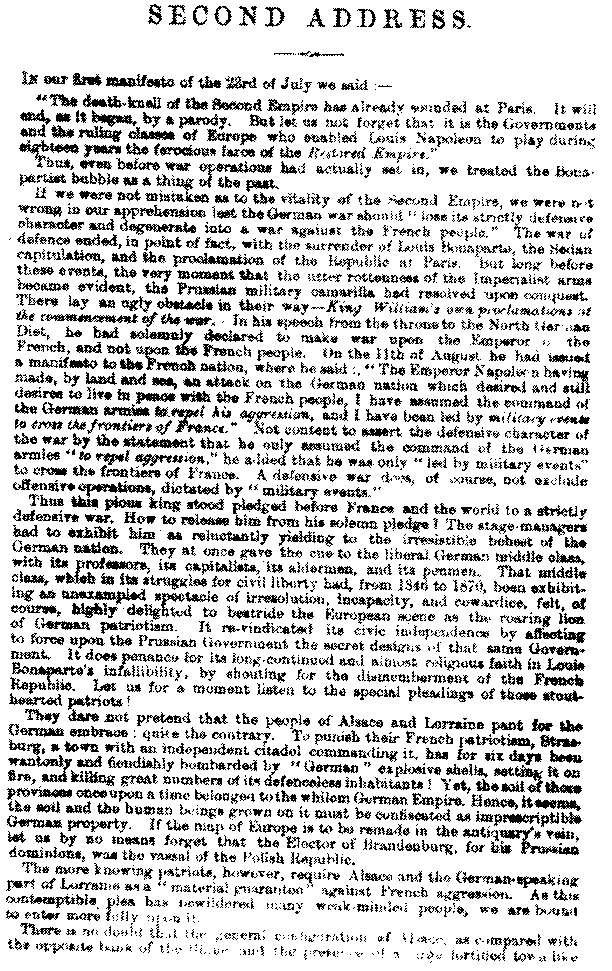
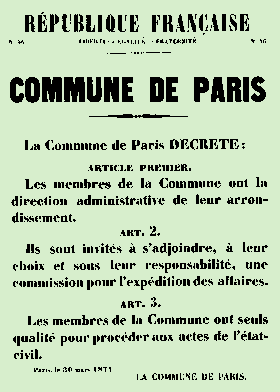
Contemporary Events:
Drawing of The monarchy dissolved and the proclamation of the Third Republic
Political cartoon of Napoleon III and Wilhelm I bathing together in the blood of the people
Workers solidarity in France – showing Lyons and Paris attempting to join hands.
French Army sent to Paris to disarm workers fraternizes and refuses to carry out their orders.
Red flag flying over the July Column in remembrance of the blood spilt by all workers who had been massacred nationally and internationally
Communards meet in the Hotel de Ville
Massacre of Communards
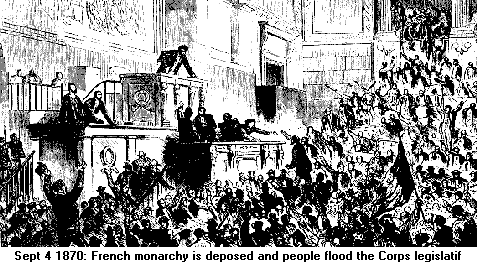

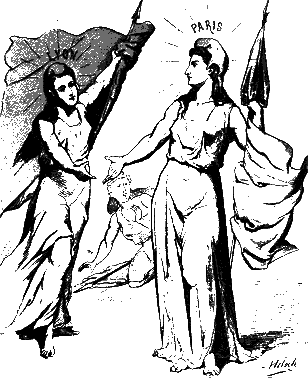
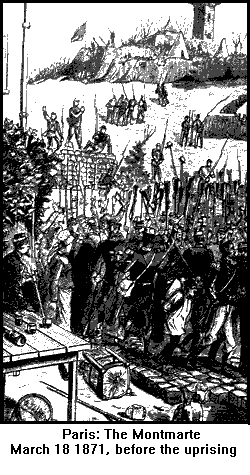
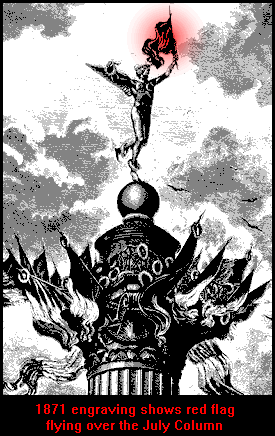
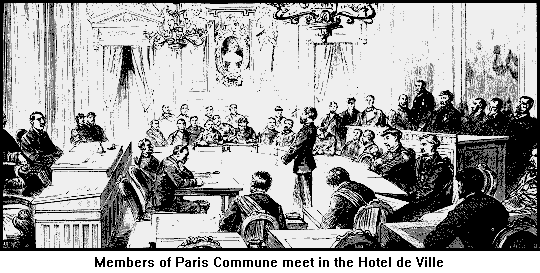
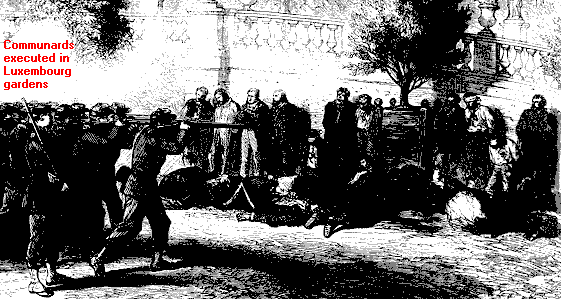
[First and Second Drafts] — The First Draft
The Civil War in France
First Draft
The Government of Defence
Four months after the commencement of the war, when the Government of Defence had thrown a sop to [the] Paris National Guard by allowing them to show their fighting capabilities at Buzenvall,[112] the Government considered the opportune moment come to prepare Paris for capitulation. To the assembly of the maires of Paris for capitulation, Trochu in presence of and supported by Jules Favre and some others of his colleagues, revealed at last his “plan.” He said literally:
“The first question, addressed to me by my colleagues on the evening of the 4th September, was this: Paris, can it stand, with any chance of success, a siege against the Prussian army? I did not hesitate to answer in the negative. Some of my colleagues here present will warrant the truth of these my words, and the persistence of my opinion, I told them in these very terms that, under the existing state of things, the attempt of Paris to maintain a siege against the Prussian army would be a folly. Without doubt, I added, this might be a heroical folly, but it would be nothing else. ... The events have not given the lie to my prevision. ”
Trochu’s plan, from the very day of the proclamation of the Republic, was the capitulation of Paris and of France. In point of fact he was the commander-in-chief of the Prussians. In a letter to Gambetta, Jules Favre himself confessed so much that the enemy to be put down, was not the Prussian soldier, but the Paris (revolutionary) “demagogue.” The high-sounding promises to the people by the Government of Defence were therefore as many deliberate lies. The “plan” they systematically carried out by entrusting the defence of Paris to Bonapartist generals, by disorganizing the National Guard and by organizing famine under the maladministration of Jules Ferry. The attempts of the Paris workmen on the 5th of October, the 31st of October, etc., to supplant these traitors by the Commune, were put down as conspiracies with the Prussian![113] After the capitulation the mask was thrown off (cast aside). The capitulards became a government by the grace of Bismarck. Being his prisoners, they stipulated with him a general armistice, the conditions of which disarmed France and rendered all further resistance impossible. Resuscitated at Bordeaux as the Government of the Republic, these very same capitulards through Thiers, their ex-Ambassador, and Jules Favre, their Foreign Minister, fervently implored Bismarck in the name of the majority of the so-called National Assembly, and long before the rise of Paris, to disarm, and occupy Paris, and put down “its canaille,” as Bismarck himself on his return from France to Berlin sneeringly told his admirers at Frankfurt. This occupation of Paris by the Prussians – such was the last word of the “plan” of the Government of Defence. The cynical effrontery with which, since their instalment at Versailles, the same men fawn upon and appeal to the armed intervention of Prussia, has dumbfounded even the venal press of Europe. The heroic exploits of the Paris National Guard, since they fight no longer under but against the capitulards, has forced even the most sceptical to brand the word “traitor” on the brazen fronts of the Trochu, Jules Favre et Co. The documents seized by the Commune, have, at last, furnished the juridical proofs of their high treason. Amongst these papers there are letters of the Bonapartist sabreurs, to whom the execution of Trochu’s “plan” had been confided, in which these infamous wretches crack jokes at and make fun of their own “defence of Paris” (cf., for instance, the letter of Alphonse Simon Guiod, supreme commander of the artillery of the army of defence of Paris and Grand Cross of the Legion of Honour, to Suzanne, General of division of artillery, published by the Journal officiel of the Commune).
It is, therefore evident, that the men who now form the government of Versailles, can only be saved from the fate of convicted traitors by civil war, the death of the Republic and a monarchical restauration [restoration] under the shelter of Prussian bayonets.
But – and this is most characteristic of the men of the Empire, as well as of the men who but on its soil and within its atmosphere could grow into mock-tribunes of the people – the victorious Republic would not only brand them as traitors, it would have to surrender them as common felons to the criminal court. Look only at Jules Favre, Ernest Picard, and Jules Ferry, the great men, under Thiers, of the Government of Defence!
A series of authenticated judiciary documents spreading over about 20 years, and published by M. Millière, a representative to the National Assembly, proves that Jules Favre, living in adulterous concubinage with the wife of a drunkard resident at Algiers, had, by a most complicated concatenation of daring forgeries, contrived to grasp in the name of his
bastards, a large succession that made him a rich man and that the connivance only of the Bonapartist tribunals saved him from exposure in a law-suit undertaken by the legitimate claimants. Jules Favre, then, this unctuous mouthpiece of family, religion, property, and order, has long since been forfeited to the Code pénal. Lifelong penal servitude would be his unavoidable lot under every honest government.
The whole “financial” correspondence between Ernest and Arthur has fallen into the hands of the Commune. Like the lachrymose Jules Favre, Ernest Picard, the Joe Miller of the Versailles Government, is a man forfeited to the Code pénal and the galleys.
To make up this trio, Jules Ferry, a poor breadless barrister before 4 September, not content to organize the famine of Paris, had contrived to job a fortune out of this famine. The day on which he would have to give an account of his peculations during the Paris siege would be his day of judgment!
No wonder then that these men who can only hope to escape from the hulks in a monarchy, protected by Prussian bayonets, who but in the turmoil of civil war can win their ticket of leave, that these desperadoes were at once chosen by Thiers and accepted by the Rurals as the safest tools of the counter-revolution!
No wonder that when in the beginning of April captured National Guards were exposed at Versailles to the ferocious outrages of Piétri’s “lambs” and the Versailles mob, M. Ernest Picard, “with his hands in his trousers pockets, walked from group to group cracking jokes,” while “on the balcony of the Prefecture Madame Thiers, Madame Jules Favre and a bevy of similar dames, looking in excellent health and spirits,” exulted in that disgusting scene. No wonder then, that while one part of France winces under the heels of the conquerors, while Paris, the heart and head of France, daily sheds streams of its best blood in self-defence against the home traitors ... , the Thiers, Favres et Co. indulge in revelries at the Palace of Louis XIV, such, for instance, as the grand fête given by Thiers in honour of Jules Favre on his return from Rouen (whither he had been sent to conspire with (fawn upon) the Prussians). It is the cynical orgy of evaded felons.
If the Government of Defence first made Thiers their Foreign Ambassador, going a-begging at all courts of Europe, there to barter a king for France for their intervention against Prussia, if, later on, they sent him on a travelling tour through out the French provinces, there to conspire with the Châteaux and secretly prepare the general elections which, together with the capitulation, would take France by surprise – Thiers, on his side, made them his ministers and high functionaries. They were safe men.
There is one thing rather mysterious in the proceedings of Thiers, his recklessness in precipitating the revolution of Paris. Not content to goad Paris by the anti-Republican demonstrations of his Rurals, by the threats to decapitate and decapitalize Paris, by Dufaure’s (Thiers’ Minister of Justice) law of the 10th of March on the échéances of bills [bills falling due] which impended bankruptcy on the Paris commerce, by appointing Orleanist ambassadors, by the transfer of the Assemblée to Versailles, by an imposition of a new tax on newspapers, by the confiscation of the Republican Paris journals, by the revival of the state of siege, first proclaimed by Palikao[61] and annulled with the downfall of the imperialist government on the 4th of September, by appointing Vinoy, the Décembriseur and ex-senator, Governor of Paris, Valentin, the imperialist gendarme, Prefect of Police, and Aurelle de Paladines, the Jesuit general, commander-in-chief of the Paris National Guard – he opened the civil war with feeble forces, by Vinoy’s attack on the buttes Montmartre, by the attempt first to rob the National Guards of cannon which belonged to them and which were only left to them by the Paris convention, because they were their property, and thus to disarm Paris.
Whence this feverish eagerness d’en finir [to finish it off]? To disarm and put down Paris was of course the first condition of a monarchical counter-revolution, but an astute intriguer like Thiers could only risk the future of the difficult enterprise in undertaking it without due preparation, with ridiculously insufficient means, except under the sway of some overwhelmingly urgent wave. The motive was this. By the agency of Pouyer-Quertier, his Finance Minister, Thiers had concluded a loan of two milliards to be paid immediately down, and some more milliards to follow at certain terms. In this loan transaction a truly royal pot de vin (drink money) was reserved for those grand citizens – Thiers, Jules Favre, Ernest Picard, Jules Simon, Pouyer-Quertier, etc. But there was one hitch in the transaction. Before definitively sealing the treaty, the contractors wanted one guarantee – the tranquillization of Paris. Hence the reckless proceedings of Thiers. Hence the savage hatred against the Paris workmen, perverse enough to interfere with this fine job.
As to the Jules Favres, Picards, etc., we have said enough to prove them the worthy accomplices of such a jobbery. As to Thiers himself, it is notorious that during his two ministries under Louis Philippe he realized 2 millions, and that during his premiership (dating March 1840) he was taunted from the tribune of the Chamber of Deputies with his Bourse peculations, in answer to which he shed tears, a commodity he disposes of as free]y as Jules Favre and the celebrated comedian Frédérick Lemaître. It is no less notorious that the first measure taken by M. Thiers to save France from the financial ruin, fastened upon her by the war, was – to endow himself with a yearly salary of 3 millions of francs, exactly the sum Louis Bonaparte got in 1850 as an equivalent from M. Thiers and his troop in the Legislative Assembly for allowing them to abolish the general suffrage.[114] This endowment of M. Thiers with 3 millions was the first word of “the economic republic,” the vista of which he had opened to his Paris electors in 1869. As to Pouyer-Quertier, he is a cotton-spinner at Rouen. In 1869, he was the leader of the millowners’ conclave that proclaimed a general reduction of wages necessary for the “conquest” of the English market – an intrigue, then baffled by the International.[115] Pouyer-Quertier, otherwise a fervent and even servile partisan of the Empire, found only one fault with it, its commercial treaty with England damaging to his own shop interests. His first step, as M. Thiers’ Finance Minister, was to denounce that “hateful” treaty and to pronounce the necessity of re-establishing the old protective duties for his own shop. His second step was the patriotic attempt to strike Alsace by the re-established old protective duties on the pretext that in this case no international treaty stood in the way of their re-introduction. By this master-stroke his own shop at Rouen would have got rid of the dangerous competition of the rival shops at Mülhausen. His last step was to make a present to his son-in-law, M. Roche-Lambert, of the receveur-generalship [general tax-collector’s office] of the Loiret, one of the rich booties falling into the lap of the governing bourgeois, and which Pouyer-Quertier had found so much fault with his imperialist predecessor, M. Magne, endowing his own son with that big jobbing place. This Pouyer-Quertier was then exactly the man for the perpetration of the above said job.
Small state rogueries, – a little character ... cankering conscience ... everlasting suggester of parliamentary intrigue ... petty expedients and devices ... rehearsing his homilies of liberalism, of the “liberatés nécessaries ” ... eagerly bent on ... strong reasons to weigh against the chances of failure ... cogent arguments which counterpoise ... kind of heroism in exaggerated baseness ... lucky parliamentary stratagems. ...
M. E. Picard est un malandrin, qui pendant toute la durée du siège a tripoté à la Bourse sur les défaites de nos armées. [M. E. Picard is a robber, who speculated at the Bourse on our army’s defeats throughout the period of the Siege.]
In his speech to the assembly of maires, etc. (25th April), Thiers says himself that the “assassins of Clement Thomas and Lecomte” [are] a handful of criminals – “et ceux qui pourront à juste titre être considérés comme complices de ces crimes par conspiration ou assistance, c’est-à-dire un très petit nombre d’individus.” [“and those who can rightly be considered as accomplices of these crimes by conspiracy or assistance, that is to say, a very small number of individuals.”]
Dufaure wants to put down Paris by press prosecutions in the provinces. Monstrous to bring journals before a jury because preaching “conciliation. ”
Dufaure plays a great part in the Thiers intrigue. By his law of the 10th of March, he roused all the indebted commerce of Paris. By his law on Paris house rents, he menanced all Paris. Both laws were to punish Paris for having saved the honour of France and delayed the surrender to Bismarck for 6 months. Dufaure is an Orleanist, and a “Liberal,” in the parliamentary sense of the word. Consequently, he has always been the minister of repression and of the state of siege.
He accepted his first portefeuille on the 13 May, 1839, after the defeat of the dèrnière prise d’armes [latest armed uprising] [117] Of the Republican party, was therefore the minister of the pitiless repression of the July government of that day.
On the 2nd June 1849,[118] Cavaignac, forced on the October (1848) to raise the state of siege, called into his ministry two ministers of Louis Philippe (Dufaure, for the Interior, and Vivien ). He appointed them on the demand of the Rue [de] Poitiers [119] (Thiers), which demanded guarantees. He thus hoped to secure the support of the dynastics for the impending election of president. Dufaure employed the most illegal means to secure Cavaignac’s candidature. Intimidation and electoral corruption had never been exercised on a larger scale. Dufaure inundated France with defamatory prints against the other candidates, and especially of Louis Bonaparte, what [readwhich] did not prevent him to become later on Louis Bonaparte’s minister. Dufaure became again the minister of the state of siege of 13 June 1849 (against the demonstration of the National Guard against the bombardment of Rome, etc., by the French army). He is now again the minister of the state of siege, proclaimed at Versailles (for department of Seine-et-Oise). Power given to Thiers to declare any department whatever in a state of siege. Dufaure, as in 1839, as in 1849, wants new repressive laws, new press laws, a law to “abridge the formalities of the courts-martial.” In a circular to the Procureurs généraux [Attorney-Generals] he denounces the cry of “conciliation ” as a press crime to be severely prosecuted. It is characteristic of the French magistrature that only one single Procureur général (that of Mayenne)[c] wrote to Dufaure to
“resign. ... I cannot serve an Administration which orders me, in a moment of civil war, to rush into party struggles and prosecute citizens, whom my conscience holds innocent, for uttering the word conciliation.”
He belonged to the “Union libérale” in 1847 which conspired against Guizot, as he belonged to the “Union libérale” of 1869 which conspired against Louis Bonaparte.[120]
With respect to the law of 10 March and the law of house rents, it ought to be remarked that both Dufaure’s and Picard’s (both advocates) best clients are amongst the house proprietors and the big bourses averse to losing anything by the siege of Paris.
Now as after the Revolution of February 1848, these men tell the Republic, as the executioner told Don Carlos, “Je vais t’assassiner, mais c’est pour ton bien. ” (I shall murder thee, but for thy own good.)
Lecomte and Clément Thomas
After Vinoy’s attempt to carry the buttes Montmartre (on the 18th March, they were shot in the gardens of the Chateau Rouge, 4 o’clock, 18th), General Lecomte and Clément Thomas were taken prisoner and shot by the same excited soldiers of the 81st of the line. It was a summary act of Lynch justice performed despite the instances of some delegates of the Central Committee. Lecomte, an epauletted cut-throat, had four times commanded his troops, on the Place Pigalles, to charge an unarmed gathering of women and children. Instead of shooting the people, the soldiers shot him. Clément Thomas, an ex-quartermaster, a “general,” extemporized [on] the eve of the June massacres (1848) by the men of the National, whose gérant [manager] he had been, had never dipped his sword in the blood of any other enemy but that of the Paris working class. He was one of the sinister plotters who deliberately provoked the June insurrection and one of its most atrocious executioners. When, on the 31st October, 1870, the Paris proletarian National Guards surprised the “Government of Defence” at the Hôtel de Ville and took them prisoner, these men who had [been] appointed by themselves, these gens de paroles [men of their word ], as one of them, Picard, called them recently, gave their word of honour that they would make place to [read for] the Commune. Thus allowed to escape scot-free, they launched Trochu’s Bretons on their too-confident captors. One of them, however, M. Tamisier, resigned his dignity as commander-in-chief of the National Guard. He refused to break his word of honour. Then the hour had again struck for Clément Thomas. He was appointed, in Tamisier’s place, commander-in-chief of the National Guard. He was the true man for Trochu’s “plan.” “He never made war upon the Prussians,” he made war upon the National Guard, whom he disorganized, disunited, calumniated, weeding out all its officers hostile to Trochu’s “plan,” setting one set of National Guards against the other and whom he sacrificed in “sorties,” so planned as to cover them with ridicule. Haunted by the spectres of his June victims, this man, without any official charge, must needs again reappear on [the] theatre of war of the 18th of March, where he scented another massacre of the Paris people. He fell a victim of Lynch justice in the first moment of popular exasperation. The men who had surrendered Paris to the tender mercies of the Décembriseur Vinoy, in order to kill the Republic and pocket the pots de vin, [tips], stipulated by the Pouyer-Quertier contract, shouted now: Assassins, Assassins! Their howl was re-echoed by the press of Europe so eager for the blood of the “proletarians.” A farce of hysterical “sensibleness” was enacted in the rural Assemblée, and now as before, the corpses of their friends were most welcome weapons against their enemies. Paris and the Central Committee were made responsible for an accident out of their control. It is known, how in the days of June 1848, the “men of Order” shook Europe with the cry of indignation against the insurgents because of the assassination of the Archbishop of Paris.[d] Even at that time they knew perfectly well from the evidence of M. Jacquemet, the vicaire général of the Archbishop, who had accompanied him to the barricades, that the Bishop had been shot by the troops of Cavaignac, and not by the insurged,[e] but his dead corpse served their turn. M. Darboy, the present Archbishop of Paris, one of the hostages taken by the Commune in self-defence against the savage atrocities of the Versailles Government, however, seems, as appears from his letter to Thiers, to have strange misgivings [that] Papa Transnonain [121] be eager to speculate in his body, as an object of holy indignation. There passed hardly a day, in which the Versailles journals did not announce his execution, which the continued atrocities, and violation of the rules of war on the side of “order,” would have scaled on the part of every government but that of the Commune. The Versailles Government had hardly realized a first military success, when Captain Desmarêt, who at the head of his gendarmes assassinated the chivalrous Flourens, has been decorated by Thiers. Flourens had saved the lives of the “defence men” on the 31st October. Vinoy the runaway (runagate), was appointed Grand Cross of the Legion of Honour, because he had our brave comrade Duval when taken prisoner, shot inside the redoubts, because as a second instalment, he had shot some dozen captive troops of the line who had joined the Paris people, and inaugurated this civil war by the “methods of December.”[122] General Galliffet – “the husband of that charming Marchioness whose costumes at the masked balls were one of the wonders of the Empire,” as a London penny-a-liner delicately puts it, – “surprised” near Rueil a captain, lieutenant, and private of National Guards, had them at once shot, and immediately published a proclamation to glorify himself on the deed. These are a few of the murders officially narrated and gloried in by the Versailles Government. 25 soldiers of the 80th Regiment of the line shot as “rebels” by the 75th.
“Every man wearing the uniform of the regular army who was captured in the ranks of the Communists was straight-away shot without the slightest mercy. The governmental troops were perfectly ferocious.”
“M. Thiers communicated the encouraging particulars of Flourens’ death to the Assembly. ”
“Never had more degraded countenances of a degraded democracy met the afflicted gaze of honest man.” (Piétri’s men!)
“Vinoy protests against any mercy to insurgent officers or line men. ”
On the 6th of April, decree of the Commune on reprisals (and hostages):
“Considering that the Versailles Government openly treads underfoot the laws of humanity and those of war, and that it has been guilty of horrors such as even the invaders of France have not dishonoured themselves by ... it is decreed, etc.”[123] (Folgen die Artikel. [The articles are as follows.])
“Every day the banditti of Versailles slaughter or shoot our prisoners, and every hour we learn that another murder has been committed. ... The people, even in its anger, detests bloodshed, as it detests civil war, but it is its duty to protect itself against the savage attempts of its enemies, and whatever it may cost, it shall be an eye for an eye, a tooth for a tooth.”[124]
“Les sergents de ville qui se battent contre Paris ont 10 frs. par jour,” [“The policemen who fight against Paris get 10 francs a day.”]
In his letter to Thiers, Darboy protests “against the atrocious excesses which add to the horror of our fratricidal war.” In the same strain writes Deguerry (curé de la Madeleine ) [(priest at the Madeleine)]:
“These executions rouse de grandes colères à Paris et peuvent y produire de terribles représailles.” “Ainsi l’on est résolu, à chaque nouvelle exécution, d’en ordonner deux. des nombreux otages que l’on a entre les mains. Jugez à quel point ce que [je] vous demande comme prêtre est d’une rigoureuse et absolue nécessité.” [“These executions rouse great wrath in Paris and may bring terrible reprisals.” “It is thus resolved, for each new execution, to dispose of two of the many hostages on hand. Judge for yourself how urgent and absolutely necessary the demand is – which (I) as a priest make of you.”]
In midst of these horrors Thiers writes to the Prefects: “L’Assemblée siège paisiblement. ” (Elle aussi a le coeur léger.)[125] [“The Assembly is sitting peacefully.” (It is also light-hearted.)]
Thiers and la commission des quinze [126] of his Rurals had the cool impudence to “deny officially” the “pretended summary executions and reprisals attributed to the troops of Versailles. ” But Papa Transnonain [said] in his circular of 16th April on the bombardment of Paris :
“If some cannon-shots have been fired, it is not the deed of the army of Versailles, but of some insurgents wanting to make believe that they are fighting, while they do not dare show themselves.”
Thiers has proved that he surpasses his hero, Napoleon I, at least in one thing – lying bulletins. (Of course, Paris bombards itself, in order to be able to calumniate M. Thiers!)
To these atrocious provocations of the Bonapartist black legs, the Commune has contented itself to take hostages and to threaten reprisals, but its threats have remained a dead letter! Not even the gendarmes masqueraded into [read as] officers, not even the captive sergents de ville, upon whom explosive bombs have been seized, were placed before a court-martial! The Commune has refused to soil its hands with the blood of these bloodhounds!
A few days before the 18th March, Clément Thomas laid before the War Minister Le Flô a plan for the disarmament of trois quarts [three-quarters] of the National Garde.
“La fine fleur de la canaille, disait-il. s’est concentrée auttour de Montmartre et s’entend avec Belleville.” [“The cream of the mob is concentrated around Montmartre and united with Belleville,” he said.]
The National Assembly
L’Assemblée élue le 8 février sous la pression de l’ennemi aux mains desquels les hommes qui gouvernent à Versailles avaient remis tous les forts et livré Paris sans défense, l’Assem- blée de Versailles avait un but unique et clairement déterminé par la convention même signée à Versailles le 29 janvier – de décider si la guerre pouvait être continuée ou traiter la paix; et, dans ce cas, fixer les conditions de cette paix et assurer le plus promptement possible l’évacuation du territoire français. [The Assembly elected on February 8 under the pressure of the enemy, to whom the men governing at Versailles had surrendered all the forts and handed over the defenceless Paris – this Versailles Assembly had but one aim, clearly determined by the Convention signed at Versailles on January 29, that is, to decide whether the war could be continued or whether to treat for peace, and, in the latter case, to establish the conditions for such a peace and ensure the evacuation of French territory as quickly as possible.]
Chanzy, Archbishop of Paris, etc.
Liberation of Chanzy took place almost simultaneously with the retreat of Saisset. The Royalist journalists were unanimous in decreeing the death of the General. They desired to fix that amiable proceeding on the Reds. Three times he had been ordered to execution, and now he was really going to be shot.
“Aujourd’hui les criminels, que vous n’avez pas même voulu poursuivre, abusent de votre magnanimité pour organiser aux portes mêmes de la cité un foyer de conspiration monarchique. Ils invoquent la guerre civile, ils mettent en oeuvre toutes les corruptions, ils acceptent toutes les complicités, ils ont osé mendier jusqu’à l’appui de l’étranger.”[128] [“Today the criminals, whom you did not even wish to pursue, abuse your magnanimity and organize a centre of monarchical conspiracy at the very gates of the city. They invoke civil war, they employ all kinds of corrupt methods, they accept any complicity, they even dare to solicit foreign support.”]
Thiers
On the 25th April, in his reception of the maires, adjuncts, and municipal councillors of the suburban communes of the Seine, Thiers said:
“La République existe. Le chef de pouvoir exécutif n’est qu’un simple citoyen. ” [“The Republic exists. The Chief of the Executive is only a common citizen.”]
The progress of France from 1830 to 1871, according to M. Thiers, consists in this: In 1830 Louis Philippe was “the best of Republics.” In 1871 the ministerial fossil of Louis Philippe’s reign, little Thiers himself, is the best of Republics.
M. Thiers commenced his régime by an usurpation. By the National Assembly he was appointed chief of the ministry of the Assembly; he appointed himself Chief of the Executive of France.
The Assembly and the Paris Revolution
The Assembly, summoned at the dictate of the foreign invader, was, as is clearly laid down in the Versailles convention of the 29th January, but elected for one single purpose: To decide the continuation of war or settle the conditions of peace. In their calling the French people to electoral urns, the capitulards of Paris themselves plainly defined that specific mission of the Assembly and this accounts to a great part for its very constitution. The continuation of the war having become impossible through the very terms of the armistice humbly accepted by the capitulards, the Assembly had in fact but to register a disgraceful peace and for this specific performance the worst men of France were [the] best.
The Republic was proclaimed on the 4th of September, not by the pettifoggers who installed themselves at the Hôtel de Ville as a Government of Defence, but by the Paris people. It was acclaimed throughout France without a single dissentient voice. It conquered its own existence by a five months’ war whose cornerstone was the prolonged resistance of Paris. Without this war, carried on by the Republic and in the name of the Republic, the Empire would have been restored by Bismarck after the capitulation of Sedan, the pettifoggers with M. Thiers at their head would have had to capitulate not for Paris, but for personal guarantees against a voyage to Cayenne, and the Rural Assembly would never have been heard of. It met only by the grace of the Republican revolution, inchoated at Paris. Being no constituent Assembly, as M. Thiers himself has repeated to nauseousness, it would, if not as a mere chronicler of the passed incidents of the Republican Revolution, not even have had the right to proclaim the destitution [removal] of the Bonaparte’s dynasty. The only legitimate power, therefore, in France is the Revolution itself, centring in Paris. That Revolution was not made against Napoleon the Little, but against the social and political conditions, which engendered the Second Empire, which received their last finish under its sway, and which, as the war with Prussia glaringly revealed, would leave France a cadaver, if they were not superseded by the regenerating powers of the French working-class Revolution. The attempts of the Rural Assembly holding only an attorney’s power to the Revolution to sign the disastrous bond handed over by its present “Executive” to the foreign invader, its attempt to treat the Revolution as its own capitulard is, therefore, a monstrous usurpation. Its war against Paris is nothing but a cowardly Chouannerie[129] under the shelter of Prussian bayonets. It is a bare conspiracy to assassinate France, in order to save the privileges, the monopolies and the luxuries of the degenerate, effete, and putrefied classes that have dragged her to the abyss from which she can only be saved by the herculean hand of a truly Social Revolution.
Thiers Finest Army
Even before he became a “statesman,” M. Thiers had proved his lying powers as a historian. But the vanity, so characteristic of dwarfish men, has this time betrayed him into the sublime of the ridiculous. His army of Order, the dregs of the Bonapartist soldatesca [soldiery] freshly reimported, by the grace of Bismarck, from Prussian prisons, the Pontifical Zouaves,[92] the Chouans[91] of Charette, the Vendéens of Cathelineau, the “municipals”[130] of Valentin, the ex-sergents de ville of Piétri and the Corsican gendarmes of Valentin, who under L. Bonaparte were only the spies of the army but under M. Thiers form its warlike flower, the whole under the supervision of epauletted mouchards and under the command of the runaway Decembrist marshals who had no honour to lose – this motley, ungainly, hangdog lot M. Thiers dubs “the finest army France ever possessed ”! If he allows the Prussians still to quarter at St. Denis, it is only to frighten them by the sight of the “finest army” of Versailles.
Thiers
Small state rogueries.
Everlasting suggester of parliamentary intrigues M. Thiers was never anything else but an “able” journalist and a clever word - “fencer,” a master of parliamentary roguery, a virtuoso in perjury, a craftsman in all the small stratagems, base perfidies, and subtle devices of parliamentary party-warfare. This mischievous gnome charmed the French bourgeoisie during half a century because he is the truest intellectual expression of their own class corruption. When in the ranks of the opposition, he over and over rehearsed his stale homily of the “libertés nécessaires,” to stamp them out when in power. When out of office, he used to threaten Europe with the sword of France. And what were his diplomatic performances in reality? To pocket in 1841 the humiliation of the London treaty,[131] to hurry on the war with Prussia by his declamations against German unity, to compromise France in 1870 by his begging tour at all the courts of Europe, to sign in 1871 the Paris capitulation to accept a “peace at any price” and implore from Prussia a concession – leave and means to get up a civil war in his own downtrodden country. To a man of his stamp the underground agencies of modern society remained of course always unknown; but even the palpable changes at its surface he failed to understand. For instance, any deviation from the old French protective system he denounced as a sacrilege and, as a minister of Louis Philippe, went the length of treating disdainfully the construction of railways as a foolish chimera and even under Louis Bonaparte he eagerly opposed every reform of the rotten French army organization. A man without ideas, without convictions, and without courage.
A professional “Revolutionist” in that sense, that in his eagerness of display, of wielding power and putting his hands into the National Exchequer, he never scrupled, when banished to the banks[g] of the opposition, to stir the popular passions and provoke a catastrophe to displace a rival; he is at the same time a most shallow man of routine, etc. The working class he reviled as “the vile multitude. ” One of his former colleagues in the legislative assemblies, a contemporary of his, a capitalist and however a member of the Paris Commune, M. Beslay thus addresses him in a public address:
“The subjugation (asservissement ) of labour to capital, such is the ‘fonds ’ [’foundation’] of your politics (policy). and [since] the day you saw the Republic of Labour installed at the Hôtel de Ville, you have never ceased to cry to France, ‘They are criminals!’”
No wonder that M. Thiers has given orders by his Home Minister Ernest Picard to prevent “the International Association” from communicating with Paris (Sitting of Assembly, 28 March). Circulaire de Thiers aux préfets et sous-préfets [Thiers’ Circular to the Prefects and Sub-Prefects ]:
“The good workmen, so numerous as compared to the bad ones ought to know that if bread flies again from their mouths, they owe it to the adepts of the International, who are the tyrants of labour, of which they pretend themselves the liberators.”
Without the International. ...
(Jetzt die Geldgeschichte.) (Er und Favre haben ihr Geld nach London übersiedelt.) [(Now about the money affair.) (He and Favre have sent their money to London.)] It is a proverb that if rogues fall out, truth comes out. We can therefore not better finish the picture of Thiers than by the words of the London Moniteur of the master of his Versailles generals. Says the Situation [132] in the number of the 28 March:
“M. Thiers has never been minister without pushing the soldiers to the massacre of the people; he, the parricide, the man of incest, the peculator, the plagiarist, the traitor, the ambitious, the impuissant [impotent].”
Banded with the Republicans before the Revolution of July, he slipped into his first ministry under Louis Philippe by thrusting Laffitte, his old protector. His first deed was to throw his old collaborator Armand Carrel into prison. He insinuated himself with Louis Philippe as a spy upon, and the gaol-accoucheur of, the Duchess of Berry, but his activity centred in the massacre of the insurgent Paris Republicans in the Rue Transnonain and the September Laws against the press,[47] to be then cast aside as an instrument become blunted. Having intrigued himself again into power in 1840, he planned the Paris fortifications, opposed as an attempt on the liberty of Paris by the whole democratic party, except the bourgeois Republicans of the National. M. Thiers replied to their outcry from the tribune of the Chambre des députés :
“Quoi? Imaginer que des ouvrages de fortification quelconque peuvent nuire a la liberté. ... C’est se placer hors de toute réalité. Et
d’abord, c’est calomnier un gouvernement quel qu’il soit de supposer qu’ll puisse un jour chercher à se maintenir en bombardant la capitale. Quoi? Après avoir perce de ses bombes la voute des Invalides ou du Panthéon, après avoir inondé de ses feux la demeure de vos familles, il se présenterait à vous pour vous demander la confirmation de son existence! Mais il serait cent tois plus impossible après la victoire qu’auparavant. ” [Chamber of Deputies: “What? To fancy that any works of fortification could ever endanger liberty. ... That is to depart completely from reality. And first of all it is a slander on a government whatever it might be like to suppose that it could some day attempt to maintain itself by bombarding the capital. What? After having breached the vault of the Hôtel des Invalides or of the Panthéon with its shells, after having inundated your houses with its fire, it would present itself before you to demand confirmation of its existence! But such a government would be a hundred times more impossible after the victory than before. ”]
Indeed, neither the government of Louis Philippe nor that of the Bonapartist Regency dared to withdraw from Paris and bombard it. This employment of the fortifications was reserved to M. Thiers, their original plotter.
When King Bomba[49] of Naples bombarded Palermo in January 1848, M. Thiers again declared in the Chamber of Deputies: “Vous savez, Messieurs, ce qui se passe à Palerme: vous avez tous tressailli d’horreur en apprenant que, pendant 48 heures, une grande ville a été bombardée. Par qui? Etait-ce par un ennemi étranger, exerçant les droits de la guerre? Non, Messieurs, par son propre gouvernement. Et pourquoi? Parce que cette ville infortunée demandait des droits. Eh bien! pour la demande de ses droits il y a eu 48 heures de bombardement. Permettez-moi d’en appeler à l’opinion européenne. C’est un service à rendre à l’humanitè que de venir, du haut de la plus grande tribune peut-être de l’Europe, faire retentir quelques paroles d’indignation contre de tels actes. Messieurs, lorsque, il y a 50 ans, les Autrichiens, exerçant les droits de la guerre, pour s’épargner les longueurs d’un siège, voulurent bombarder Lille, lorsque plus tard les Anglais, qui exerçaient aussi les droits de la guerre, bombardèrent Copenhague, et tout récemment, quand le régent Espartero, qui avait rendu des services à son pays, pour réprimet une insurrection, a voulu bombarder Barcelone, dans tous les partis, il y a eu une générale indignation.” [“You know, gentlemen, what is happening at Palermo. You, all of you, shake with horror on hearing that a large town has been bombarded for 48 hours. By whom? Was it by a foreign enemy exercising the rights of war? No, gentlemen, it was by its own Government. And why? Because that unfortunate town demanded its rights. Well, then, for demanding its rights, it has got 48 hours of bombardment. Allow me to appeal to European public opinion. It is doing a service to mankind to stand up and make reverberate some words of indignation against such acts from perhaps the greatest tribune of Europe. Gentlemen, 50 years ago when the Austrians, exercising the rights of war, wanted to bombard Lille in order to spare it a long siege, when later the English, who also exercised the rights of war, bombarded Copenhagen, and recently, when the Regent Espartero, who had rendered services to his country, wanted to bombard Barcelona in order to suppress an insurrection, indignation was general in all political parties.”]
Little more than a year later, Thiers acted the most fiery apologist of the bombardment of Rome by the troops of the French Republic, and exalted his friend, General Changarnier, for sabring down the Paris National Guards protesting against this breach of the French Constitution.
A few days before the Revolution of February 1848, fretting at the long exile from place to which Guizot had condemned him, [and] scenting the growing commotion of the masses, which he hoped would enable him to oust his rival and impose himself upon Louis Philippe, Thiers exclaimed in the Chamber of Deputies:
“Je suis du parti de la révolution, tant en France qu’en Europe. Je souhaite que le gouvernement de la révolution reste dans les mains des hommes modérés. ... Mais quand ce gouvernement passerait dans les mains d’hommes ardents, fût-ce des radicaux, je n’abandonnerai pas ma cause pour cela. Je serai toujours du parti de la révolution. ” [“I am of the party of the Revolution, not only in France but in Europe. I wish the Government of the Revolution to remain in the hands of moderate men... , but if that Government should fall into the hands of ardent men, even into those of Radicals, I shall, for all that, not desert my cause. I shall always be of the party of the Revolution. ”]
To put down the February Revolution was his exclusive occupation from the day when the Republic was proclaimed to the coup d’état.
The first days after the February explosion he anxiously hid himself, but the Paris workmen despised him too much to hate him. Still, with his notorious cowardice, which made Armand Carrel answer to his boast “he would one day die on [the] banks of the Rhine”: “Thou wilt die in a gutter” – he dared not play a part on the public stage before the popular forces were broken down through the massacre of the insurgents of June. He confined himself first to the secret direction of the conspiracy of the réunion [party] of the Rue de Poitiers which resulted in the Restauration of the Empire, until the stage had become sufficiently clear to reappear publicly on it.
During the siege of Paris, on the question whether Paris was about to capitulate, Jules Favre answered that, to utter the word capitulation, the bombardment of Paris was wanted! This explains his melodramatic protests against the Prussian bombardment, indicating the latter was a mock-bombardment, while the Thiers bombardment is a stern reality.
Parliamentary mountebank.
He is for 40 years on the stage. He has never initiated a single useful measure in any department of state or life. Vain, sceptical, epicurean, he has never written or spoken for things. In his eyes the things themselves are mere pretexts for the display of his pen or his tongue. Except his thirst for place and pelf and display there is nothing real about him, not even his chauvinism.
In the true vein of vulgar professional journalists he now sneers in his bulletins [at] the bad looks of his Versailles prisoners, now communicates that the Rurals are “à leur aise [at their ease],” now covers himself with ridicule by his bulletin on the taking of Moulin-Saquet (4 of May), where 300 prisoners were taken.
“Le reste des insurgés s’est enfui à toutes jambes, laissant 150 morts et blessés sur le champ de bataille,” [“The rest of the insurgents took to their heels, leaving 150 dead and wounded on the battlefield,”] and snappishly adds: “Voilà la victoire que la Commune peut célébrer demain dans ses bulletins.” “Paris sera sous peu délivré de ses terribles tyrans qui l’oppriment.” [“There’s the victory the Commune can celebrate tomorrow in its bulletins.” “Paris will shortly be delivered from the terrible tyrants who oppress it.”]
Paris – the “Paris” of the mass of the Paris people fighting against him is not “Paris.” “Paris – that is the rich, the capitalist, the idle” (why not the cosmopolitan stew?). This is the Paris of M. Thiers. The real Paris, working, thinking, fighting Paris, the Paris of the people, the Paris of the Commune is a “vile multitude.” There is the whole case of M. Thiers, not only for Paris, but for France. The Paris that showed its courage in the “pacific procession” and Saisset’s escapade, that throngs now at Versailles, at Rueil, at St. Denis, at St. Germain-en-Laye, followed by the cocottes sticking to the “man of religion, family, order, and property” (the Paris of the really “dangerous,” of the exploiting and lounging classes) (“the franc-fileurs ”[89]) and amusing itself by looking by the telescope at the battle going on, for whom “the civil war is but an agreeable diversion” – that is the Paris of M. Thiers (as the emigration of Coblenz was the France of M. de Calonne). In his vulgar journalist vein he knows not even to observe sham dignity, but he murders the wives and girls and children, found under the ruins of Neuilly, not to swerve from the etiquette of “legitimacy.” He must needs illuminate the municipal elections he has ordered in France by the conflagration of Clamart, burnt by petroleum bombs. The Roman historians finish off
Nero’s character by telling us that the monster gloried in being a rhymester and a comedian. But lift a mere professional journalist and parliamentary mountebank like Thiers to power, and he will outnero Nero.
He acts only his part as the blind tool of class interests in allowing the Bonapartist “generals” to revenge themselves on Paris; but he acts his personal part in the little byplay of bulletins, speeches, addresses, in which the vanity, vulgarity, and lowest taste of the journalist creep out.
He compares himself with Lincoln and the Parisians with the rebellious slaveholders of the South. The Southerners fought for the slavery of labour and the territorial secession from the United States. Paris fights for the emancipation of labour and the secession from power of Thiers’ State parasites, of the would-be slaveholders of France!
In his speech to the maires
“On peut compter sur ma parole à laquelle je n’ai jamais manqué!” [“You can count on my word, which I have never broken!”]
“L’assemblée est une des plus libérales qu’ait nommée la France.” [“The Assembly is one of the most liberal France has elected.”]
Er wird die Republik retten [He will save the Republic]
“pourvu que l’ordre et le travail ne soient pas perpétuellement compromis par ceux qui se prétendent les gardiens particuliers du salut de la République.” [“provided that order and work are not constantly endangered by those who claim to be particular guardians of the safety of the Republic.”]
In der Sitzung der Assemblée vom 27 April sagt er: “L’assemblée est plus libérale que lui-même!” [He said at the April 27 session of the Assembly: “The Assembly is more liberal than he himself is!”]
He, whose rhetorical trump card was always the denunciation of the Vienna treaties, he signs the Paris treaty,[133] not only the dismemberment of one part of France, (not only the occupation of almost 1/2 of it), but the milliards of indemnity, without even asking Bismarck to specify and prove his war expenses! He does not even allow the Assembly at Bordeaux to discuss the paragraphs of his capitulation!
He who upbraided throughout his life the Bourbons because they came back in the rear of foreign armies and because of their undignified behaviour to the allies occupying France after the conclusion of peace,[134] he asks nothing from Bismarck in the treaty but one concession: 40,000 troops to subdue Paris (as Bismarck stated in the Diet). Paris was for all purposes of internal defence and [opposing] foreign aggression fully secured by its armed National Guard, but Thiers superadded at once [to] the capitulation of Paris to the foreigner, the character of the capitulation of Paris to himself and Co. This stipulation was a stipulation for civil war. That war itself he opens not only with the passive permission of Prussia, but by the facilities she lends him, by the captive French troops she magnanimously despatches him from German dungeons! In his bulletins, in his and Favre’s speeches in the Assembly, he crawls in the dust before Prussia and threatens Paris every eight days with her intervention, after having failed to get it, as stated by Bismarck himself. The Bourbons were dignity itself compared to this mountebank, this grand apostle of chauvinism!
After the break-down of Prussia (Tilsit peace 1807), its government felt that it could only save itself and the country by a great social regeneration (revolution). It naturalized in Prussia on a small scale, within the limits of a feudal monarchy, the results of the French Revolution. It liberated the peasant, etc.[135]
After the Crimean defeat, which, however Russia might have saved her honour by the defence of Sevastopol and dazzled the foreigner by her diplomatic triumphs at Paris, laid open at home the rottenness of her social and administrative system, her government emancipated the serf and [reformed] her whole administrative and judicial system.[136] In both countries the daring social reform was fettered and limited in its character because it was octroyed[h] from the throne and not (instead of being) conquered by the people. Still there were great social changes, doing away with the worst privileges of the ruling classes and changing the economical basis of the old society. They felt that the great malady could only be cured by heroic measures. They felt that they could only answer to the victors by social reforms, by calling into life elements of popular regeneration. The French catastrophe of 1870 stands unparalleled in the history of the modern world! It showed official France, the France of Louis Bonaparte, the France of the ruling classes and their State parasites – a putrescent cadaver. And what is the first attempt of the infamous men, who had got at her government by a surprise of the people and who continue to hold it by a conspiracy with the foreign invader, what is [their] first attempt? To assassinate, under Prussian patronage, by L. Bonaparte’s soldatesca and Piétri’s police, the glorious work of popular regeneration commenced at Paris, to summon all the old Legitimist spectres, beaten by the July Revolution, the fossil swindlers of Louis Philippe, beaten by the Revolution of February, and celebrate an orgy of counter-revolution! Such heroism in exaggerated self-debasement is unheard of in the annals of history! But, what is most characteristic, instead of arousing a general shout of indignation on the part of official Europe and America, it evokes a current of sympathy and of fierce denunciation of Paris! This proves that Paris, true to its historical antecedents, seeks the regeneration of the French people in making it the champion of the regeneration of old society, making the social regeneration of mankind the national business of France! It is the emancipation of the producing class from the exploiting classes, their retainers and their State parasites, who prove the truth of the French adage, that “les valets du diable sont pires que le diable himself.” [“the devil’s valets are worse than the devil himself.”] Paris has hissed[i] the flag of mankind!
“stamp of 2 centimes on each copy of every periodical, whatever its nature.” “Forbidden to found new journals until the raising of the state of siege.”
The different fractions of the French bourgeoisie had successively their reigns, the great landed proprietors under the Restoration (the old Bourbons), the capitalists under the parliamentary monarchy of July (Louis Philippe), while its Bonapartist and Republican elements kept rankling in the background. Their party feuds and intrigues were of course carried on on pretexts of public welfare, and a popular revolution having got rid of these monarchies, the other set in.
All this changed with the Republic (February). All the fractions of the bourgeoisie combined together in the Party of Order, that is the party of proprietors and capitalists, bound together to maintain the economic subjugation of labour and the repressive State machinery supporting it. Instead of a monarchy, whose very name signified the prevalence of one bourgeois fraction over the other, a victory on one side and a defeat on the other (the triumph of one side and the humiliation of the other), the Republic was the anonymous joint-stock company of the combined bourgeois fractions, of all the exploiteurs of the people clubbed together, and indeed, Legitimists, Bonapartists, Orleanists, bourgeois Republicans, Jesuits and Voltairiens, embraced each other – no longer hidden by the shelter of the crown, no longer able to interest the people in their party feuds by masquerading them into [read as] struggles for popular interest, no longer subordinate the one to the other. Direct and confessed antagonism of their class rule to the emancipation of the producing masses – order, the name for the economical and political conditions of their class rule and the servitude of labour, this anonymous or Republican form of the bourgeois régime – this bourgeois Republic, this Republic of the Party of Order is the most odious of all political régimes. Its direct business, its only raison d’être is to crush down the people. It is the terrorism of class rule. The thing is done in this way. The people having fought and made the Revolution, proclaimed the Republic, and made room for a National Assembly, the bourgeois, whose known Republican professions are a guarantee for their “Republic,” are pushed on the foreground of the stage by the majority of the Assembly, composed of the vanquished and professed enemies of the Republic. The Republicans are entrusted with the task to goad the people into the trap of an insurrection, to be crushed by fire and sword. This part was performed by the party of the National with Cavaignac at their head after the Revolution of February (by the June Insurrection). By their crime against the masses, these Republicans lose then their sway. They have done their work and, if yet allowed to support the Party of Order in its general struggle against the proletariat, they are at the same time displaced from the government, forced to fall back in the last ranks, and only allowed “on sufferance.” The combined Royalist bourgeois then become the father of the Republic, the true rule of the “Party of Order” sets in. The material forces of the people being broken for the time being, the work of reaction – the breaking down of all the concessions conquered in four revolutions – begins piece by piece. The people is stung to madness not only by the deeds of the Party of Order, but by the cynical effrontery with which it is treated as the vanquished, with which in its own name, in the name of the Republic, that low lot rules it supreme. Of course, that spasmodic form of anonymous class despotism cannot last long, can only be a transitory phasis. It knows that it is seated on a revolutionary volcano. On the other hand, if the Party of Order is united in its war against the working class, in its capacity of the Party of Order, the play of intrigue of its different fractions, the one against the other, each for the prevalence of its peculiar interest in the old order of society, each for the restoration of its own pretender and personal ambitions, sets in in full force as soon as its rule seems secured (guaranteed) by the destruction of the material revolutionary forces. This combination of a common war against the people and a common conspiracy against the Republic, combined with the internal feuds of its rulers, and their play of intrigues, paralyses society, disgusts and bewilders the masses of the middle class* and “troubles” business, keeps them in a chronic state of disquietude. All the conditions of despotism are created (have been engendered) under this régime, but despotism without quietude, despotism with parliamentary anarchy at its head. Then the hour has struck for a coup d’état, and the incapable lot has to make room for any lucky pretender, making [an] end of the anonymous form of class rule. In this way Louis Bonaparte made an end of the bourgeois Republic after its 4 years of existence. During all that time Thiers was the “âme damnée” [tool] of the Party of Order, that in the name of the Republic made war upon the Republic, a class war upon the people, and, in reality, created the Empire. He played exactly the same part now as he played then, only then but as a parliamentary intriguer, now as the Chief of the Executive. Should he not be conquered by the Revolution, he will now as then be a baffled tool. Whatever counter-vailing government will set in, its first act will be to cast aside the man who surrendered France to Prussia and bombarded Paris.
Thiers had many grievances against Louis Bonaparte. The latter had used him as a tool and a dupe. He had frightened him (shocked his nerves) by his arrest after the coup d’état. He had annulled him by putting down the parliamentary régime, the only one under which a mere State parasite, like Thiers, a mere talker, can play a political part. Last [but] not least Thiers, having been the historic shoeblack of Napoleon, had so long described his deeds, as to fancy he had enacted them himself. The legitimate caricature of Napoleon I was in his eyes not Napoleon the Little, but little Thiers. With all that there was no infamy committed by L. Bonaparte which had not been backed by Thiers, from the occupation of Rome by the French troops to the war with Prussia.
Only a man of his shallow head can fancy for one moment, that a Republic with his head on its shoulders, with a National Assembly half Legitimist, half Orleanist, with an army under Bonapartist leaders, will, if victorious, not push him aside.
There is nothing more grotesquely horrid than a Tom Pouce affecting to play the (acting the part [of]) Timur Tamerlane. With him the deeds of cruelty are not only a matter of business, but a thing of theatrical display (stage effect) of phantastical vanity. To write “his” bulletins, to show “his” severity, to have “his” troops, “his” strategy, “his” bombardments, “his” petroleum bombs, to hide “his” cowardice under the cold-bloodedness with which he allows the Decembrist blacklegs to take their revenge on Paris! This kind of heroism in exaggerated baseness! He exults in the important part he plays and the noise he makes in the world! He quite fancies to be a great man: and how gigantic (titanic) he, the dwarf, the parliamentary dribbler, must look in the eyes of the world! In [the] midst [of] the horrid scenes of this war, one cannot help smiling at the ridiculous capers Thiers Vanity cuts! M. Thiers is a man of lively imagination, there runs an artist’s vein through his blood, and an artist’s vanity able to gull him into a belief in his own lies, and a belief in his own grandeur.
Through all the speeches, bulletins, etc., of Thiers, runs a vein of elated vanity.
Splendid bombardment (with petroleum bombs) from Mont-Valérien, zerstört [destroyed] a part of the houses in the Ternes within the rampart (?), with a grandiose conflagration and a fearful thunder of cannon shaking all Paris. Bombs purposely thrown into [the] Ternes and the Champs-Elysées quarters.
Explosive bombs, petroleum bombs.
The Commune
The glorious British penny-a-liner has made the splendid discovery that this is not what we used to understand by self-government. Of course, it is not. It is not the self-administration of the towns by turtle-soup guzzling aldermen, jobbing vestries, and ferocious workhouse guardians. It is not the self-administration of the counties by the holders of broad acres, long purses and empty heads. It is not the judicial abomination of “the Great Unpaid.” [137] It is not political self-government of the country through the means of an oligarchic club and the reading of the Times newspaper. It is the people acting for itself by itself.
Within this war of cannibals the most disgusting, the “literary” shrieks of the hideous gnome seated at the head of the government!
The ferocious treatment of the Versailles prisoners was not interrupted one moment, and their cold-blooded assassination was resumed so soon as Versailles had convinced itself that the Commune was too humane to execute its decree of reprisals!
The Paris Journal (at Versailles) says that 13 line soldiers made prisoners at the railway station of Clamart were shot off-hand, and all prisoners wearing the line uniforms who arrive in Versailles will be executed whenever doubts about their identity are cleared up!
M. Alexandre Dumas, fils, tells that a young man exercising the functions, if not bearing the title, of a general, was shot when having marched (in custody) a few hundred yards along a road.
Députation de [la] Commune à Bicêtre (27 April) pour faire une enquête sur les 4 gardes nationaux du 185e bataillon de marche de la Garde nationale, où ils ont visité le survivant (grièvement blessé) Scheffer. [Deputation from the Commune went to Bicêtre (April 27) where they visited the only survivor (seriously wounded) Scheffer to inquire about the four National Guards of the 185th Infantry Battalion of the National Guard.]
“Le malade a déclaré que, le 15 April, à la Belle-Epine, près de Villejuif, il était surpris avec trois de ses camarades par les chasseurs à cheval, qui leur ont dit de se rendre. Comme il leur était impossible de faire une résistance utile contre les forces qui les entouraient, ils jetèrent leurs armes à terre et se rendirent. Les soldats les entourèrent, les firent prisonniers sans exercer aucune violence ni aucune menace envers eux. Ils étaient déjà prisonniers depuis quelques instants, lorsqu’un capitaine des chasseurs à cheval arriva et se précipita sur eux, le revolver au poing. Il fit feu sur l’un d’eux sans dire un seul mot et l’étendit raide mort, puis il en fit autant sur le garde Scheffer, qui reçut une balle en pleine poitrine et tomba à côté de ses camarades. Les deux autres gardes re retirèrent effrayés de cette infâme agression, mais le féroce capitaine se précipita sur les deux prisonniers et les tua de deux autres coups de revolver. Les chasseurs, après les actes d’atroce et de féroce lâcheté, se retirèrent avec leur chef, laissant leurs victimes étendues sur le sol." [139] [“The wounded man said that on April 15,[k] at Belle-Epine, near Villejuif, he and three comrades were attacked by cavalrymen who told them to surrender. As it was impossible to put up effective resistance against the forces which were surrounding them, they threw their arms to the ground and surrendered. The soldiers surrounded them and took them prisoner without using violence or threats. They had been prisoners for several minutes when a cavalry captain came and rushed at them, revolver in hand. Without a word he fired at one of them and killed him; in the same way he shot at the guard Scheffer who received a bullet in the chest and fell beside his comrades. Terrified by this foul attack, the two other guards drew back, but the frenzied captain rushed at them and killed them with two revolver shots. After these atrocious and base acts, the cavalrymen retired with their chief, leaving their victims lying dead on the ground.”]
“New York Tribune ”[140] outdoes the London papers.
M. Thiers’ “most liberal and most freely elected National Assembly that ever existed in France” is quite of a piece with his “finest army that France ever possessed.” This senile Chambre introuvable, chosen on a false pretext, consists almost exclusively of Legitimists and Orleanists. The municipal elections, carried on under Thiers himself on the 30th of April, show their relation to the French people! Of 700,000 councillors (in round numbers) returned by the 35,000 communes still left in mutilated France, 200 are Legitimists, 600 Orleanists, 7,000 avowed Bonapartists, and all the rest Republicans or Communists.[l] (Versailles Cor., Daily News, 5 May.) Is any other proof wanted that this Assembly with the Orleanist mummy Thiers at its head represent an usurpatory minority?
Paris
M. Thiers represented again and again the Commune as the instrument of a handful of “convicts” and “ticket-of-leave men,” of the scum of Paris. And this “handful” of desperadoes holds in check since [read for] more than 6 weeks the “finest army that France ever possessed” led by the invincible MacMahon and inspired by the genius of Thiers himself!
The exploits of the Parisians have not only refuted him. All elements of Paris have spoken.
“Il ne faut point confondre le mouvement de Paris avec la surprise de Montmartre, qui n’en a été que l’occasion et le point de départ; ce mouvement est général et profond dans la conscience de Paris; le plus grand nombre de ceux-là mêmes qui, pour une cause ou pour une autre, s’en sont tenus à l’ècart n’en désavouent point pour cela la légitimité sociale.” [“One must not confuse the movement of Paris with the surprise attack on Montmartre, the latter being only the cause and starting point; this movement is general and goes deep into the consciousness of Paris; even the majority of those who for one reason or another keep aloof do not deny its social legitimacy.”]
Who says this? The delegates of the Syndical chambers, men who speak in the name of 7-8,000 merchants and industrials.[141] They have gone to tell it at Versailles. ... The Ligue de la réunion républicaine ... the manifestation of the francs- maçons,[142] etc. [The League of Republican Union ... the demonstration of the Freemasons, etc.]
The Province
If Thiers fancied one moment that the provinces were really antagonistic to the Paris movement, he would do all in his power to give the provinces the greatest possible facilities to become acquainted with the movement and all “its horrors.” He would solicit them to look at it in its naked reality, to convince themselves with their own eyes and ears of what it is. Not he! He and his “defence men” try to keep the provinces down, to prevent their general rising for Paris, by a wall of lies, as they kept out the news from the provinces in Paris during the Prussian siege. The provinces are only allowed to look at Paris through the Versailles camera obscura (distorting glass). (Les mensonges et les calomnies des journaux de Versailles parviennent seuls aux départements et y font loi.) [(Only the lies and slanders of the Versailles journals reach the departments and have any validity there.)] Pillages and murders of [read by] 20,000 ticket-of-leave men dishonour the capital.
“La Ligue se donne pour premier devoir de faire la lumière et de rétablir les relations normales entre la province and Paris.”[143] [“The League considers its first duty to clarify the facts and restore the normal relations between the provinces and Paris.”]
As they were, when besieged in Paris, thus they are now in besieging it in their turn.
“Le mensonge comme par le passé est leur arme favorite. Ils suppriment, saisissent les journaux de la capitale, interceptent les communications, sift the letters, de telle sorte que la province est réduite aux nouvelles qu’il plaît aux Jules Favre, Picard et Cons. de lui donner, sans qu’il soit possible de vérifier l’exactitude de leur dire.” [“As before, lying is their favourite weapon. They suppress and seize the capital’s newspapers, intercept communications, sift the letters, so that the provinces can only get the news which Jules Favre, Picard and company are pleased to give, and there is no way to verify the truth of what they say.”]
Thiers’ bulletins, Picard’s circulaires, Dufaure’s. ... The placards in the communes. The felon press of Versailles and the Germans. The petit moniteur.[144 ]The reintroduction of passports for travelling from one place to another. An army of mouchards spread in every direction. Arrests (in Rouen, etc., under Prussian authority), etc. Les milliers de commissaires de police répandus dans les environs de Paris ont reçu du préfet-gendarme Valentin l’ordre de saisir tous les journaux, à quelque nuance qu’ils appartiennent, qui s’impriment dans la ville insurgée, et de les brûler en place publique comme au meilleur temps de la Ste. Inquisition. [The thousands of police superintendents scattering round Paris received an order from the prefect-gendarme Valentin to seize all newspapers, whatever their shade, printed in this insurgent city and to burn them in public as was done at the height of the Holy Inquisition.]
Thiers’ government first appealed to the provinces [m] to form battalions of National Guards and send them to Versailles against Paris. The Province, as the Journal de Limoges [145] says, showed its discontent by refusing the bataillons of volontaires [volunteers] which were asked from it by Thiers and his Ruraux. The few Breton idiots, fighting under a white flag, every one of them wearing on his breast a Jesus heart in white cloth and shouting “Vive le roi!” are the only “provincial” army gathered round Thiers.
M. Dufaure’s press law (8 April ). Confessedly directed against the “excesses” of the provincial press.
Then the numerous arrestations in the Province. It is placed under the Laws of Suspects.[147]
Adresse des délégués de Lon présentée a l’Assemblée par Greppo[148] [le] 24 avril. [Petition of the Lyons delegates presented to the Assembly by Greppo on April 24.]
The municipalities of the provincial towns committed the great impudence to send their deputations to Versailles in order to call upon them to grant what [was] demanded by Paris; not one commune of France has sent an address approving of the acts of Thiers and the Rurals; the provincial papers, like these municipal councils, as Dufaure complains in his circular against conciliation to the procureur général,
“mettent sur la même ligne l’Assemblée issue du suffrage universel et la prétendue commune de Paris, reprochent à la première de n’avoir pas accordé à Paris ses droits municipaux, etc.” [“put the Assembly born of universal suffrage on the same footing with the pretender Paris Commune, reproach the former with not having accorded Paris its municipal rights, etc.”]
and what is worse, these municipal councils, for instance, that of Auch,
“unanimement lui demandent de proposer immédiatement un armistice avec Paris [unanimously demand of it to propose immediately an armistice with Paris ] and that the Assembly chosen on the 8th of February, dissolves itself because its mandate had expired.” (Dufaure, [à ] l’Assemblée de Versailles, 26 April.)
It ought to be remembered that these were the old municipal councils,[149] not those elected on 30th April. Their delegations so numerous, that Thiers decided no longer to receive them personally but address them to a ministerial subaltern.
It is most characteristic, that the same men (Thiers et Co.) who in May 1850 abolished by a parliamentary conspiracy (Bonaparte aided them, to get them into a snare, to have them at his mercy, and to proclaim himself after the coup d’état as the restorer of the universal suffrage against the Party of Order and its Assembly) the universal suffrage, because under the Republic it might still play them freaks, are now its fanatical adepts, make it their “legitimate” title against Paris, after it had received under Bonaparte such an organization as to be the mere plaything in the hand of the Executive, a mere machine of cheat, surprise, and forgery on the part of the Executive. (Congrès de la Ligue des villes ) (Rappel, 6 mai.)[150]
Trochu, Jules Favre et Thiers, Provincials
It may be asked how these superannuated parliamentary mountebanks and intriguers like Thiers, Favre, Dufaure, Garnier-Pagès (only strengthened by a few rascals of the same stamp) continue to reappear, after every revolution, on the surface, and usurp the executive power – these men that always exploit and betray the Revolution, shoot down the people that made it, and sequester the few liberal concessions conquered from former governments (which they opposed themselves)?
The thing is very simple. In the first instance, if very unpopular, like Thiers after the February Revolution, popular magnanimity spares them. After every successful rising of the people the cry of conciliation, raised by the implacable enemies of the people, is re-echoed by the people in the first moments of the enthusiasm at its own victory. After this first moment men like Thiers and Dufaure eclipse themselves as long as the people holds material power, and work in the dark. They reappear as soon as it is disarmed, and are acclaimed by the bourgeoisie as their chefs-de-file [file-leaders].
Or, like Favre, Garnier-Pagès, Jules Simon, etc. (recruited by a few younger ones of similar stamp) and Thiers himself after the 4th of September, [they] were the “respectable” Republican opposition under Louis Philippe; afterwards the parliamentary opposition under L. Bonaparte. The reactionary régimes they have themselves initiated when raised to power by the Revolution, secure for them the ranks of the opposition, deporting, killing, exiling the true revolutionists. The people forget their past, the middle class look upon them as their men, their infamous past is forgotten, and thus they reappear to recommence their treason and their work of infamy.
“It (the Commune) arrests generals (Cluseret!) only to shoot them, and institutes a committee of public safety which is utterly unworthy!”
Troops under General Lacretelle took the redoubt of Moulin-Saquet situated betwixt Fort Issy and Montrouge, by a coup de main. The garrison was surprised by treachery on the part of the commandant Gallien, who had sold the password to the Versailles troops. 150 of the Federals bayoneted and over 300 of them made prisoners. M. Thiers, says the Times correspondent, was weak when he ought to have been firm (the coward is always weak as long as he has to apprehend danger for himself ), and firm when everything was to be gained by some concessions. (The rascal is always firm, when the employment of material force bleeds France, gives great airs to himself, but when he, personally, is safe. This is his whole cleverness. Like Anthony, Thiers is an “honest man.”)
“Délivrance de Paris des affreux tyrans qui l’oppriment,” (“les Versaillais étaient déguisés en gardes nationaux,”) (“le plus grand nombre des fédérés dormaient et ont été frappés ou saisis dans leur sommeil.”) [“Deliverance of Paris from the dreadful tyrants who oppress it,” (“Versailles men disguised as National Guards,”) (“Most of the Communards were asleep and were killed or captured in their sleep.”)]
“Notre artillerie ne bombarde pas: elle canonne, il est vrai.” (Moniteur des communes, journal de Picard.) [“Our artillery does not bombard: it’s true it shells.” (Commune Monitor, Picard’s paper.)]
“Blanqui, enseveli mourant dans un cachot, Flourens, haché par les gendarmes, Duval, fusillé par Vinoy, les ont tenus dans leurs mains au 31 octobre et [qu’] ils [ne] leur ont rien faits.” [“Blanqui, shut up dying in a prison cell, Flourens, hacked to pieces by the gendarmes, and Duval, shot by Vinoy, held these people in their hands on October 31, and nothing was done to them.”]
The Commune
1. Measures for the Working Class
A great lot of workshops and manufactories have been closed in Paris, their owners having run away. This is the old method of the industrial capitalists, who consider themselves entitled, “by the spontaneous action of the laws of political economy,” not only to make a profit out of labour, as the condition of labour, but to stop it altogether and throw the workmen on the pavement – to produce an artificial crisis whenever a victorious revolution threatens the “order” of their “system.” The Commune, very wisely, has appointed a Communal commission which, in co-operation with delegates chosen by the different trades, will inquire into the ways of handing over the deserted workshops and manufactories to co-operative workmen societies with some indemnity for the capitalist deserters (16 April ); (this commission has also to make statistics of the abandoned workshops).
Commune has given order to the mairies to make no distinction between the femmes called illegitimate, the mothers and widows of National Guards, as to the indemnity of 75 centimes.
The public prostitutes till now kept for the “men of Order” at Paris, but for their “safety” kept in personal servitude under the arbitrary rule of the police; the Commune has liberated the prostitutes from this degrading slavery, but swept away the soil upon which, and the men by whom, prostitution flourishes. The higher prostitutes – the cocottes – were of course, under the rule of Order, not the slaves, but the masters of the police and the governors.
There was, of course, no time to reorganize public instruction (education); but by removing the religious and clerical element from it, the Commune has taken the initiative in the mental emancipation of the people. It has appointed a commission for the organization de l’enseignement [of education] (primary (elementary) and professional) (28 April ). It has ordered that all tools of instruction, like books, maps, paper, etc., be given gratuitously by the schoolmasters, who receive them in their turn from the respective mairies to which they belong. No schoolmaster is allowed on any pretext to ask payment from his pupils for these instruments of instruction (28 April ).
et d’instruments de travail nicht über 20 frs. pourra être dégagée gratuitement à partir du 12 mai courant (7 May ). [Pawnshops : all pawn-tickets dated before April 25, 1871, for articles of clothing, furniture, linen, books, bedding and work tools worth no more than 20 francs may, beginning from May 12 of this year, be redeemed without a charge (7 May ).]
2. Measures for [the] Working Class, but mostly for the Middle Classes
Échéances (Payment of bills of exchange due) (expiration of bills ): all prosecutions for bills of exchange, fallen due, suspended (12 April ).
All commercial papers of that sort to be repaid in (repayments spread over) two years, to begin next July 15, the debt being not chargeable with interest. The total amount of the sums due divided in 8 equal coupures [portions ] payable by trimester (first trimester to be dated from July 15). Only on these partial payments when fallen due judicial prosecutions permitted (16 April ). The Dufaure laws on leases and bills of exchange entailed the bankruptcy of the majority of the respectable shopkeepers of Paris.
The notaries, huissiers, auctioneers, bumbailiffs and other judicial officers making till now a fortune of their functions, transformed into agents of the Commune receiving from it fixed salaries like other workmen.
As the professors of the Ecole de médecine have run away, the Commune appointed a commission for the foundation of free universities no longer State parasites; given to the students that had passed their examination, means to practise independent of Doctor titles (titles to be conferred by the faculty).
Since the judges of the Civil Tribunal of the Seine, like the other magistrates always ready to function under any class government, had run away, Commune appointed an advocate to do the most urgent business until the reorganization of tribunals on the basis of general suffrage (26 April ).
3. General Measures
Church separated from State; the religious budget suppressed; all clerical estates declared national properties (3 April ). The Commune, having made inquiries consequent upon private information, found that beside the old guillotine the “government of order ” had commanded the construction of a new guillotine (more expeditious and portable) and paid in advance. The Commune ordered both the old and the new guillotines to be burned publicly on the 6th of April. The Versailles journals, re-echoed by the press of Order all over the world, narrated the Paris people, as a demonstration against the bloodthirstiness of the Communards, had burnt these guillotines! (6 April.) All political prisoners were set free at once after the Revolution of the 18th of March. But the Commune knew that under the régime of L. Bonaparte and his worthy successor the Government of Defence, many people
were simply incarcerated on no charge whatever as political suspects. Consequently it charged [one] of its members – Protot – to make inquiries. By him 150 people [were] set free who, being arrested since six months, had not yet under gone any judicial examination; many of them, already arrested under Bonaparte, had been for a year in prison without any charge or judicial examination (9 April ). This fact, so characteristic of the Government of Defence, enraged them. They asserted the Commune had liberated all felons. But who liberated convicted felons? The forger Jules Favre. Hardly got into power, he hastened to liberate Pic and Taillefer, condemn ed for theft and forgery in the affair of the Etendard. One of these men, Taillefer, daring to return to Paris, has been reinstated in his convenient abode. But this is not all. The Versailles Government has delivered, in the Maisons centrales [prisons] all over France, convicted thiefs on the condition of entering M. Thiers’ army.
The Journal officiel has inaugurated the publicity of the sittings of the Commune (15 April ).
Decree of Paschal Grousset for the protection of foreigners against requisitions. Never a government in Paris so courteous to foreigners (27 April ).
The Commune has abolished political and professional oaths (27 April ).
4. Measures of Public Safety
Disarmament of the “loyal” National Guards (30 March ); Commune declares incompatibility between seats in its ranks and at Versailles (29 March ).
“The Monarchists wage war like savages; they shoot prisoners, they murder the wounded, they fire on ambulances, troops raise the butt-end of their rifles in the air and then fire traitorously.” (Proclamation of [the ] Commune.)[153]
In regard to these decrees of reprisals to be remarked:
In the first instance, men of all layers of the Paris society – after the exodus of the capitalists, the idlers and the parasites – have interposed at Versailles to stop the civil war – except the Paris clergy. The Archbishop and the cure de [la] Madeleine have only written to Thiers because averse to “the effusion of their own blood ,” in their quality as hostages.
Secondly: After the publication by the Commune of the decree of reprisals, the taking of hostages, etc., the atrocious treatment of the Versailles prisoners by Piétri’s lambs and Valentin’s gendarmes did not cease, but the assassination of the captive Paris soldiers and National Guards was stopped to set in with renewed fury so soon as the Versailles Government had convinced itself that the Commune was too humane to execute its decree of the 6th of April. Then the assassination set in again wholesale. The Commune did not execute one hostage, not one prisoner, not even some gendarme officers who under the disguise of National Guards had entered Paris as spies and were simply arrested.
13 soldiers of the line made prisoners at the railway station of Clamart were shot off-hand, and all prisoners wearing the line uniforms who arrive in Versailles will be executed whenever doubts about their identity are cleared up. (Liberté at Versailles.) Alexander Dumas, fils, now at Versailles, tells that a young man exercising the functions, if not bearing the title, of a general, was shot, by order of a Bonapartist general, after having marched in custody a few hundred yards along a road. Parisian troops and National Guards surrounded in houses by gendarmes, [who] inundate the house with petroleum and then fire it. Some cadavers of National Guards (calcinés ) [(calcined)] have been transported by the ambulance of the press of the Ternes. (Mot d’ordre, 20 April.) “They have no right to ambulances.”
“It is provoking (Daily News, 6 May. Paris correspondence ), however, and discouraging, that whatever [may] be the authority possessed by the Commune, it is continually changing hands, and we know not to-day with whom the power may rest to-morrow. ... In all these eternal changes one sees more than ever the want of a presiding hand. The Commune is a concourse of equivalent atoms, each one jealous of another and none endowed with supreme control over the others.”
5. Financial Measures
See Daily News, 6 May.
Principal outlay for war!
Only 8928 frs. from saisies [seizures] – all taken from ecclesiastics, etc.
La Commune
The Rise of the Commune and the Central Committee
The Commune had been proclaimed at Lyons, then Marseilles, Toulouse, etc., after Sedan. Gambetta tried his best to break it down.[154]
The different movements at Paris in the beginning of October aimed at the establishment of the Commune, as a measure of defence against the foreign invasion, as the realization of the rise of the 4th of September. Its establishment by the movement of the 31 October failed only because Blanqui, Flourens and the other then leaders of the movement believed in the gens de paroles [men of their word] who had given their parole d’honneur [word of honour] to abdicate and make room for a Commune freely elected by all the arrondissements of Paris. It failed because they saved the lives of those men so eager for the assassination of their saviours. Having allowed Trochu and Ferry to escape, they surprised them by Trochu’s Bretons.[q] It ought to be remembered that on the 31st of October the self-imposed “Government of Defence” existed only on sufferance. It had not yet gone even through the farce of a plebiscite.[155] Under the circumstances, there was of course nothing easier than to misrepresent the character of the movement, to decry it as a treasonable conspiracy with the Prussians, to improve the dismissal of the only man[r] amongst them who would not break his word, for strengthening Trochu’s Bretons, who were for the Government of the Defence what the Corsican spadassins [desperadoes] had been for L. Bonaparte, by the appointment of Clément Thomas as commander-in-chief of the National Guard; there was nothing easier for these old panic-mongers [than] – appealing to the cowardly fears of the middle class [in the presence of the] working bataillons who had taken the initiative, throwing distrust and dissension amongst the working bataillons themselves, by an appeal to patriotism – to create one of those days of blind reaction and disastrous misunderstandings by which they have always contrived to maintain their usurped power. As they had slipt into power the 4th of September by a surprise, they were now enabled to give it a mock sanction by a plebiscite of the true Bonapartist pattern during days of reactionary terror.
The victorious establishment at Paris of the Commune in the beginning of November 1870 (then already initiated in the great cities of the [country] and sure to be imitated all over France) would not only have taken the defence out of the hands of traitors, and imprinted its enthusiasm [on it] as the present heroic war of Paris shows, it would have altogether changed the character of the war. It would have become the war of Republican France, hissing[s] the flag of the Social Revolution of the 19th century, against Prussia, the banner bearer of the conquest and counter-revolution. Instead of sending the hackneyed old intriguer a-begging at all courts of Europe, it would have electrified the producing masses in the old and the new world. By the escamotage of the Commune on October 31, the Jules Favre et Co. secured the capitulation of France to Prussia and initiated the present civil war.
But this much is shown: The Revolution of the 4th September was not only the reinstalment of the Republic because the place of the usurper had become vacant by his capitulation at Sedan – it not only conquered that Republic from the foreign invader by the prolonged resistance of Paris although fighting under the leadership of its enemies – that Revolution was working its way in[to] the heart of the working classes. The Republic had ceased to be a name for a thing of the past. It was impregnated with a new world. Its real tendency, veiled from the eye of the world through the deceptions, the lies and the vulgarizing of a pack of intriguing lawyers and word fencers, came again and again to the surface in the spasmodic movements of the Paris working classes (and the South of France) whose watchword was always the same, the Commune !
The Commune – the positive form of the Revolution against the Empire and the conditions of its existence – first essayed in the cities of Southern France, again and again proclaimed in spasmodic movements during the siege of Paris and escamotés [conjured away] by the sleights of hands of the Government of Defence and the Bretons of Trochu, the “plan of capitulation” hero – was at last victoriously installed on the 26th March, but it had not suddenly sprung into life on that day. It was the unchangeable goal of the workmen’s revolution. The capitulation of Paris, the open conspiracy against the Republic at Bordeaux, the coup d’état initiated by the nocturnal attack on Montmartre, rallied around it all the living elements of Paris, no longer allowing the defence men to limit it to the insulated efforts of the most conscious and revolutionary portions of the Paris working class.
The Government of Defence was only undergone as a pis aller [makeshift] of the first surprise, a necessity of the war. The true answer of the Paris people to the Second Empire, the Empire of Lies, was the Commune.
Thus also the rising of all living Paris – with the exception of the pillars of Bonapartism and its official opposition, the great capitalists, the financial jobbers, the sharpers, the loungers, and the old State parasites – against the Government of Defence does not date from the 18th of March, although it conquered on that day its first victory against the conspiration [conspiracy]; it dates from the 31 January[t], from the very day of the capitulation. The National Guard – that is all the armed manhood of Paris – organized itself and really ruled Paris from that day, independently of the usurpatory government of the capitulards installed by the grace of Bismarck. It refused to deliver its arms and artillery, which was its property and only left them in the capitulation[?] because its property.[u] It was not the magnanimity of Jules Favre that saved these arms from Bismarck, but the readiness of armed Paris to fight for its arms against Jules Favre and Bismarck. In view of the foreign invader and the peace negotiations Paris would not complicate the situation. It was afraid of civil war. It observed a mere attitude of defence and content with the de facto self-rule of Paris. But it organized itself quietly and steadfastly for resistance. (Even in the terms of the capitulation itself the capitulards had unmistakably shown their tendency to make the surrender to Prussia at the same time the means of their domination over Paris. The only concession of Prussia they insisted upon, a concession, which Bismarck would have imposed upon them as a condition, if they had not begged it as a concession – was 40,000 soldiers for subduing Paris. In the face of its 300,000 National Guards – more than sufficient for securing Paris from an attempt by the foreign enemy, and for the defence of its internal order – the demand of these 40,000 men – a thing which was besides avowed – could have no other purpose.) On its existing military organization it grafted a political federation according to a very simple plan. It was the alliance of all the Guard nationale, put in connection the one with the other by the delegates of each company, appointing in their turn the delegates of the bataillons, who in their turn appointed general delegates, generals of legions, who were to represent an arrondissement and to co-operate with the delegates of the 19 other arrondissements. Those 20 delegates, chosen by the majority of the bataillons of the National Guard, composed the Central Committee, which on the 18th March initiated the greatest revolution of this century and still holds its post in the present glorious struggle of Paris. Never were elections more sifted, never delegates fuller representing the masses from which they had sprung. To the objection of the outsiders that they were unknown – in point of fact, that they only were known to the working classes, but no old stagers, no men illustrious by the infamies of their past, by their chase after pelf and place – they proudly answered: “So were the 12 Apostles,” and they answered by their deeds.
The Character of the Commune
The centralized State machinery which, with its ubiquitous and complicated military, bureaucratic, clerical and judiciary organs, entoils (inmeshes) the living civil society like a boa constrictor, was first forged in the days of absolute monarchy as a weapon of nascent modern society in its struggle of emancipation from feudalism. The seignorial privileges of the medieval lords and cities and clergy were transformed into the attributes of a unitary State power, displacing the feudal dignitaries by salaried State functionaries, transferring the arms from medieval retainers of the landlords and the corporations of townish citizens to a standing army, substituting for the checkered (party-coloured) anarchy of conflicting medieval powers the regulated plan of a State power, with a systematic and hierarchic division of labour. The first French Revolution with its task to found national unity (to create a nation) had to break down all local, territorial, townish and provincial independence. It was, therefore, forced to develop, what absolute monarchy had commenced, the centralization and organization of State power, and to expand the circumference and the attributes of the State power, the number of its tools, its independence, and its supernaturalist sway of real society, which in fact took the place of the medieval supernaturalist heaven, with its saints. Every minor solitary interest engendered by the relations of social groups was separated from society itself, fixed and made independent of it and opposed to it in the form of State interest, administered by State priests with exactly determined hierarchical functions.
This parasitical [excrescence upon] civil society, pretending to be its ideal counterpart, grew to its full development under the sway of the first Bonaparte. The Restoration and the Monarchy of July added nothing to it but a greater division of labour, growing at the same measure in which the division of labour within civil society created new groups of interest, and, therefore, new material for State action. In their struggle against the Revolution of 1848, the Parliamentary Republic of France and the governments of all continental Europe, were forced to strengthen, with their measures of repression against the popular movement, the means of action and the centralization of that governmental power. All revolutions thus only perfected the State machinery instead of throwing off this deadening incubus. The fractions and parties of the ruling classes which alternately struggled for supremacy, considered the occupancy (control) (seizure) and the direction of this immense machinery of government as the main booty of the victor. It centred in the creation of immense standing armies, a host of State vermin, and huge national debts. During the time of the absolute monarchy it was a means of the struggle of modern society against feudalism, crowned by the French Revolution, and under the first Bonaparte it served not only to subjugate the Revolution and annihilate all popular liberties, it was an instrument of the French Revolution to strike abroad, to create for France on the Continent instead of feudal monarchies more or less States after the image of France. Under the Restoration and the Monarchy of July it became not only [a] means of the forcible class domination of the middle class, and [read but] a means of adding to the direct economic exploitation a second exploitation of the people by assuring to their [i.e., the middle class] families all the rich places of the State household. During the time of the revolutionary struggle of 1848 at last it served as a means of annihilating that Revolution and all aspirations at the emancipation of the popular masses. But the State parasite received only its last development during the Second Empire. The governmental power with its standing army, its all directing bureaucracy, its stultifying clergy and its servile tribunal hierarchy had grown so independent of society itself, that a grotesquely mediocre adventurer with a hungry band of desperadoes behind him sufficed to wield it. It did no longer want the pretext of an armed Coalition of old Europe against the modern world founded by the Revolution of 1789. It appeared no longer as a means of class domination, subordinate to its parliamentary ministry or legislature. Humbling under its sway even the interests of the ruling classes, whose parliamentary show work it supplanted by self-elected Corps législatifs and self-paid senates, sanctioned in its absolute sway by universal suffrage, the acknowledged necessity for keeping up “order,” that is the rule of the landowner and the capitalist over the producer, cloaking under the tatters of a masquerade of the past the orgies of the corruption of the present and the victory of the most parasite fraction, the financial swindler, the debauchery of all the reactionary influences of the past let loose – a pandemonium of infamies – the State power had received its last and supreme expression in the Second Empire. Apparently the final victory of this governmental power over society, it was in fact the orgy of all the corrupt elements of that society. To the eye of the uninitiated it appeared only as the victory of the Executive over the Legislative, of [read as] the final defeat of the form of class rule pretending to be the autocracy of society [by] its form pretending to be a superior power to society. But in fact it was only the last degraded and the only possible form of that class ruling, as humiliating to those classes themselves as to the working classes which they kept fettered by it.
The 4th of September was only the revindication of the République against the grotesque adventurer that had assassinated it. The true antithesis to the Empire itself – that is, to the State power, the centralized executive, of which the Second Empire was only the exhausting formula – was the Commune. This State power forms in fact the creation of the middle class, first [as] a means to break down feudalism, then [as] a means to crush the emancipatory aspirations of the producers, of the working class. All reactions and all revolutions had only served to transfer that organized power – that organized force of the slavery of labour – from one hand to the other, from one fraction of the ruling classes to the other. It had served the ruling classes as a means of subjugation and of pelf. It had sucked new forces from every new change. It had served as the instrument of breaking down every popular rise[v] and served it to crush the working classes after they had fought and been ordered to secure its transfer from one part of its oppressors to the others. This was, therefore, a revolution not against this or that, legitimate, constitutional, republican or imperialist form of State power. It was a revolution against the State itself, of this supernaturalist abortion of society, a resumption by the people for the people of its own social life. It was not a revolution to transfer it from one fraction of the ruling classes to the other, but a revolution to break down this horrid machinery of class domination itself. It was not one of those dwarfish struggles between the executive and the parliamentary forms of class domination, but a revolt against both these forms, integrating each other, and of which the parliamentary form was only the deceitful bywork of the Executive. The Second Empire was the final form of this State usurpation. The Commune was its definite negation, and, therefore, the initiation of the Social Revolution of the 19th century. Whatever therefore its fate at Paris, it will make le tour du monde [a trip round the world]. It was at once acclaimed by the working class of Europe and the United States as the magic word of delivery. The glories and the antediluvian deeds of the Prussian conqueror seemed only hallucinations of a bygone past.
But this one form of class rule had only broken down to make the Executive, the governmental State machinery the great and single object of attack to the revolution.
Parliamentarism in France had come to an end. Its last term and fullest sway was the Parliamentary Republic from May 1848 to the coup d’état. The Empire that killed it, was its own creation. Under the Empire with its Corps législatif and its Senate – in this form it has been reproduced in the military monarchies of Prussia and Austria – it had been a mere farce, a mere bywork of despotism in its crudest form. Parliamentarism then was dead in France and the workmen’s revolution certainly was not to awaken it from this death.
The Commune – the reabsorption of the State power by society as its own living forces instead of as forces controlling and subduing it, by the popular masses themselves, forming their own force instead of the organized force of their suppression – the political form of their social emancipation, instead of the artificial force (appropriated by their oppressors) (their own force opposed to and organized against them) of society wielded for their oppression by their enemies. The form was simple like all great things. The reaction of former revolutions – the time wanted for all historical developments, and in the past always lost in all revolutions, in the very days of popular triumph, whenever it had rendered its victorious arms, to be turned against itself – first by displacing the army by the National Guard.[w]
“For the first time since the 4th September the Republic is liberated from the government of its enemies. ... [It gives] to the city a national militia that defends the citizens against the power (the government) instead of a permanent army that defends the government against the citizens.” (Proclamation of Central Committee of 22 March.)[156]
(The people had only to organize this militia on a national scale, to have done away with the standing armies; [this is] the first economical condition sine qua [non ] for all social improvements, discarding at once this source of taxes and State debt, and this constant danger to government usurpation of class rule – of the regular class rule or an adventurer pretending to save all classes); at the same time the safest guarantee against foreign aggression and making in fact the costly military apparatus impossible in all other States; the emancipation of the peasant from the blood-tax and [from being] the most fertile source of all State taxation and State debts. Here [is] already the point in which the Commune is a luck for the peasant, the first word of his emancipation. With the “independent police” abolished, and its ruffians supplanted by servants of the Commune. The general suffrage, till now abused either for the parliamentary sanction of the Holy State Power, or a play[x] in the hands of the ruling classes, only employed by the people to sanction (choose the instruments of) parliamentary class rule once in many years, [is] adapted to its real purposes, to choose by the Communes their own functionaries of administration and initiation. [Dispelled is] the delusion as if administration and political governing were mysteries, transcendent functions only to be trusted to the hands of a trained caste – State parasites, richly-paid sycophants and sinecurists in the higher posts, absorbing the intelligence of the masses and turning them against themselves in the lower places of the hierarchy. Doing away with the State hierarchy altogether and replacing the haughteous masters of the people into [read by] always removable servants, a mock responsibility by a real responsibility, as they act continuously under public supervision. Paid like skilled workmen, 12 pounds a month, the highest salary not exceeding £240 a year, a salary somewhat more than 1/5, according to a great scientific authority, Professor Huxley, to satisfy a clerk for the Metropolitan School Board. The whole sham of State mysteries and State pretensions was done away [with] by a Commune, mostly consisting of simple working men, organizing the defence of Paris, carrying war against the praetorians of Bonaparte, securing the approvisionnement [supply] of that immense town, filling all the posts hitherto divided between government, police, and prefecture, doing their work publicly, simply, under the most difficult and complicated circumstances, and doing it, as Milton did his Paradise Lost, for a few pounds, acting in bright daylight, with no pretensions to infallibility, not hiding itself behind circumlocution offices, not ashamed to confess blunders by correcting them. Making in one order the public functions – military, administrative, political – real workmen’s functions, instead of the hidden attributes of a trained caste; (keeping order in the turbulence of civil war and revolution) (initiating measures of general regeneration). Whatever the merits of the single measures of the Commune, its greatest measure was its own organization, extemporized with the foreign enemy at one door, and the class enemy at the other, proving by its life its vitality, confirming its thesis by its action. Its appearance was a victory over the victors of France. Captive Paris resumed by one bold spring the leadership of Europe, not depending on brute force, but by taking the lead of the social movement, by giving body to the aspirations of the working class of all countries.
With all the great towns organized into Communes after the model of Paris, no government could repress the movement by the surprise of sudden reaction. Even by this preparatory step the time of incubation, the guarantee of the movement, came. All France [would be] organized into self-working and self-governing Communes, the standing army replaced by the popular militias, the army of State parasites removed, the clerical hierarchy displaced by the schoolmaster, the State judge transformed into Communal organs, the suffrage for the national representation not a matter of sleight of hand for an all-powerful government but the deliberate expression of organized Communes, the State functions reduced to a few functions for general national purposes.
Such is the Commune – the political form of the social emancipation, of the liberation of labour from the usurpations (slaveholding) of the monopolists of the means of labour, created by the labourers themselves or forming the gift of nature. As the State machinery and parliamentarism are not the real life of the ruling classes, but only the organized general organs of their dominion, the political guarantees and forms and expressions of the old order of things, so the Commune is not the social movement of the working class and therefore of a general regeneration of mankind, but the organized means of action. The Commune does not [do] away with the class struggles, through which the working classes strive to [read for] the abolition of all classes and, therefore, of all classes [class rule] (because it does not represent a peculiar interest, it represents the liberation of “labour,” that is the fundamental and natural condition of individual and social life which only by usurpation, fraud, and artificial contrivances can be shifted from the few upon the many), but it affords the rational medium in which that class struggle can run through its different phases in the most rational and humane way. It could start violent reactions and as violent revolutions. It begins the emancipation of labour – its great goal – by doing away with the unproductive and mischievous work of the State parasites, by cutting away the springs which sacrifice an immense portion of the national produce to the feeding of the State monster on the one side, by doing, on the other, the real work of administration, local and national, for working men’s wages. It begins therefore with an immense saving, with economical reform as well as political transformation.
The Communal organization once firmly established on a national scale, the catastrophes it might still have to undergo, would be sporadic slaveholders’ insurrections, which, while for a moment interrupting the work of peaceful progress, would only accelerate the movement, by putting the sword into the hands of the Social Revolution.
The working class know that they have to pass through different phases of class struggle. They know that the superseding of the economical conditions of the slavery of labour by the conditions of free and associated labour can only be the progressive work of time (that economical transformation), that they require not only a change of distribution, but a new organization of production, or rather the delivery (setting free) of the social forms of production in present organized labour (engendered by present industry), of [read from] the trammels of slavery, of [read from] their present class character, and their harmonious national and international co-ordination. They know that this work of regeneration will be again and again relented[y] and impeded by the resistance of vested interests and class egotisms. They know that the present “spontaneous action of the natural laws of capital and landed property” can only be superseded by “the spontaneous action of the laws of the social economy of free and associated labour” by a long process of development of new conditions, as was the “spontaneous action of the economic laws of slavery” and the “spontaneous action of the economical laws of serfdom.” But they know at the same time that great strides may be [made] at once through the Communal form of political organization and that the time has come to begin that movement for themselves and mankind.
Peasantry
(War indemnity.) Even before the instalment of the Commune, the Central Committee had declared through its Journal officiel: “The greater part of the war indemnity should be paid by the authors of war. ” [157] This is the great “conspiracy against civilization” the men of Order are most afraid of. This [is] the most practical question. With the Commune victorious, the authors of the war will have to pay its indemnity; with Versailles victorious, the producing masses who have already paid in blood, ruin, and contribution, will have again to pay, and the financial dignitaries will even contrive to make a profit out of the transaction. The liquidation of the war costs is to be decided by the civil war. The Commune represents on this vital point not only the interests of the working class, the petty middle class, in fact, all the middle class with the exception of the bourgeoisie (the wealthy capitalists) (the rich landowners, and their State parasites). It represents above all the interest of the French peasantry. On them the greater part of the war taxes will be shifted, if Thiers and his “Ruraux ” are victorious. And people are silly enough to repeat the cry of the “Ruraux ” that they – the great landed proprietors – “represent the peasant,” who is of course, in the naivety of his soul, exceedingly anxious to pay for these good “landowners” the milliards of the war indemnity, who made him already pay the milliard of indemnity: the Revolution indemnity.[83]
The same men deliberately compromised the Republic of February by the additional 45 centimes tax[84] on the peasant, but this they did in the name of the Revolution, in the name of the “provisional government,” created by it. It is now in their own name that they wage a civil war against the Communal Republic to shift the war indemnity from their own shoulders upon those of the peasant! He will of course be delighted by it!
The Commune will abolish conscription, the Party of Order will fasten the blood-tax on the peasant. The Party of Order will fasten upon him the tax-collector for the payment of a parasitical and costly State machinery, the Commune will give him a cheap government. The Party of Order will continue [to] grind him down by the townish usurer, the Commune will free him of the incubus of the mortgages lasting upon his plot of land. The Commune will replace the parasitical judiciary body eating the heart of his income – the notary, the huissier, etc. – [by] Communal agents doing their work at workmen’s salaries, instead of enriching himself out of the peasant’s work. It will break down this whole judiciary cobweb which entangles the French peasant and gives abodes to the judiciary bench and maires of the bourgeois spiders that suck its blood! The Party of Order will keep him under the rule of the gendarme, the Commune will restore him to independent, social and political life! The Commune will enlighten him by the rule of the schoolmaster, the Party of Order force upon him the stultification by the rule of the priest! But the French peasant is above all a man of reckoning! He will find it exceedingly reasonable that the payment of the clergy will no longer [be] exacted from him by the tax-collector, but will be left to the “spontaneous action” of his religious instinct!
The French peasant had elected Louis Bonaparte President of the Republic, but the Party of Order (during the anonymous régime of the Republic under the assembly constituante and législative ) was the creator of the Empire! What the French peasant really wants, he commenced to show in 1849 and 1852 by opposing his maire to the government’s prefect, his schoolmaster to the government’s parson, himself to the government’s gendarme! The nucleus of the reactionary laws of the Party of Order in 1849 – and peculiarly in January and February 1850[85] – were specifically directed against the French peasantry! If the French peasant had made Louis Bonaparte President of the Republic because in his tradition all the benefits he had derived from the first Revolution were phantastically transferred on the first Napoleon, the armed risings of peasants in some departments of France and the gendarme hunting upon them after the coup d’état proved that that delusion was rapidly breaking down! The Empire was founded on the delusions artificially nourished into power and [on] traditional prejudices, the Commune would be founded on his living interests and his real wants.
The hatred of the French peasant is centring on the “Rurals,” the men of the Château, the men of the milliard of indemnity and the townish capitalist, masqueraded into [read as] a landed proprietor, whose encroachment upon him marched never more rapidly than under the Second Empire, partly fostered by artificial State means, partly naturally growing out of the very development of modern agriculture. The “Rurals” know that three months’ rule of the Republican Empire in France would be the signal of the rising of the peasantry and the agricultural proletariat against them. Hence their ferocious hatred of the Commune! What they fear even more than the emancipation of the townish proletariat is the emancipation of the peasants. The peasants would soon acclaim the townish proletariat as their own leaders and seniors. There exists of course in France as in most continental countries a deep antagonism between the townish and rural producers, between the industrial proletariat and the peasantry. The aspirations of the proletariat, the material basis of its movement is labour organized on a grand scale, although now despotically organized, and the means of production centralized, although now centralized in the hands of the monopolist, not only as a means of production, but as a means of the exploitation and enslavement of the producteur [producers]. What the proletariat has to do is to transform the present capitalist character of that organized labour and those centralized means of labour, to transform them from the means of class rule and class exploitation into forms of free associated labour and social means of production. On the other hand, the labour of the peasant is insulated and the means of production are parcelled, dispersed. On these economical differences rests superconstructed[z] a whole world of different social and political views. But this peasantry proprietorship has long since outgrown its normal phase, that is, the phase in which it was a reality, a mode of production and a form of property which responded to the economical wants of society and placed the rural producers themselves into normal conditions of life. It has entered its period of decay. On the one side a large prolétariat foncier (rural proletariat) has grown out of it, whose interests are identical with those of the townish wages labourers. The mode of production itself has become superannuated by the modern progress of agronomy. Lastly – the peasant proprietorship itself has become nominal, leaving to the peasant the delusion of proprietorship and expropriating him from the fruits of his own labour. The competition of the great farm producers, the blood-tax, the State tax, the usury of the townish mortgagee and the multitudinous pilfering of the judiciary system thrown around him, have degraded him to the position of a Hindoo ryot, while expropriation – even expropriation from his nominal proprietorship – and his degradation into a rural proletarian is an everyday fact. What separates the peasant from the proletarian is, therefore, no longer his real interest, but his delusive prejudice. If the Commune, as we have shown, is the only power that can give him immediate great loans even in its present economical conditions, it is the only form of government that can secure to him the transformation of his present economical conditions, rescue him from expropriation by the landlord on the one hand, save him from grinding, trudging[aa] and misery on the pretext of proprietorship on the other, that can convert his nominal proprietorship of the land into real proprietorship of the fruits of his labour, that can combine for him the profits of modern agronomy, dictated by social wants and every day now encroaching upon him as a hostile agency, without annihilating his position as a really independent producer. Being immediately benefited by the Communal Republic, he would soon confide in it.
Union (Ligue) Républicaine
The party of disorder, whose régime topped[ab] under the corruption of the Second Empire, has left Paris (exodus from Paris), followed by its appurtenances, its retainers, its menials, its State parasites, its mouchards, its cocottes, and the whole band of low bohème (the common criminals) that form the complement of that bohème of quality. But the true vital elements of the middle classes, delivered by the workmen’s revolution from their sham representants, has for the first time in the history of French Revolutions, separated from it and come out in its true colours. It is the “Ligue of Republican Liberty,”[158] acting the intermediary between Paris and the provinces, disavowing Versailles and marching under the banners of the Commune.
The Communal Revolution as the Representative of all Classes of Society not Living upon Foreign Labour[ac]
We have seen that the Paris proletarian fights for the French peasant, and Versailles fights against him; that the greatest anxiety of the Ruraux is that Paris be heard by the peasant and no longer separated by [read from] him through the blockade; that at the bottom of its war upon Paris is the attempt to keep the peasantry as its bondman and treat him as before as its matière “taillable à merci et miséricorde” [its object “liable to pay taxes at its mercy and behest”].
For the first time in history the petty and moyenne middle class [petty and middle bourgeoisie] has openly rallied round the workmen’s Revolution, and proclaimed it as the only means of their own salvation and that of France! It forms with them the bulk of the National Guard, it sits with them in the Commune, it mediates for them in the Union républicaine!
The principal measures taken by the Commune are taken for the salvation of the middle class – the debtor class of Paris against the creditor class! That middle class had rallied in the June insurrection (1848) against the proletariat under the banners of the capitalist class, their generals, and their State parasites. It was punished at once on the 19 September 1848 by the rejection of the “concordats à l’amiable.”[79] The victory over the June insurrection showed itself at once also as the victory of the creditor, the wealthy capitalist over the debtor, the middle class. It insisted mercilessly on its pound of flesh. On the 13th June, 1849 the National Guard of that middle class was disarmed and sabred down by the army of the bourgeoisie!
During the Empire, [as a result of] the dilapidation of the State resources, upon which the wealthy capitalist fed, this middle class was delivered to the plunder of the stock-jobber, the railway kings, the swindling associations of the Crédit mobilier, etc., and expropriated by capitalist association (joint-stock company). If lowered in its political position, attacked in its economical interests, it was morally revolted by the orgies of that régime. The infamies of the war gave the last shock and roused its feelings as Frenchmen. [Considering] the disasters bestowed upon France by that war, its crisis of national breakdown and its financial ruin, this middle class feels that not the corrupt class of the would-be slaveholders of France, but only the manly aspirations and the herculean power of the working class can come to the rescue!
They feel that only the working class can emancipate them from priest rule, convert science from an instrument of class rule into a popular force, convert the men of science themselves from the panderers to class prejudice, place-hunting State parasites, and allies of capital into free agents of thought! Science can only play its genuine part in the Republic of Labour.
Republic only possible as Avowedly Social Republic
This civil war has destroyed the last delusions about [the] “Republic,” as the Empire [destroyed] the delusion of unorganized “universal suffrage” in the hands of the State gendarme and the parson. All vital elements of France acknowledge that a Republic is only in France and Europe possible as a “Social Republic,” that is a Republic which disowns the capital and landowner class of the State machinery to supersede it by the Commune, that frankly avows “social emancipation” as the great goal of the Republic and guarantees thus that social transformation by the Communal organization. The other Republic can be nothing but the anonymous terrorism of all monarchical fractions, of the combined Legitimists, Orleanists, and Bonapartists to land in an Empire quelconque [of any kind] as its final goal, the anonymous terror of class rule which having done its dirty work will always burst into an Empire!
The professional Republicans of the Rural Assembly are men who really believe, despite the experiments of 1848-51, despite the civil war against Paris – the Republican form of class despotism [to be] a possible, lasting form, while the “Party of Order” demands it only as a form of conspiracy for fighting the Republic and reintroducing its only adequate form, monarchy or rather imperialism, as the form of class despotism. In 1848 these voluntary dupes were pushed in the foreground till, by the insurrection of June, they had paved the way for the anonymous rule of all fractions of the would-be slaveholders in France. In 1871, at Versailles, they are from [the] beginning pushed in the background, there to figure as the “Republican” decoration of Thiers’ rule and sanction by their presence the war of the Bonapartist generals upon Paris! In unconscious self-irony these wretches hold their party meeting in the Salle des Paume (Tennis Court) to show how they have degenerated from their predecessors in 1789![159] By their Schölchers, etc., they tried to coax Paris in[to] tendering its arms to Thiers and to force it into disarmament by the National Guard of “Order” under Saisset! We do not speak of the so-called socialist Paris deputies like Louis Blanc. They undergo meekly the insults of a Dufaure and the Ruraux, dote upon Thiers’ “legal” rights, and whining in [the] presence of the banditti cover themselves with infamy!
Workmen and Comte
If the workmen have outgrown the time of socialist sectarianism, it ought not be forgotten that they have never been in the leading strings of Comtism. This sect has never afforded the International but a branch of about half a dozen of men, whose programme was rejected by the General Council.[160] Comte is known to the Parisian workmen as the prophet in politics of imperialism (of personal dictatorship ), of capitalist rule in political economy, of hierarchy in all spheres of human action, even in the sphere of science, and as the author of a new catechism with a new pope and new saints in place of the old ones.
If his followers in England play a more popular part than those in France it is not by preaching their sectarian doctrines, but by their personal valour, and by the acceptance [... ? ...] of the forms of working-men class struggle created without them,[ad] as, f.i., the trade unions and strikes in England which by the by are denounced as heresy by their Paris co-religionists.
The Commune (Social Measures)
That the workmen of Paris have taken the initiative of the present Revolution and in heroic self-sacrifice bear the brunt of this battle, is nothing new. It is the striking fact of all French Revolutions! It is only a repetition of the past! That the Revolution is made in the name and confessedly for the popular masses, that is, the producing masses, is a feature this Revolution has in common with all its predecessors. The new feature is that the people, after the first rise, have not disarmed themselves and surrendered their power into the hands of the Republican mountebanks of the ruling classes, that, by the constitution of the Commune, they have taken the actual management of their Revolution into their own hands and found at the same time, in the case of success, the means to hold it in the hands of the people itself, displacing the State machinery, the governmental machinery of the ruling classes by a governmental machinery of their own. This is their ineffable crime! Workmen infringing upon the governmental privilege of the upper 10,000 and proclaiming their will to break the economical basis of that class despotism which for its own sake wielded the organized State force of society! This is it that has thrown the respectable classes in Europe as in the United States into the paroxysm of convulsions and accounts for their shrieks of abomination [that] it is blasphemy, [and for] their fierce appeals to assassination of the people and the billingsgate of abuse and calumny from their parliamentary tribunes and their journalistic servants’ hall!
The greatest measure of the Commune is its own existence, working, acting under circumstances of unheard-of difficulty! The red flag, hissed[ae] by the Paris Commune, crowns in reality only the government of workmen for Paris! They have clearly, consciously proclaimed the Emancipation of Labour, and the transformation of society, as their goal! But the actual “social” character of their Republic consists only in this, that workmen govern the Paris Commune! As to their measures, they must, by the nature of things, be principally confined to the military defence of Paris and its approvisionnement [supply]!
Some patronizing friends of the working class, while hardly dissembling their disgust even at the few measures they consider as “socialist,” although there is nothing socialist in them except their tendency, express their satisfaction and try to coax genteel sympathies for the Paris Commune by the great discovery that, after all, workmen are rational men and whenever in power always resolutely turn their back upon socialist enterprises! They do in fact neither try to establish in Paris a phalanstère nor an Icarie.[161] Wise men of their generation! These benevolent patronizers, profoundly ignorant of the real aspirations and the real movement of the working classes, forget one thing. All the socialist founders of sects belong to a period in which the working class themselves were neither sufficiently trained and organized by the march of capitalist society itself to enter as historical agents upon the world’s stage, nor were the material conditions of their emancipation sufficiently matured in the old world itself. Their misery existed, but the conditions of their own movement did not yet exist. The utopian founders of sects, while in their criticism of present society clearly describing the goal of the social movement, the supersession of the wages system with all its economical conditions of class rule, found neither in society itself the material conditions of its transformation, nor in the working class the organized power and the conscience [consciousness] of the movement. They tried to compensate for the historical conditions of the movement by phantastic pictures and plans of a new society in whose propaganda they saw the true means of salvation. From the moment the working-men class movement became real, the phantastic utopias evanesced, not because the working class had given up the end aimed at by these Utopists, but because they had found the real means to realize them, but in their place came a real insight into the historic conditions of the movement and a more and more gathering force of the military organization of the working class. But the last 2 ends of the movement proclaimed by the Utopians are the last ends proclaimed by the Paris Revolution and by the International. Only the means are different and the real conditions of the movement are no longer clouded in utopian fables. These patronizing friends of the proletariat, in glossing over the loudly proclaimed socialist tendencies of this Revolution, are therefore but the dupes of their own ignorance. It is not the fault of the Paris proletariat, if for them the utopian creations of the prophets of the working-men movement are still the “Social Revolution,” that is to say, if the Social Revolution is for them still “utopian.”
“The proletarians of the capital, in [the] midst [of] the défaillances [failures] and the treasons of the governing (ruling) classes, have understood (compris ) that the hour has arrived for them to save the situation in taking into their own hands the direction (management ) of public affairs (the state business).”
They denounce “the political incapacity and the moral decrepitude of the bourgeoisie” as the source of “the misfortunes of France.”
“The workmen, who produce everything and enjoy nothing, who suffer from misery in the midst of their accumulated products, the fruit of their work and their sweat ... shall they never be allowed to work for their emancipation? ... The proletariat, in face of the permanent menace against its rights, of the absolute negation of all its legitimate aspirations, of the ruin of the country and all its hopes, has understood that it was its imperious duty and its absolute right to take into its hands its own destinies and to assure their triumph in seizing the State power (en s’emparant du pouvoir ).”[73]
It is here plainly stated that the government of the working class is, in the first instance, necessary to save France from the ruins and the corruption impended upon it by the ruling classes, that the dislodgment of these classes from power (of these classes who have lost the capacity of ruling France) is a necessity of national safety.
But it is no less clearly stated that the government by the working class can only save France and do the national business, by working for its own emancipation, the conditions of that emancipation being at the same time the conditions of the regeneration of France.
It is proclaimed as a war of labour upon the monopolists of the means of labour, upon capital.
The chauvinism of the bourgeoisie is only a vanity, giving a national cloak to all their own pretensions. It is a means, by permanent armies, to perpetuate international struggles, to subjugate in each country the producers by pitching them against their brothers in each other country, a means to prevent the international co-operation of the working classes, the first condition of their emancipation. The true character of that chauvinism (long since become a mere phrase) has come out during the war of defence after Sedan, everywhere paralysed by the chauvinist bourgeoisie in the capitulation of France, in the civil war carried on under that high priest of chauvinism, Thiers, on Bismarck’s sufferance! It came out in the petty police intrigue of the Anti-German League,[162] [in the] foreigners hunting in Paris after the capitulation. It was hoped that the Paris people (and the French people) could be stultified into the passion of national hatred and by factitious outrages to the foreigner forget its real aspiration and its home betrayers!
How has this factitious movement disappeared (vanished) before the breath of revolutionary Paris! Loudly proclaiming its international tendencies – because the cause of the producer is every[where] the same and its enemy everywhere the same, whatever its nationality (in whatever national garb? – it proclaimed as a principle the admission of foreigners into the Commune; it chose even a foreign workman[af] (a member of the International) into its Executive, it decreed [the destruction of] the symbol of French chauvinism – the Vendôme Column!
And while their bourgeois chauvins have dismembered France, and act under the dictatorship of the foreign invasion, the Paris workmen have beaten the foreign enemy by striking at their own class rulers, have abolished fractions, in conquering the post as the vanguard of the workmen of all nations!
The genuine patriotism of the bourgeoisie – so natural for the real proprietors of the different “national” estates – has faded into a mere sham consequent upon the cosmopolitan character imprinted upon their financial, commercial, and industrial enterprise. Under similar circumstances it would explode in all countries as it did in France.
Decentralisation by the Ruraux and the Commune
It has been said that Paris, and with it, the other French towns, were oppressed by the rule of the peasants, and that its present struggle is for its emancipation from the rule of the peasantry! Never was a more foolish lie uttered!
Paris, as the central seat and the stronghold of the centralized government machinery, subjected the peasantry to the rule of the gendarme, the tax-collector, the Prefect, and the priest, and the rural magnates, that is, to the despotism of its enemies, and deprived it of all life (took the life out of it). It repressed all organs of independent life in the rural districts. On the other hand, the government, the rural magnate, the gendarme and the priest, into whose hands the whole influence of the provinces was thus thrown by the centralized State machinery centring at Paris, brought this influence to bear for the government and the classes whose government it was, not against [the] Paris [of] the government, the parasite, the capitalist, the idle, the cosmopolitan stew, but against the Paris of the workman and the thinker. In this way, by the government centralization with Paris as its base, the peasants were suppressed by the Paris of the government and the capitalist and the Paris of the workmen was suppressed by the provincial power handed over into the hands of the enemies of the peasants.
“The revolution of the 18th March had not for its only object the securing to Paris of Communal representation elected, but subject to the despotic tutelage of a national power strongly centralized. It is to conquer, and secure independence for all the communes of France, and also of [read for] all superior groups, departments, and provinces, united amongst themselves for their common interest by a really national pact; it is to guarantee and perpetuate the Republic. ... Paris has renounced her apparent omnipotence which is identical with her forfeiture, she has not renounced that moral power, that intellectual influence, which so often has made her victorious in France and Europe in her propaganda.“ [163]
“This time again Paris works and suffers for all France, of which it prepares by its combats and its sacrifices the intellectual, moral, administrative and economical regeneration, the glory and the prosperity.” (Programme of the Commune de Paris sent out by balloon.)[164]
Mr. Thiers, in his tour through the provinces, managed the elections, and above all, his own manifold elections. But there was one difficulty. The Bonapartist provincials had for the moment become impossible. (Besides, he did not want them, nor did they want him.) Many of the old Orleanist stagers had merged into the Bonapartist lot. It was, therefore, necessary, to appeal to the rusticated Legitimist landowners who had kept quite aloof from politics and were just the men to be duped. They have given the apparent character to the Versailles Assembly, its character of the “Chambre introuvable ” of Louis XVIII, its “Rural” character. In their vanity, they believed, of course, that their time had at last come with the downfall of the Second Bonapartist Empire and under the shelter of foreign invasion, as it had come in 1814 and 1815. Still they are mere dupes. So far as they act, they can only act as elements of the “Party of Order,” and its “anonymous” terrorism as in 1848-1851. Their own party effusions lend only the comical character to that association. They are, therefore, forced to suffer as president the jail-accoucheur of the Duchess of Berry and as their ministers the pseudo-Republicans of the Government of Defence. They will be pushed aside as soon as they have done their service. But – a trick of history – by this curious combination of circumstances they are forced to attack Paris because of revolting against “the République une et indivisible ”
[the Republic, one and indivisible] (Louis Blanc expresses it so, Thiers calls it unity of France) while their very first exploit was to revolt against unity by declaring for the “decapitation and decapitalization” of Paris, by wanting the Assembly to throne in a provincial town. What they really want is to go back to what preceded the centralized State machinery, become more or less independent of its prefects and its ministers, and put into its place the provincial and local domainial influence of the Châteaux. They want a reactionary decentralization of France. What Paris wants is to supplant that centralization which has done its service against feodality, but has become the mere unity of an artificial body, resting on gendarmes, red and black armies, repressing the life of real society, lasting as an incubus upon it, giving Paris an “apparent omnipotence” by enclosing it and leaving the provinces outdoor[ag] – to supplant this unitarian France which exists besides the French society, by the political union of French society itself through the Communal organization.
The true partisans of breaking up the unity of France are therefore the Rurals, opposed to the united State machinery so far as it interferes with their own local importance (seignorial rights), so far as it is the antagonist of feudalism.
What Paris wants is to break up that factitious unitarian system, so far as it is the antagonist of the real living union of France and a mere means of Class rule.
Comtist View
Men completely ignorant of the existing economical system are of course still less able to comprehend the workmen’s negation to that system. They can of course not comprehend that the social transformation the working class aim at is the necessary, historical, unavoidable birth[ah] of the present system itself. They talk in deprecatory tones of the threatened abolition of “property,” because in their eyes their present class form of property – a transitory historical form – is property itself, and the abolition of that form would therefore be the abolition of property. As they now defend the “charity” of capital rule and the wages system, if they had lived in feudal times or in times of slavery they would have defended the feudal system and the slave system, as founded on the nature of things, as a spontaneous outgrowth[?] springing from nature; [they would have] fiercely declaimed against their “abuses,” but at the same time from the height of their ignorance answering to the prophecies of their abolition by the dogma of their “charity” weighed by “moral checks” (“constraints”).
They are as right in their appreciation of the aims of the Paris working classes, as is M. Bismarck in declaring that what the Commune wants is the social property which makes property the attribute of labour; far from creating individual “moral constraints” [it] will emancipate the “morals” of the individual from its class constraints.
Poor men! They do not even know that every social form of property has “morals” of its own, and that the form of [. ...][ai]
How the breath of the popular revolution has changed Paris! The Revolution of February was called the revolution of moral contempt. It was proclaimed by the cries of the people, “A bas les grands voleurs! A bas les assassins! ” [“Down with the big thieves! Down with the assassins!”] Such was the sentiment of the people. But as to the bourgeoisie, they wanted broader sway for corruption! They got it under Louis Bonaparte’s (Napoleon the Little’s) reign. Paris, the gigantic town, the town of historic initiative, was transformed in[to] the maison dorée [“gilded house” – brothel] of all the idlers and swindlers of the world, into a cosmopolitan stew! After the exodus of the “better class of people,” the Paris of the working class reappeared, heroic, self-sacrificing, enthusiastic in the sentiment of its herculean task! No cadavers in the Morgue, no insecurity of the streets. Paris was never more quiet within. Instead of the cocottes, the heroic women of Paris! Manly, stern, fighting, working, thinking Paris! Magnanimous Paris! In view of the cannibalism of their enemies, making their prisoners only dangerless![aj] ... What Paris will no longer stand is yet the existence of the cocottes and cocodès [dandies]. What it is resolved to drive away or transform is this useless, sceptical and egoistical race which has taken possession of the gigantic town, to use it as its own. No celebrity of the Empire shall have the right to say, “Paris is very pleasant in the best quarters, but there are too many paupers in the others.” (Vérité,[165] 23 April ):
“Private crime wonderfully diminished at Paris. The absence of thieves and cocottes, of assassinations and street-attacks: all the conservateurs [conservatives] have fled to Versailles!”
“There has not been signalized one single nocturnal attack even in the most distant and less frequented quarters since the citizens do their police business themselves.”
Fragments
Thiers on the Rurals
This party “knows only to employ three means: foreign invasion, civil war and anarchy. ... Such a government will never be that of France.” (Chambre des députés of 5th janvier, 1833.)
Government of Defence
And this same Trochu said in his famous programme: “The governor of Paris will never capitulate,” and Jules Favre in his circular: “Not a stone of our fortresses, nor a foot of our territories,” same as Ducrot: “I shall never return to Paris save dead or victorious.” He found afterwards at Bordeaux that his life was necessary for keeping down the “rebels” of Paris. (These wretches know that in their flight to Versailles they have left behind the proofs of their crimes, and to destroy these proofs they would not recoil from making Paris a mountain of ruins bathed in a sea of blood.) (Manifeste à la province, by balloon.)[42]
“The unity which has been imposed upon us to the present, by the Empire, the Monarchy, and Parliamentary Government is nothing but centralization, despotic, unintelligent, arbitrary and onerous. The political unity as desired by Paris, is a voluntary association of all local initiative,” ... a central delegation from the Federal Communes. “End of the old governmental and clerical world, of military supremacy and bureaucracy and jobbing in monopolies and privileges to which the proletariat owed its slavery and the country its misfortunes and disasters. (Proclamation of Commune, 19 April.)[164]
Gendarmes and Policemen
20,000 gendarmes (drawn to Versailles from all France, im ganzen 30,000 untet dem Empire[ak]) and 12,000 Paris police agents – basis of the finest army France ever had.
Republican Deputies of París
The Republican Deputies of Paris “have not protested either against the bombardment of Paris, or the summary executions of the prisoners, or the calumnies against the people of Paris. They have on the contrary, by their presence at the Assembly and their mutisme [mutism], given a consecration to all these acts supported by the notoriety the Republican Party has given those men. Have become the allies and conscious accomplices of the monarchical party. Declares them traitors to their mandate and the Republic.” (Association générale des défenseurs de la République.)[166] (9 May.)
“Centralization leads to apoplexy in Paris and to absence of life everywhere else.” (Lamennais.)
“Aujourd’hui tout se rapporte à un centre, et ce centre est, pour ainsi dire, I’Etat même.” [“Today everything relates to a centre, and this centre is, so to speak, the State itself.”] (Montesquieu.)[167]
Vendôme Affair, etc.
The Central Committee of the National Guard, constituted by the nomination of a delegate of each company, on the entrance of the Prussians into Paris, transported to Montmartre, Belleville et La Villette the cannon and mitrailleuses found[ed] by the subscription of the National Guards themselves, which cannon and mitrailleuses were abandoned by the Government of National Defence, even in those quarters which were to be occupied by the Prussians.
On the morning of the 18th March the Government made an energetic appeal to the National Guard, but out of 400,000 National Guards only 300 men answered.
On the 18th March, at 3 o’clock in the morning, the agents of police and some bataillons of the line were at Montmartre, Belleville, and La Villette to surprise the guardians of artillery and to take it away by force.
The National Guard resisted, the soldiers of the line levèrent la crosse en l’air [raised the butts of their guns in th air], despite the menaces and the orders of General Lecomte, shot the same day by his soldiers at the same time as Clément Thomas. (#8220;Troops of the line threw the butts of their muskets in the air, and fraternized with the insurgents.”)
The bulletin of victory by Aurelle de Paladines was already printed; also papers found on the Decentralization[al] of Paris.
On the 19 March the Central Committee declared the state of siege of Paris raised; on the 20[th] Picard proclaimed it for the department of the Seine-et-Oise.
“The Government has resolved to act. The criminals who affect to institute a government must be delivered to regular justice and the cannon taken away must be restored to the Arsenals.”
Late in the afternoon, the nocturnal surprise having failed, he appeals to the National Guards :
“The Government is not preparing a coup d’état. The Government of the Republic has not and cannot have any other aim than the safety of the Republic.”
He will only “do away with the insurgent committee"... “almost all unknown to the population.”
Late in the evening, a third proclamation to the National Guard, signed by Picard and Aurelle:
“Some misguided men ... resist formally the National Guard and the army. ... The Government has chosen that your arms should be left to you. Seize them with resolution to establish the reign of law and to save the Republic from anarchy.”
(On the 17th Schölcher tries to wheedle them into disarming.)
“You have charged us to organize the defence of Paris and of your rights.... At this moment our mandate has expired; we give it back to you, we will not take the place of those whom the popular breath vient de renverser [has just overthrown].”[168]
They allowed the members of the Government to with draw quietly to Versailles (even such as they had in their hands like Ferry).
The Communal elections convoked for the 22 March through the demonstration of the Party of Order, removed[am] to the 26th March.
Le Comité central était si peu sûr de sa victoire qu’il accepta avec empressement la médiation des maires et des députés de Paris ... L’entêtement de Thiers lui permit (au Comité) de vivre un ou deux jours: il eut alors conscience de ses forces. Fautes sans nombre des révolutionnaires. Au lieu de mettre les sergents de ville hors d’état de nuire, on leur ouvrit les portes; ils allèrent à Versailles, où ils furent accueillis comme les sauveurs; on laissa partir le 43e de ligne; on renvoya dans leurs foyers tous les soldats qui avaient fraternisé avec le peuple; on permit à la réaction de s’organiser dans le centre même de Paris; on laissa tranquille Versailles. Tridon, Jaclard, Varlin, Vaillant voulaient qu’on allât immédiatement débusquer les royalistes ... Favre et Thiers faisaient des démarches pressantes auprès des autorités prussiennes dans le but d’obtenir leurs concours ... pour réprimer le mouvement insurrectionnel de Paris. [The Central Committee was so little sure of its own victory that it hastily accepted the mediation by the mayors and deputies of Paris. ... Thiers’ obstinacy permitted it (the committee) to subsist one or two days: it then became aware of its own strength. Countless mistakes by the revolutionaries. Instead
of disarming the police, they opened the gates to them; the police went to Versailles, where they were welcomed as saviours; they let the 43rd Regiment of the line leave; they sent home all the soldiers who had fraternized with the people; they allowed the reactionaries to organize themselves in the very centre of Paris; they left Versailles undisturbed. Tridon, Jaclard, Varlin and Vaillant wanted to drive out the Royalists immediately. ... Favre and Thiers took immediate action to obtain the support of the Prussian authorities ... in order to suppress the insurrectional movement in Paris.]
L’occupation constante de Trochu et de Clément Thomas d’entraver toutes les tentatives d’armement et d’organisation de la Garde nationale. La marche sur Versailles fut décidée, préparée et entreprise par le Comité central, à l’insu de la Commune et même en opposition directe avec sa volonté nettement manifestée ... [Trochu and Clément Thomas were constantly preoccupied with thwarting every attempt of the National Guard to arm and organize. The march on Versailles was decided on, prepared and undertaken by the Central Committee without the knowledge of the Commune and even in opposition to its expressed wish. ...]
As M. Littré said in a letter (Daily News, 20 April):
“Paris disarmed; Paris manacled by the Vinoys, the Valentins, the Paladines, the Republic was lost. This the Parisians understood. With the alternative of succumbing without fighting, and risking a terrible contest of uncertain issue, they chose to fight; and I cannot but praise them for it.”
The expedition to Rome, the work of Cavaignac, Jules Favre, and Thiers.
“Un gouvernement qui a tous les avantages intérieurs du gouvernement républicain et la force ex du go mo. Je pa de la République fédérative. ... C’est une société des sociétés, qui en font une nouvelle qui peut s’agrandir par des nombreux associés, jusqu’à ce que sa puissance suffise à la sûreté de ceux qui se sont unis. Cette sorte de république ... peut se maintenir, dans sa grandeur, sans que l’intérieur se corrompe. La forme de cette société prévient tous les inconvénients.” (Montesquieu, Esprit des lois, 1. IX. ch. I.)[169] [“A form of government that has all the internal advantages of a republican government and the external force of a monarchical government. I mean a federal republic. ... It is a society made up of societies that constitute a new one, capable of growing by means of numerous associates, until its power is sufficient to ensure the security of those who have united. ... A republic of this kind ... may preserve its greatness without becoming internally corrupt; the form of this society prevents all disadvantages.” (Montesquieu, The Spirit of the Laws, Vol. I, Bk. IX, Ch. I.)]
§78 ) Il y a dans chaque commune de In République une administration municipale. Dans chaque district, une administration intermédiaire, dans chaque département une administration centrale. §79 ) les officiers municipaux sont élus par les assemblées de la Commune. §80 ) Les administrateurs sont nommés par les assemblées électorales de département et de district. §81 ) Les municipalites et les administrations sont renouvelées tous les ans par moitié. [§78 ) Each commune of the Republic has a municipal administration; each district, an intermediate administration; each department, a central administration. § 79 ) The municipal officials are elected by the assemblies of the commune. §80 ) The administrators are appointed by the electoral assemblies of the department and the district. §81 ) Half of the municipal and administration members are replaced every year.]
Roused on the one hand by Jules Favre’s call to civil war in the Assembly – he told that the Prussians had threatened to interfere, if the Parisians did not give in at once – encouraged by the forbearance of the people and the passive attitude towards them of the Central Committee, the “Party of Order” at Paris resolved on a coup de main, which came off on the 22 March under the etiquette of a Peaceful Procession, a peaceable demonstration against the Revolutionary Government. And it was a peaceful demonstration of a very peculiar character. “The whole movement seemed a surprise. There were no preparations to meet it.” “A riotous mob of gentlemen,” in their first rank the familiars of the Empire, the Heeckeren, Coëtlogon, and H. de Pène, etc., ill-treating and disarming National Guards detached from advanced sentinels (sentries), who fled to the Place Vendôme whence the National Guards march at once to the Rue Neuve-des- Petits-Champs. Meeting the rioters, they received order not to fire, but the rioters advance under the cry: “Down with the Assassins! Down with the Committee!”, insult the guards, grasp at their muskets, shoot with a revolver citizen Maljournal (lieutenant d’état-major de la place ) (membre du Comité central) [(lieutenant of the staff at the Place) (member of the Central Committee)]. General Bergeret calls upon them to withdraw (disband) (retire). During about 5 minutes the drums are beaten and the sommations (replacing the English reading of the Riot Act) made. They reply by cries of insult. Two National Guards fall severely wounded. Meanwhile their comrades hesitate and fire into the air. The rioters try to forcibly break through the lines and to disarm them. Bergeret commands fire and the cowards fly. The émeute [riot] is at once dispersed and the fire ceases. Shots are fired from houses on the National Guards. Two of them, Wahlin and François are killed, eight are wounded. The streets through which the “pacific” disband are strewn with revolvers and sword-canes (many of them picked up in the Rue de la Paix). Vicomte de Molinet, killed from behind (by his own people), [is] found with a dagger fixed by a chain.
This was then simply an attempt to do by the reactionists of Paris, armed with revolvers, cane-swords, and daggers, what Vinoy had failed to do with his sergents de ville, soldiers, cannon and mitrailleuse. That the “lower orders” of
Paris allowed themselves not even to be disarmed by the “gentlemen” of Paris, was really too bad!
When on the 13th June, 1849 the National Guards of Paris made a really “unarmed” and “pacific” procession to protest against a crime, the attack on Rome by the French troops, General Changarnier was praised by his intimate Thiers for sabring and shooting them down. The state of siege was declared, new laws of repression, new proscriptions, a new reign of terror! Instead of all that, the Central Committee and the workmen of Paris strictly kept on the defensive, during the encounter itself, allowed the assailers (the gentlemen of the dagger), to return quietly home, and, by their indulgence, by not calling them to account for this daring enterprise, encouraged them so much that two days later, under the leadership of Admiral Saisset, sent from Versailles, [they] rallied again and tried again their hands at civil war.
And this Vendôme Affair evoked at Versailles a cry of “assassination of unarmed citizens,” reverberating throughout the world. Be it remarked that even Thiers, while eternally reiterating the assassination of the two generals, has not once dared to remind the world of this “assassination of unarmed citizens.”
As in the medieval times the knight may use any weapon whatever against the plebeian, but the latter must not dare even to defend himself.
(27 March, Versailles. Thiers :
“I give a formal contradiction to those who accuse me of leading the way for a monarchical settlement. I found the Republic an accomplished fact. Before God and man I declare I will not betray it.”)
After the second rising of the Party of Order, the Paris people took no reprisals whatever. The Central Committee even committed the great blunder, against the advice of its most energetic members, not to march at once at Versailles, where, after the flight of Adm. Saisset and the ridiculous collapse of the National Guard of Order, consternation ruled supreme, there being not yet any forces of resistance organized.
After the election of the Commune, the Party of Order tried again their forces at the ballot-box, and, when again beaten, effected their exodus from Paris. During the election hand-shaking and fraternization of the bourgeois (in the courts of the Mayoralities) with the insurgent National Guards, while among themselves they talk of nothing but “décimation en masse,” “mitraille,” “frying at Cayenne,” “wholesale fusillades.”
“The runaways of yesterday think to-day, by flattering the men of the Hôtel de Ville, to keep them quiet until the Rurals and Bonapartist generals, who are gathering at Versailles, will be in a position to fire on them.”
Thiers commenced the armed attack on the National Guard for the second time in [the] Affair of April 2. Fighting between Courbevoie and Neuilly, close to Paris. National Guards beaten, bridge of Neuilly occupied by Thiers’ soldiers. Several thousands of National Guards having come out of Paris and occupied Courbevoie et Puteaux and the bridge of Neuilly, routed. Many prisoners taken. Many of the insurgents immediately shot as rebels. Versailles troops began the firing.
“The Government of Versailles has attacked us. Not being able to count upon the army, it has sent Pontifical Zouaves of Charette, Bretons of Trochu, and gendarmes of Valentin, in order to bombard Neuilly.”[171]
On 2nd April the Versailles Government had sent forward a division chiefly consisting of gendarmes, marines, forest
“The people of Paris [were] not making any aggressive attempt ... when the Government ordered it to be attacked by the ex-soldiers of the Empire, organized as praetorian troops, under the command of ex-Senators.” [172]
Footnotes
Note. Throughout this document, the term “middle-class” should be read as “bourgeoisie”, i.e., the capitalist class, both large and small, rather than understood in the modern usage of “middle-class”, meaning professional and small business people as opposed to the big capitalists.
a. In his final manuscript, Marx made a revision: Ernest Picard was Minister of Finance of the Government of National Defence and the Electeur libre was the paper of the Finance Office (see p. 45).
b. The correct date was 31 July.
c. Louis Vacheron.
d. Denis Auguste Affre.
e. insurged: insurgents.
g. “banks” should read “ranks.”
h. octroyed: granted.
i. “hissed” should read “hoisted.”
j. That hideous Triboulet (a typical tragic buffoon in Victor Hugo’s Le Roi s’amuse).
k. The correct date was April 25.
l. This refers to the supporters of the Commune.
m. In the manuscript, above the words “first appealed to the provinces” is the following: “turned to the provinces with an anxious appeal, before it had obtained an army of captives from Bismarck.” (Retranslated from the German translation of the “Drafts of The Civil War in France ” in Marx/Engels, Werke, Vol. 17.)
n. “23 Bataillon” should read “22nd Battalion.”
o. “St. Thérèse’” should read “St. Honoré.”
p. trailed: searched.
q. In the German translation, this sentence reads: “They allowed Trochu and Ferry to escape, and these then fell upon them with Trochu s Bretons.”
r. François Tamisier.
s. “hissing” should read “hoisting.”
t. The correct date was 28 January.
u. In the German translation, the latter part of the sentence reads: “... which were its property, had been officially acknowledged as its property in the capitulation and were, therefore, left to it.”
v. rise: rising.
w. In the German translation, this sentence reads: “As against previous revolutions – in which the time necessary for all historical development always got lost and in which, in the very first days of popular triumph, as soon as the people had laid down their victorious arms they were turned against the people themselves – the Commune first of all replaced the army by the National Guard.”
x. play: plaything.
y. relented: retarded.
z. superconstructed: as superstructure.
aa. “trudging” should read “drudging.”
ab. topped: reached its summit.
ac. foreign labour: the labour of others.
ad. In the German translation, this sentence reads: “... and because their sects accept the forms of proletarian class struggle, which were created without them. ...”
ae. “hissed” should read “hoisted.”
af. Leo Frankel.
ag. outdoor: outside.
ah. birth: product.
ai. In the German translation, the last two paragraphs read:
“They are as right in their appreciation of the aims of the Paris working classes, as is M. Bismarck in declaring that what the Commune wants is the Prussian municipal system.
“Poor men! They do not even know that every social form of property has ‘morals’ of its own, and that the form of social property which makes property the attribute of labour – far from creating individual ‘moral constraints’ – will emancipate the ‘morals’ of the individual from its class constraints.”
aj. In the German translation, this sentence reads: “Faced with the cannibalism of its enemies, it took measures so that its captives could not endanger it any longer.”
ak. Totalling 30,000 under the Empire.
al. “Decentralization” should read “Décembrization.” [122]
am. removed: was postponed.
[First and Second Drafts] — The Second Draft
The Civil War in France
Second Draft
1) Government of Defence. Trochu, Favre, Picard, Ferru, as teh Deputies of Paris
The Republic proclaimed on the 4th [of] September by the Paris workmen, was acclaimed through all France without a single voice of dissent. Its right of life was fought for by a 5 months’ defensive war (centring in) based upon the resistance of Paris. Without that war of defence waged in the name of the Republic, William the Conqueror[a] would have restored the Empire of his “good brother” Louis Bonaparte. The cabal of barristers, with Thiers for their statesman, and Trochu for their general,[b] installed themselves at the Hôtel de Ville at a moment of surprise, when the real leaders of [the] Paris working class were still shut up in Bonapartist prisons and the Prussian army was already marching upon Paris. So deeply were the Thiers, the Jules Favres, the Picards then imbued with the belief in the historical leadership of Paris that they founded their claim as the Government of National Defence upon their having been chosen in the elections to the Corps législatif in 1869.
In our second address on the late war, five days after the advent of those men, we told you what they were.[c] If they had seized the government without consulting Paris, Paris had proclaimed the Republic in the teeth of their resistance. And their first step was to send Thiers begging about at all courts of Europe there to buy if possible foreign mediation, bartering the Republic for a king. Paris did bear with their régime (assumption of power), because they highly professed on their solemn vow to wield that power for the single purpose of national defence. Paris, however, could not be (was not to be) seriously defended without arming the working class, organizing them into a National Guard, and training them through the war itself. But Paris armed was the Social Revolution armed. The victory of Paris over the Prussians would have been a victory of the Republic over French class rule. In this conflict between national duty and class interest the Government of National Defence did not hesitate one moment to turn into a Government of National Defection. In a letter to Gambetta, Jules Favre confessed that what Trochu stood in defence of [read against], was not the Prussian soldier, but the Paris workman. Four months after the commencement of the siege when they thought the opportune moment come for breaking the first word of capitulation, Trochu, in the presence of Jules Favre and others of his colleagues, addresses the réunion [meeting] of the maires of Paris in these terms:
“The first question, addressed to me by my colleagues on the very evening of the 4th Sept. was this: Paris, can it with any chance of success, stand a siege against the Prussian army? I did not hesitate to answer in the negative. Some of my colleagues here present will warrant the truth of my words, and the persistence of my opinion. I told them, in these very terms, that under the existing state of things, the attempt of Paris to maintain a siege against the Prussian army, would be a folly. Without doubt, I added, it might be a heroic folly, but it would be nothing more... . The events (managed by himself) have not given the lie to my prevision. "
(This little speech of Trochu was after the armistice, published by M. Corbon, one of the maires present. Thus on the very evening of the proclamation of the Republic, Trochu’s “plan,” known to his colleagues, [was] nothing else but the capitulation of Paris and France. To cure Paris of its “heroic folly,” it had to undergo a treatment of decimation and famine, long enough to screen the usurpers of the 4th of September from the vengeance of the December men. If national defence had been more than a false pretence for “government,” its self-appointed members would have abdicated on the 5th of September, publicly revealed Trochu’s “plan” and called upon the Paris people to at once surrender to the conqueror or take the work of defence in its own hands. Instead of this the imposters published high-sounding manifestoes wherein Trochu, “the governor will never capitulate,” and Jules Favre, the Foreign Minister, “not cede a stone of our fortresses, nor a foot of our territory.” Through the whole time of the siege Trochu’s plan was systematically carried out. In fact the vile Bonapartist cut-throats, to whose trust they gave
the generalship of Paris, cracked in their intimate correspondence ribald jokes at the well-understood farce of the defence. (See, f.i., the correspondence of Alphonse Simon Guiod, supreme commander of the artillery of the army of defence of Paris and Grand Cross of the Legion of Honour, to Suzanne, general of division of artillery, published by the Journal officiel of the Commune.) The mask of imposture was dropped at the capitulation of Paris. The “Government of National Defence ” unmasked (resurged) itself as the “government of France by Bismarck’s prisoners ” – a part which Louis Bonaparte himself, at Sedan, had considered too infamous even for a man of his stamp. On their wild flight to Versailles, after the events of the 18th March, the capitulards have left in the hands of Paris the documentary evidence of their treason, to destroy which, as the Commune says in its Manifesto to the Provinces, “they would not recoil from battering Paris into a heap of ruins washed in a sea of blood." [42]
Some of the most influential members of the Government of Defence had moreover urgent private reasons of their own to be passionately bent upon such a consummation. Look only at Jules Favre, Ernest Picard, and Jules Ferry!
Shortly after the conclusion of the armistice, M. Millière, one of the representatives of Paris to the National Assembly, published a series of authentic legal documents in proof that Jules Favre, living in concubinage with the wife of a drunkard, resident at Algiers, had by a most daring concoction of forgeries, spread over many years, contrived to grasp, in the name of the children of his adultery, a large succession which made him a rich man, and that, in a lawsuit undertaken by the legitimate heirs, he only escaped exposure through the connivance of the Bonapartist tribunals. Since those dry legal documents were not to be got rid of by any horsepower of rhetorics, Jules Favre, in the same heroism of self-abusement, remained for once tongue-tied until the turmoil of the civil war allowed him to brand the Paris people in the Versailles assembly as a band of “escaped convicts” in utter revolt against family, religion, order and property!
([The ] Pic Affair). This very forger had hardly got into power when he sympathetically hastened to liberate two brother forgers, Pic and Taillefer, who had been under the Empire itself convicted to the hulks for theft and forgery. One of these men, Taillefer, daring to return to Paris after the instalment of the Commune, was at once returned to a convenient abode; and then Jules Favre told all Europe that Paris was setting free all the felonious inhabitants of her prisons!
Ernest Picard, appointed by himself the Home Minister[d] of the French Republic on the 4th of September, after having striven in vain to become the Home Minister of Louis Bonaparte, is the brother of one Arthur Picard, an individual, expulsed from the Paris Bourse as a blackleg (Report of the Prefecture of Police, d.d. 13 July,[e] 1867) and convicted on his own confession of a theft of 300,000 francs while a director of one of the branches of the Société générale (see Report of the Prefecture of Police, 11 December, 1868). Both these reports have been still published at the time of the Empire. This Arthur Picard was made by Ernest Picard the rédacteur en chef [chief editor] of his Electeur libre to act during the whole siege as his financial go-between, discounting at the Bourse the State secrets in the trust of Ernest and safely speculating on the disasters of the French army, while the common jobbers were misled by the false news, and official lies, published in the Electeur libre, the organ of the Home Minister. The whole financial correspondence between that worthy pair of brothers has fallen into the hands of the Commune. No wonder that Ernest Picard, the Joe Miller of the Versailles Government, “with his hands in his trousers pockets, walked from group to group cracking jokes,” at the first batch of Paris National Guards, made prisoners and exposed to the ferocious outrages of Piétri’s lambs.
Jules Ferry, a penniless barrister before the 4th of September, contrived as the Maire of Paris, to job during the siege a fortune out of the famine which was to a great part the work of his maladministration. The documentary proofs are in the hands of the Commune. The day on which he would have to give an account of his maladministration would be his day of judgment.
These men therefore are the deadly foes of the working men’s Paris, not only as parasites of the ruling classes, not only as the betrayers of Paris during the siege, but above all as common felons who only in the ruins of Paris, this stronghold of the French Revolution, can hope to find their tickets of leave. These desperadoes were exactly the men to become the ministers of Thiers.
2) Thiers, Dufaure, Pouyer-Querties
In the “parliamentary sense” things are only a pretext for words, serving as a snare for the adversary, an embuscade [ambuscade] for the people, or a matter of artistic display for the speaker himself.
Their master M. Thiers, the mischievous gnome, has charmed the French bourgeoisie for almost half a century, because he is the most consummate intellectual expression of their own class corruption. Even before he became a statesman, he had shown his lying powers as a historian. Eager of display, like all dwarfish men, greedy of place and pelf, with a barren intellect but lively fancy, epicurean, sceptical, of an encyclopedic facility for mastering (learning) the surface of things, and turning things into a mere pretext for talk, a word-fencer of rare conversational power, a writer of lucid shallowness, a master of small state roguery, a virtuoso in perjury, a craftsman in all the petty stratagems, cunning devices and base perfidies of parliamentary party-warfare, national and class prejudices standing him in the place of ideas, and vanity in the place of conscience, in order to displace a rival, and to shoot[?] the people, in order to stifle the Revolution, mischievous when in opposition, odious when in power, never scrupling to provoke revolutions, the history of his public life is the chronicle of the miseries of his country. Fond of brandishing with his dwarfish arms in the face of Europe the sword of the first Napoleon, whose historical shoeblack he had become, his foreign policy always culminated in the utter humiliation of France, from the London convention of 1841[f] [53] to the Paris capitulation of 1871 and the present civil war he wages under the shelter of Prussian invasion. It need not be said that to such a man the deeper undercurrents of modern society remained a closed book, but even the most palpable changes at its surface were abhorrent to a brain all whose vitality had fled to the tongue. For instance, he never fatigued to denounce any deviation from the old French protective system as a sacrilege, railways he sneeringly derided, when a minister of Louis Philippe, as a wild chimera, and every reform of the rotten French army system he branded under Louis Bonaparte as a profanation. With all his versatility of talent and shiftiness of purpose, he was steadily wedded to the traditions of a fossilized routine, and never, during his long official career, became guilty of one single, even the smallest measure of practical use. Only the old world’s edifice may be proud of being crowned by two such men as Napoleon the Little and little Thiers. The so-called accomplishments of culture appear in such a man only as the refinement of debauchery and the ... [g] of selfishness.
Banded with the Republicans under the Restauration, Thiers insinuated himself with Louis Philippe as a spy upon and the jail-accoucheur of the Duchess of Berry, but his activity when he had first slipt into a ministry (1834-35) centred in the massacre of the insurgent Republicans at the Rue Transnonain and the incubation of the atrocious September laws against the press.[47]
Reappearing as the chief of the cabinet in March 1840 he came out with the plot of the Paris fortifications. To the [protest] of the Republican party against the sinister attempt on the liberty of Paris, he replied:
“What! To fancy that any works of fortification could endanger liberty! And first of all, you calumniate every Government whatever in supposing that it could one day try to maintain itself by bombarding the capital... . But it would be [a] hundred times more impossible after its victory than before."
Indeed no French government whatever save that of M. Thiers himself with his ticket-of-leave ministers and his Rural ruminants could have dared upon such a deed! And this too in the most classic form; one part of his fortifications in the hands of his Prussian conquerors and protectors.
When King Bomba[49] tried his hands at Palermo in January 1848, Thiers rose in the Chamber of Deputies:
“You know, gentlemen, what passes at Palermo: you all shock [read shake] with horror” (in the “parliamentary” sense) “when hearing that during 48 hours a great town has been bombarded. By whom? Was it by a foreign enemy, exercising the rights of war? No, gentlemen, by its own government."
(If it had been by its own government, under the eyes and on the sufferance of the foreign enemy, all would, of course, have been right.)
“And why? Because that unfortunate town (city) demanded its rights. Well, then. For the demand of its rights, it has had 48 hours of bombardment."
(If the bombardment had lasted 4 weeks and more, all would have been right.)
“Allow me to appeal to the opinion of Europe. It is doing a service to mankind to come and make reverberate from the greatest tribune perhaps of Europe some words of indignation (indeed! words!) against such acts... . When the Regent Espartero, who had rendered services to his country (what Thiers never did), in order to suppress an insurrection, wanted to bombard Barcelona, there was from all parts of the world a general shriek of indignation."
Well, about a year later this fine-souled man became the sinister suggester and the most fierce defender (apologist) of the bombardment of Rome by the troops of the French Republic, under the command of the Legitimist Oudinot.
A few days before the Revolution of February, fretting at the long exile from power to which Guizot had condemned
him, smelling in the air the commotion, Thiers exclaimed again in the Chamber of Deputies:
“I am of the party of Revolution, not only in France, but in Europe. I wish the government of the Revolution to remain in the hands of moderate men. But if that government should pass into the hands of ardent men, even of the Radicals, I should not for all that desert (abandon) my cause. I shall always be of the party of the Revolution."
The Revolution of February came. Instead of displacing the cabinet [of] Guizot by the cabinet [of] Thiers, as the little man had dreamt, it displaced Louis Philippe by the Republic. To put down that Revolution was M. Thiers’ exclusive business from the proclamation of the Republic to the coup d’état. On the first day of the popular victory, he anxiously hid himself, forgetting that the contempt of the people rescued him from its hatred. Still, with his legendary courage, he continued to shy the public stage until after the bloody disruption of the material forces of the Paris proletariat by Cavaignac, the bourgeois Republican. Then the scene was cleared for his sort of action. His hour had again struck. He became the leading mind of the “Party of Order ” and its “Parliamentary Republic,” that anonymous reign in which all the rival factions of the ruling classes conspired together to crush the working class and conspired against each other, each for the restoration of its own monarchy.
(The Restoration had been the reign of aristocratic landed proprietors, the July Monarchy the reign of the capitalist, Cavaignac’s republic the reign of the “Republican” fraction of the bourgeoisie, while during all these reigns the band of hungry adventurers forming the Bonapartist party had panted in vain for the plunder of France, that was to qualify them as the saviours of “order and property, family and religion."
That Republic was the anonymous reign of the coalesced Legitimists, Orleanists, and Bonapartists with the bourgeois Republicans for their tail.)
3) The Rural Assembly
If this Rural Assembly, meeting at Bordeaux, made this government, the “Government of Defence men” had before hand taken good care to make that Assembly. For that purpose they had dispatched Thiers on a travelling tour through the provinces, there to foreshadow coming events and make ready for the surprise of the general elections. Thiers had to overcome one difficulty. Quite apart from having become an abomination to the French people, the Bonapartists, if numerously elected, would at once have restored the Empire and embaled [h] M. Thiers and Co. for a voyage to Cayenne. The Orleanists were too sparsely scattered to fill their own places and those vacated by the Bonapartists. To galvanize the Legitimist party had therefore become unavoidable. Thiers was not afraid of his task. [The Legitimists were] impossible as a government of modern France, and therefore contemptible as rivals for place and pelf; who could be fitter to be handled as the blind tool of counter-revolution than the party whose action, in the words of Thiers, had always been confined to the three resources of “foreign invasion, civil war, and anarchy"? (Speech of Thiers at the Chamber of Deputies of January 5, 1833.) A select set of the Legitimists, expropriated by the Revolution of 1789, had regained their estates by enlisting in the servant hall of the first Napoleon, [but] the bulk of them, by the milliard of indemnity and the private donations of the Restoration. Even their seclusion from participation in active politics under the successive reigns of Louis Philippe and Napoleon the Little served as a lever to the re-establishment of their wealth, as landed proprietors. Freed from court and representation costs at Paris, they had, out of the very corners of provincial France, only to gather the golden apples falling into their Châteaux from the tree of modern industry, railways enhancing the price of their land, agronomy applied to it by capitalist farmers, increasing its produce, and the inexhaustible demand of a rapidly swollen town population securing the growth of markets for that produce. The very same social agencies which reconstituted their material wealth and remade their importance as partners of that joint-stock company of modern slaveholders, screened them from the infection of the modern ideas and allowed them, in rustic innocence, nothing to forget and nothing to learn. Such people furnished the mere passive material to be worked upon by a man like Thiers. While executing the mission entrusted to him by the Government of Defence, the mischievous imp overreached his mandataries in securing to himself that multitude of elections which was to convert the Defence men from his opponent masters into his avowed servants.
The electoral traps being thus laid, the French people was suddenly summoned by the capitulards of Paris to choose, within 8 days, a National Assembly, with the exclusive task, by virtue of the terms of the convention of the 31st January, dictated by Bismarck, to decide on war or peace. Quite apart [from] the extraordinary circumstances, under which that election occurred, with no time for deliberation, with one half of France under the sway of Prussian bayonets, with its other half secretly worked upon by the government intrigue, with Paris secluded from the provinces, the French people felt instinctively that the very terms of the armistice, undergone by the capitulards left France no choice (alternative) but that of a peace à outrance [at any price], and that for its sanction the worst men of France would be the best. Hence the Rural Assembly emerging at Bordeaux.
Still we must distinguish between the old régime orgies and the real historical business of the Rurals. Astonished to find themselves the strongest fraction of an immense majority composed of themselves and the Orleanists, with a contingent of bourgeois Republicans and a mere sprinkling of Bonapartists, they vainly believed in the long expected advent of their retrospective millennium. There were the heels of the foreign invasion, trampling upon France, there was the downfall of the Empire and the captivity of a Bonaparte, and there they were themselves. The wheel of history had evidently turned round to stop at the Chambre introuvable of 1816, with its deep and impassionate curses against the revolutionary deluge and its abominations, with its “decapitation and decapitalization of Paris,” its “decentralization” breaking through the network of State rule by the local influences of the Châteaux and its religious homilies and its tenets of antediluvian politics, with [its] gentilhommerie [gentility], flippancy, its genealogic spite against the drudging masses, and its Oeil-de-Boeuf[i] views of the world. Still in point of fact they had only to act their part as joint-stock holders of the “Party of Order,” as monopolists of the means of production. From 1848 to 1851, they had only to form a fraction of the interregnum of the “Parliamentary Republic,” with this difference that then they were represented by the educated and trained parliamentary champions, the Berryer, the Falloux, the Larochejaquelein, while now they had to ask in their rustic rank and file, imparting thus a different tone and tune to the Assembly, masquerading its bourgeois reality under feudal colours. Their grotesque exaggerations (lies [?][j]) serve only to set off the liberalism of their banditti government. Ensnared into an usurpation of powers beyond their electoral mandates, they live only on the sufferance of their self-made rulers. The foreign invasion of 1814 and 1815[173] having been the deadly weapon wielded against them by the bourgeois parvenus, they have [in] injudicial blindness fastened upon themselves the responsibility of this unprecedented surrender of France to the foreigner by their bourgeois foes. The French people, astonished and insulted by the reappearance of all the noble Pourceaugnacs it believed buried long since, has become aware that beside making the Revolution of the 19th century it has to finish off[k] the Revolution of 1789 by driving the [... ? ...][l] to the last goal of all rustic criminals – the shambles.
5) Opening of the Civil War. [The] 18 March Revolution. Clément Thomas. Lecomte the Vendome Affair
The disarmament of Paris, as a mere necessity of the counter revolutionary plot, might have been undertaken in a more temporizing circumspect manner, but as a clause of the urgent financial treaty with its irresistible fascinations, it brooked no delay. Thiers had therefore to try his hands at a coup d’état. He opened the civil war by sending Vinoy, the Décembriseur, at the head of a multitude of sergents de ville and a few regiments of the line, upon the nocturnal expedition against the buttes Montmartre. His felonious attempt having broken down on the resistance of the National Guards and their fraternization with the soldiers, on the following day, in a manifesto stuck to the walls of Paris, Thiers told the National Guards of his magnanimous resolve to leave them their arms, with which he felt sure they would be eager to rally round the Government against “the rebels.” Out of 300,000 National Guards only 300 responded to his summons. The glorious workmen’s Revolution of the 18th March had taken undisputed possession (sway) of Paris.
The Central Committee, which directed the defence of Montmartre and emerged on the dawn of the 18th March as the leader of the Revolution, was neither an expedient of the moment nor the offspring of secret conspiracy. From the very day of the capitulation, by which the Government of National Defence had disarmed France but reserved to itself a bodyguard of 40,000 troops for the purpose of cowing Paris, Paris stood on the watch. The National Guard reformed its organization and entrusted its supreme control to a Central Committee, consisting of the delegates of the single companies, mostly workmen, with their main strength in the workmen’s suburbs, but soon accepted by the whole body save its old Bonapartist formations. On the eve of the entrance of the Prussians into Paris, the Central Committee took measures for the removal to Montmartre, Belleville, and La Villette, of the cannon and mitrailleuses treacherously abandoned by the
capitulards even in those quarters which the Prussians were about to occupy. It thus made safe of the artillery, furnished by the subscriptions of the National Guard, officially recognized as their private property in the convention of the 31st of January, and on that very title exempted from the general surrender of arms. During the whole interval from the meeting of the National Assembly at Bordeaux to the 18th of March, the Central Committee had been the people’s government of the capital, strong enough to persist in its firm attitude of defence despite the provocations of the Assembly, the violent measures of the Executive, and the menacing concentration of troops.
(The Revolution of the 4th of September had restored the Republic. The tenacious resistance of Paris during the siege, serving as the basis of a war of defence in the provinces, had wrung from the foreign invader the recognition of the Republic. Its true meaning and purpose were only revealed by the Revolution of the 18th March and that revelation was a Revolution. It was to supersede the social and political conditions of class rule which had engendered the Second Empire, and in their turn ripened under its tutelage into rottenness. Europe thrilled as under an electric shock. It seemed for a moment to doubt whether, in its recent sensational performances of State and war there was any reality and whether they were not the mere hallucination of a long bygone past, upon which the old world system rests.)
The defeat of Vinoy by the National Guard was but a check given to the counter-revolution plotted by the ruling classes, but the Paris people turned at once that incident of their self-defence into the first act of a Social Revolution. The Revolution of the 4th September had restored the Republic after the throne of the usurper had become vacant. The tenacious re- sistance of Paris during its siege, serving as the basis for the defensive war in the provinces, had wrung from the foreign invader the recognition of that Republic, but its true meaning and purpose were only revealed on the 18th of March. It was to supersede the social and political conditions of class rule, upon which the old world’s system rests, which had engendered the Second Empire and under its tutelage, ripened into rottenness. Europe thrilled as under an electric shock. It seemed for a moment to doubt whether its late sensational performances of State and war had any reality in them and were not the mere sanguinary dreams of a long bygone past. The traces of the long endured famine still upon their figures,[m] and under the very eyes of Prussian bayonets, the Paris working class conquered in one bound the championship of progress, etc.
In the sublime enthusiasm of historic initiative, the Paris workmen’s Revolution made it a point of honour to keep the proletarian clean of the crimes in which the Revolution and still more the counter-revolution of their natural superiors (betters) abound.
Clément Thomas, Lecomte, etc.
But the horrid “atrocities” that have sullied this Revolution?
So far as these atrocities imputed to them by their enemies are not the deliberate calumny of Versailles or the horrid spawn of the penny-a-liner’s brain, they relate only to two facts – the execution of the Generals Lecomte and Clément Thomas and the Vendôme Affair, of which we shall dispose in a few words.
One of the paid cut-throats selected for the (felonious handiwork) execution of the nocturnal coup de main on Montmartre, General Lecomte had on the Place Pigalles four times ordered his troops of the 81st of the line to charge an unarmed gathering, and on their refusal fiercely insulted them. Instead of shooting women and children, some of his own men shot him, when taken prisoner in the afternoon of the 18th March, in the gardens of the Château-Rouge. The inveterate habits acquired by the French soldatesca under the training of the enemies of the working class, are of course not likely to change the very moment they change sides. The same soldiers executed Clément Thomas.
“General” Clément Thomas, a discontent ex-quartermaster sergeant had, in the latter times of Louis Philippe’s reign, enlisted in the “Republican” National newspaper, there to serve in the double quality of straw man (responsible gérant) and bully. The men of the National, having abused the February Revolution, to cheat themselves into power, metamorphosed their old quartermaster-sergeant into a “General” on the eve of the butchery of June, of which he, like Jules Favre, was one of the sinister plotters and became one of the most merciless executors. Then his generalship came to a sudden end. He disappeared only to rise again to the surface on the 1st November 1870. The day before, the Government of Defence, caught at the Hôtel de Ville, had upon their word of honour, solemnly bound themselves to Blanqui, Flourens and the other representatives of the working class to abdicate their usurped power into the hands of a Commune to be freely chosen by Paris. They broke, of course, their word of honour, to let loose the Bretons of Trochu, who had taken the place of the Corsicans of Louis Bonaparte, upon the people guilty of believing in their honour. M. Tamisier alone refusing to sully his name by such a breach of faith, tendering at once his resignation of the commander ship-in-chief of the National Guard, “General” Clément Thomas was shuffled into his place. During his whole tenure of office he made war not upon the Prussians, but upon the Paris National Guard, proving inexhaustible in pretexts to prevent their [read its] general armament, in devices of disorganization by pitching its bourgeois elements against its working men’s elements, of weeding out the officers hostile to Trochu’s “plan” and disbanding under the stigma of cowardice the very proletarian bataillons whose heroism is now astonishing their most inveterate enemies. Clément Thomas felt proud of having reconquered his June pre-eminence as the personal enemy of the Paris working class. Only a few days before the 18th of March he laid before the War Minister Le Flô a plan of his own for finishing off “la fine fleur (the cream) of the Paris canaille. ” As if haunted by the June spectres, he must needs appear, in the quality of an amateur detecteur [detective], on the scene of action after Vinoy’s rout!
The Central Commune[n] tried in vain to rescue these two criminals Lecomte and Clément Thomas from the soldiers’ wild Lynch justice, of which they themselves and the Paris workmen were as guilty as the Princess Alexandra of the people crushed to death on the day of her entrance in London. Jules Favre with his forged pathos, flung his curses upon Paris, the den of assassins. The Rural Assembly mimicked hysterical contortions of “sensiblerie ” [sentimentality]. These men never shed their crocodile tears but as a pretext for shedding the blood of the people. To handle respectable cadavers as weapons of civil war has always been a favourite trick with the Party of Order. How did Europe ring in 1848 with their shouts of horror at the assassination of the Archbishop of Paris[o] by the insurgents of June, while they were fully aware from the evidence of an eyewitness, M. Jaquemet, the Archbishop’s vicar, that the Bishop had been shot by Cavaignac’s own soldiers! Through the letters to Thiers of the present Archbishop of Paris,[p] a man with no martyr’s vein in him, there runs the shrewd suspicion that his Versailles friends were quite the men to console themselves of his prospective execution in the violent desire to fix that amiable proceeding on the Commune! However, when the cry of “assassins” had served its turn, Thiers coolly disposed of it by declaring from the tribune of the National Assembly, that the “assassination” was the private deed of a “very few” obscure individuals.
The “men of Order,” the reactionists of Paris, trembling at the people’s victory as the signal of retribution, were quite astonished by proceedings, strangely at variance with their own traditional methods of celebrating a defeat of the people. Even the sergents de ville, instead of being disarmed and locked up, had the doors of Paris flung wide open for their safe retreat to Versailles, while the “men of Order,” left not only unhurt, were allowed to rally quietly [and] lay hold on the strongholds in the very centre of Paris. They interpreted, of course, the indulgence of the Central Committee and the magnanimity of the armed workmen, as mere symptoms of conscious weakness. Hence their plan to try under the mask of an “unarmed” demonstration the work which four days before Vinoy’s cannon and mitrailleuses had failed in. Starting from the quarters of luxury, a riotous mob of “gentlemen” with all the “petits crevés ” [dandies] in their ranks and the familiars of the Empire, the Heeckeren, Coëtlogon, H. de Pène, etc., at their head fell in marching order under the cries of “Down with the Assassins! Down with the Central Committee! Vive l’Assemblée nationale!", ill-treating and disarming the detached posts of National Guards they met with on their progress. When then at last debouching in[to] the Place Vendôme, they tried, under shouts of ribald insults, to dislodge the National Guards from their headquarters, forcibly break through the lines. In answer to their pistol-shots the regular sommations (the French equivalent of the English reading of the Riot Act) were made, but proved ineffective to stop the aggressors. Then fire was commanded by the general of the National Guard[q] and these rioters dispersed in wild flight. Two National Guards killed, eight dangerously wounded and the streets, through which they [the rioters] disbanded, strewn with revolvers, daggers and cane-swords, gave clear evidence of the “unarmed” character of their “pacific” demonstration. When, on the 13th June 1849, the National Guards of Paris made a really “unarmed” demonstration of protest against the felonious assault on Rome by French troops, Changarnier, the general of the “Party of Order” had their ranks sabred, trampled down by cavalry, and shot down. The state of siege was at once proclaimed, new arrests, new proscriptions, a new reign of terror set in. But the “lower orders” manage these things otherwise. The runaways of the 22nd March, being neither followed nor harassed on their flight, nor afterwards called to account by the judge of instruction (juge d’instruction), were able two days later to muster again an “armed” demonstration under Admiral Saisset. Even after the grotesque failure of this their second rising they were, like all other Paris citizens, allowed to try their hands at the ballot-box for the election of the Commune. When succumbing in this bloodless battle, they at last purged Paris from their presence by an unmolested exodus dragging along with them the cocottes, the lazzaroni and the other dangerous class[es] of the capital. The assassination of the “unarmed citizens” on the 22nd of March is a myth which even Thiers and his Rurals have never dared to harp upon entrusting it exclusively to the servants’ hall of European journalism.
If there is to be found fault with in the conduct of the Central Committee and the Paris workmen towards these “men of Order” from 18th March to the time of their exodus, it is an excess of moderation bordering upon weakness.
Look now to the other side of the medal!
After the failure of their nocturnal surprise of Montmartre, the Party of Order began their regular campaign against Paris in the commencement of April. For inaugurating the civil war by the methods of December, the massacre in cold blood of the captured soldiers of the line and infamous murder of our brave friend Duval, Vinoy, the runaway, is appointed by Thiers Grand Cross of the Legion of Honour! Galliffet, the fancy man of that woman so notorious for her shameless masquerades at the orgies of the Second Empire, boasts in an official manifesto of the cowardly assassination of Paris National Guards with their lieutenant and their captain made by surprise and treason. Desmarêt, the gendarme, is decorated for his butchery-like chopping of the high-souled and chivalrous Flourens, the encouraging particulars of whose death are triumphantly communicated to the Assembly of Thiers. In the horribly grotesque exultation of a Tom Pouce playing the part of Timur Tamerlane, Thiers denies the “rebels” against his littleness all the rights and customs of civilized warfare, even the right of “ambulances."
When the Commune had published on the 7 April the decree of reprisals, declaring it its duty to protect itself against the cannibal exploits of the Versailles banditti and to demand an eye for an eye, a tooth for a tooth, the atrocious treatment of the Versailles prisoners, of whom Thiers says in one of his bulletins, “never had more degraded countenances of a degraded democracy met the afflicted gazes of honest men,” did not cease, but the fusillades of the captives were stopped. Hardly, however, had he and his Decembrist general become aware, that the Commune’s decree was but an empty threat, that even their spying gendarmes caught in Paris under the disguise of National Guards, that even their sergents de ville captured with explosive bombs upon them were spared, when at once the old régime set in again wholesale, and has continued to this day. The National Guards who had surrendered at Belle-Epine to an overwhelming force of Chasseurs were then shot down one after the other by the captain of the peloton [platoon] on horseback; houses to which Parisian troops and National Guards had fled, [were] surrounded by gendarmes, inundated with petroleum, and then set on fire, the calcinated corpses being afterwards transported by Paris ambulance; the bayoneting of the National Guards surprised by treason in their beds at the redoubt of Moulin-Saquet (the Federals surprised in their beds asleep), the massacre (fusillade) of Clamart, prisoners wearing the line uniform shot off-hand, – all these high deeds flippantly told in Thiers’ bulletin are only a few incidents of this slaveholders’ rebellion! But would it not be ludicrous to quote single facts of ferocity in view of this civil war, fermented amidst the ruins of France, by the conspirators of Versailles, from the meanest motives of class interest, and [in view of] the bombardment of Paris under the patronage of Bismarck, in the sight of his soldiers! The flippant manner in which Thiers reports on these things in the bulletin has even shocked the not over-sensitive nerves of the Times. All this is, however, “regular” as the Spaniards say. The fights of the ruling classes against the producing classes menacing their privileges, are full of the same horrors, although none exhibits such an excess of tenacity on the part of the oppressed and bear such an abasement... .[r] Theirs has always been the old axiom of knight-errantry that every weapon is fair if used against the plebeian.
“L’Assemblée siège paisiblement [The Assembly is sitting peacefully],” writes Thiers to the Prefects.
[The] Affair at Belle-Epine
The affair at Belle-Epine, near Villejuif [was like] this: On the 25th April four National Guards [were] being surrounded by a troop of mounted Chasseurs, who bid them to surrender and lay down their arms. Unable to resist, they obeyed and were left unhurt by the Chasseurs. Some time later their captain, a worthy officer of Galliffet’s, arrived in full gallop and shot the prisoners down with his revolver, one after the other, and then trotted off with his troop. Three of the guards were dead, one, named Scheffer, grievously wounded, survived, and was afterwards brought to the Hospital of Bicêtre. Thither the Commune sent a commission to take up the evidence of the dying man, which it published in its rapport [report]. When one of the Paris members of the Assemblée interpellated the War Minister upon that report, the Rurals drowned the voice of the deputy and forbid the minister to answer. It would be an insult to their “glorious” army – not to commit murder, but to speak of it.
The tranquillity of mind with which that Assembly bears with the horrors of civil war is told in one of Thiers’ bulletins to his Prefects: “L’Assemblée siège paisiblement” (has the coeur léger like Ollivier),[125] and the Executive with its ticket-of-leave men shows by its gastronomical feats, given by Thiers and at the table of German princes, that their digestion is not troubled even by the ghosts of Lecomte and Clément Thomas.
6) The Commune
The Commune had, after Sedan, been proclaimed by the workmen of Lyons, Marseilles and Toulouse. Gambetta did his best to destroy it.[154] During the siege of Paris the ever recurrent workmen’s commotions, again and again crushed on false pretences by Trochu’s Bretons, those worthy substitutes of Louis Bonaparte’s Corsicans, were as many attempts to dislodge the government of impostors by the Commune. The Commune then silently elaborated was the true secret of the Revolution of the 4th of September. Hence, on the very dawn of the 18th March, after the rout of the counter-revolution, drowsy Europe started up from its dreaming under the Paris thunderbursts of “Vive la Commune! "
What is the Commune, this sphinx so tantalizing to the bourgeois mind?
In its most simple conception [it is] the form under which the working class assume the political power in their social strongholds, Paris and the other centres of industry.
“The proletarians of the capital,” said the Central Committee in its proclamation of the 20 March, “have, in the midst of the failures and treason of the ruling classes, understood that for them the hour had struck to save the situation by taking into their own hands the direction of public affairs... . They have understood that it was their imperious duty and their absolute right to take into their own hands their own destiny by seizing upon the political power (State power).”[73]
But the proletariat cannot, as the ruling classes and their different rival fractions have done in the successive hours of their triumph, simply lay hold on the existent State body and wield this ready-made agency for their own purpose. The first condition for the hold[ing] of political power, is to transform [the] working machinery and destroy it – an instrument of class rule. That huge governmental machinery, entoiling like a boa constrictor the real social body in the ubiquitous meshes of a standing army, hierarchical bureaucracy, an obedient police, clergy and a servile magistrature, was first forged in the days of absolute monarchy as a weapon of nascent middle-class [bourgeois] society in its struggles of emancipation from feudalism. The first French Revolution with its task to give full scope to the free development of modern middle-class [bourgeois] society had to sweep away all the local, territorial, townish and provincial strongholds of feudalism, prepared the social soil for the superstructure of a centralized State power, with omnipresent organs ramified after the plan of a systematic and hierarchic division of labour.
But the working class cannot simply lay hold on the ready made State machinery and wield it for their own purpose. The political instrument of their enslavement cannot serve as the political instrument of their emancipation.
The modern bourgeois State is embodied in two great organs, parliament and the government. Parliamentary omnipotence had, during the period of the Party of Order Republic, from 1848 to 1851, engendered its own negative – the Second Empire – and imperialism, with its mere mockery of parliament, is the régime now flourishing in most of the great military States of the continent. At first view, apparently, the usurpatory dictatorship of the governmental body over society itself, rising alike above and humbling alike all classes; it has in fact, on the European continent at least, become the only possible State form in which the appropriating class can continue to sway it over the producing class. The assembly of the ghosts of all the defunct French parliaments which still haunts Versailles wields no real force save the governmental machinery as shaped by the Second Empire. The huge governmental parasite, entoiling the social body like a boa constrictor in the ubiquitous meshes of its bureaucracy, police, standing army, clergy and magistrature, dates its birth from the days of absolute monarchy. The centralized State power had at that time to serve nascent middle-class [bourgeois] society as a mighty weapon in its struggles of emancipation from feudalism. The French Revolution of the 18th century, with its task to sweep away the medieval rubbish of seigniorial, local, townish and provincial privileges, could not but simultaneously clear the social soil of the last obstacles hampering the full development of a centralized State power, with omnipresent organs wrought after the plan of a systematic and hierarchic division of labour. Such [read Thus] it burst into life under the First Empire, itself the offspring of the Coalition wars of old semi-feudal Europe against modern France. During the subsequent parliamentary régimes of the Restauration, the July Monarchy, and the Party of Order Republic, the supreme management of that State machinery with its irresistible allurements of place, pelf and patronage became not only the butt of contest between the rival fractions of the ruling class, but at the same degree that [read as] the economic progress of modern society swelled the ranks of the working class, accumulated its miseries, organized its resistance and developed its tendencies at emancipation, in one word, that [read as] the modern struggle of classes, the struggle between labour and capital, assumed shape and form, the physiognomy and the character of the State power underwent a striking change. It had always been the power for the maintenance of order, i.e., the existing order of society, and therefore, of the subordination and exploitation of the producing class by the appropriating class. But as long as this order was accepted as an uncontrovertible and uncontested necessity, the State power could assume an aspect of impartiality. It kept up the existing subordination of the masses, which was the unalterable order of things and a social fact undergone without contest on the part of the masses, exercised by their “natural superiors” without solicitude. With the entrance of society itself into a new phase, the phase of class struggle, the character of its organized public force, the State power, could not but change also (but also undergo a marked change) and more and more develop its character as the instrument of class despotism, the political engine forcibly perpetuating the social enslavement of the producers of wealth by its appropriators, of the economic rule of capital over labour. After each new popular revolution, resulting in the transfer of the direction of the State machinery from one set of the ruling classes to another, the repressive character of the State power was more fully developed and more mercilessly used, because the promises made, and seemingly assured by the Revolution, could only be broken by the employment of force. Besides, the change worked by the successive revolutions sanctioned only politically the social fact, the growing power of capital, and, therefore, transferred the State power itself more and more directly into the hands of the direct antagonists of the working class. Thus the Revolution of July transferred the power from the hands of the landowners into those of the great manufacturers (the great capitalists), and the Revolution of February into those of the united fractions of the ruling class, united in their antagonism to the working class, united as “the Party of Order,” the order of their own class rule. During the period of the Parliamentary Republic the State power became at last the avowed instrument of war, wielded by the appropriating class against the productive mass of the people. But as an avowed instrument of civil war, it could only be wielded during a time of civil war, and the condition of life for the Parliamentary Republic was, therefore, the continuance of openly-declared civil war, the negative of that very “order” in the name of which the civil war was waged. This could only be a spasmodic, exceptional state of things. It was impossible as the normal political form of society, unbearable even to the mass of the middle classes. When therefore all elements of popular resistance were broken down, the Parliamentary Republic had to disappear before (give way to) the Second Empire.
The Empire – professing to rest upon the producing majority of the nation, the peasants, [who stayed] apparently out of the range of the class struggle between capital and labour (indifferent and hostile to both the contesting social powers), wielding the State power as a force superior to the ruling and ruled classes, imposing upon both an armistice (silencing the political, and therefore revolutionary form of the class struggle), divesting the State power from its direct form of class despotism by braking the parliamentary, and therefore directly political power of the appropriating classes – was the only possible State form to secure the old social order a respite of life. It was, therefore, acclaimed throughout the world as the “saviour of order” and the object of admiration during 20 years on the part of the would-be slaveholders all over the world. Under its sway, coincident with the change brought upon the market of the world by California, Australia,[174] and the wonderful development of the United States, an unsurpassed period of industrial activity set [in], an orgy of stock-jobbery, finance swindlings, joint-stock company adventure – leading all to rapid centralization of capital by the expropriation of the middle class and widening the gulf between the capitalist class and the working class. The whole turpitude of the capitalist régime, given full scope to its innate tendency, broke loose unfettered. At the same time, an orgy of luxurious debauch, meretricious splendour, a pandemonium of all the low passions of the higher classes. This ultimate form of the governmental power was at the same time its most prostitute, shameless plunder of the State resources by a band of adventurers, hotbed of huge State debts, the glory of prostitution, a fictitious life of false pretences. The governmental power with all its tinsel covering from top to bottom immerged in mud. The maturity of rottenness of the State machinery itself, and the putrescence of the whole social body, flourishing under it, were laid bare by the bayonets of Prussia, herself only eager to transfer the European seat of that régime of gold, blood, and mud from Paris to Berlin.
This was the State power in its ultimate and most prostitute shape, in its supreme and basest reality, which the Paris working class had to overcome, and of which this class alone could rid society. As to parliamentarism, it had been killed by its own charges[s] and by the Empire. All the working class had to do was not to revive it.
What the workmen had to break down was not a more or less incomplete form of the governmental power of old society; it was that power itself in its ultimate and exhausting shape, the Empire. The direct opposite to the Empire was the Commune.
In its most simple conception the Commune meant the preliminary destruction of the old governmental machinery at its central seats, Paris and the other great cities of France, and its superseding by real self-government which in Paris and the great cities, the social strongholds of the working class, was the government of the working class. Through the siege Paris had got rid of the army which was replaced by a National Guard, with its bulk formed by the workmen of Paris. It was only due to this state of things, that the rising of the 18th of March had become possible. This fact was to become an institution, and the National Guard of the great cities, the people armed against governmental usurpation, to supplant the standing army defending the government against the people. The Commune [was] to consist of the municipal councillors of the different arrondissements (as Paris was the initiator and the model, we have to refer to it), chosen by the suffrage of all citizens, responsible, and revocable in short terms. The majority of that body would naturally consist of workmen or acknowledged representatives of the working class. It was to be a working, not a parliamentary body, executive and legislative at the same time. The police agents, instead of being the agents of a central government, were to be the servants of the Commune, having, like the functionaries in all the other departments of administration, to be appointed and always revocable by the Commune; all the functionaries, like the members of the Commune itself, having to do their work at workmen’s wages. The judges were also to be elected, revocable, and responsible. The initiative in all matters of social life to be reserved to the Commune. In one word, all public functions, even the few ones that would belong to the Central Government, were to be executed by Communal agents, and, therefore, under the control of the Commune. It is one of the absurdities to say that the Central functions, not of governmental authority over the people, but necessitated by the general and common wants of the country, would become impossible. These functions would exist, but the functionaries themselves could not, as in the old governmental machinery, raise themselves over real society, because the functions were to be executed by Communal agents, and, therefore, always under real control. The public functions would cease to be a private property bestowed by a central government upon its tools. With the standing army and the governmental police, the physical force of repression was to be broken. By the disestablishment of all churches as proprietary bodies and the banishment of religious instruction from all public schools (together with [the introduction of] gratuitous instruction) into the recesses of private life, there to live upon the alms of the faithful, [and by] the divestment of all educational institutes from governmental patronage and servitude, the mental force of repression was to be broken, [and] science made not only accessible to all, but freed from the fetters of government pressure and class prejudice. The municipal taxation to be determined and levied by the Commune, the taxation for general State purposes to be levied by Communal functionaries, and disbursed by the Commune itself for the general purposes (its disbursement for the general purposes to be supervised by the Commune itself).
The governmental force of repression and authority over society was thus to be broken in its merely repressive organs, and where it had legitimate functions to fulfil, these functions were not to be exercised by a body superior to the society, but by the responsible agents of society itself.
7) Schluss[t]
To [the] fighting, working, thinking Paris, electrified by the enthusiasm of historic initiative, full of heroic reality, the new society in its throes, there is opposed at Versailles the old society, a world of antiquated shams and accumulated lies. Its true representation is that Rural Assembly, peopled with the gibberish ghouls of all the defunct régimes into [read in] which class rule had successively embodied itself in France, at their head a senile mountebank of parliamentarism, their sword in the hands of the imperialist capitulards, bombarding Paris under the eyes of their Prussian conquerors.
The immense ruins which the Second Empire, in its fall, has heaped upon France, are for them only an opportunity to dig out and throw to the surface the rubbish of former ruins, of Legitimacy or Orleanism.
The flame of life is to burn in an atmosphere of the sepulchral exhalation of all the bygone emigrations. (The very air they breathe is the sepulchral exhalation of all bygone emigrations.)
There is nothing real about them but their common conspiracy against life, their egotism of class interest, their wish to feed upon the carcass of French society, their common slaveholders’ interests, their hatred of the present, and their war upon Paris.
Everything about them is a caricature, from that old fossil of Louis Philippe’s régime, Count Jaubert, exclaiming in the National Assembly, in the palace of Louis XIV, “We are the State” ("The State, that is ourselves"),[175] (they are in fact the State spectre in its secession from society), and [read to] the Republican fawners upon Thiers holding their réunions [meetings] in the Jeu de Paume (Tennis Court) to show their degeneracy from their predecessors in 1789.
Thiers at the head, the bulk of the majority split into these two groups of Legitimists and Orleanists, in the tail the Republicans of [the] “old style.” Each of these fractions intrigues for a restoration of its own, the Republicans for that of the Parliamentary Republic – building their hopes upon the senile vanity of Thiers, forming in the meantime [the] Republican decoration of his rule and sanctioning by their presence the war of the Bonapartist generals upon Paris, after having tried to coax it into the arms of Thiers and to disarm it under Saisset! Knights of the sad figure, the humiliations they voluntarily bear with, [show] what Republicanism, as a special form of class rule, has come down to. It was in view of them that Thiers said to the assembled maires of the Seine and Oise: What could they more want? “Was not he, a simple citizen, at the head of the State?” Progress from 1830 to 1870 [shows] that then Louis Philippe was the best of Republics, and that now Louis Philippe’s Minister, little Thiers himself, is the best of Republics.
Being forced to do their real work – the war against Paris – through the imperialist soldiers, gendarmes, and police, under the sway of the retired Bonapartist generals, they tremble in their shoes at the suspicion that – as during their regime of 1848-51 – they are only forging the instrument for a second restoration of the Empire. The Pontifical Zouaves and the Vendéens of Cathelineau and the Bretons of Charette are in fact their “parliamentary” army, the mere phantasms of an army compared with the imperial reality. While fuming with rage at the very name of the Republic, they accept Bismarck’s dictates in its name, waste in its name the rest of French wealth upon the civil war, denounce Paris in its name, forge laws of prospective proscription against the rebels in its name, usurp dictation over France in its name.
Their title [is] the general suffrage, which they had always opposed during their own regimes from 1815 to 1848, [and] abolished in May 1850, after it had been established against them by the Republic, and which they now accept as the prostitute of the Empire, forgetting that with it they accept the Empire of the plebiscites! They themselves are impossible even with the general suffrage.
They reproach Paris to revolt [read for revolting] against national unity, and their first word was the decapitation of that unity by the decapitalization of Paris. Paris has done the thing they pretended to want, but it has done it, not as they wanted it, as a reactionary dream of the past, but as the revolutionary vindication of the future. Thiers, the Chauvin, threatens since the 18th March Paris with the “intervention of Prussia,” stood at Bordeaux for the “intervention of Prussia,” acts against Paris in fact only by the means accorded to him by Prussia. The Bourbons were dignity itself, compared to this mountebank of chauvinism.
Whatever may be the name – in case they are victorious – of their Restoration, with whatever successful pretender at its head, its reality can only be the Empire, the ultimate and indispensable political form of the rule of their rotten classes. If they succeed to restore it, and they must restore it with any of their plans of restoration successful – they succeed only to accelerate the putrefaction of the old society they represent and the maturity of the new one they combat. Their dim eyes see only the political outwork of the defunct régimes and they dream of reviving them by placing a Henry the 5th or the Count of Paris at their head. They do not see that the social bodies which bore these political superstructures have withered away, that these régimes were only possible under now outgrown conditions and past phases of French society, and that it can only yet bear with imperialism, in its putrescent state, and the Republic of Labour in its state of regeneration. They do not see that the cycles of political forms were only the political expression of the real changes society underwent.
The Prussians, who in coarse war exultation of triumph look at the agonies of French society and exploit them with the sordid calculation of a Shylock, and the flippant coarseness of the [... ? ...],[u] are themselves already punished by the transplantation of the Empire to the German soil. They themselves are doomed to set free in France the subterranean agencies which will engulf them with the old order of things. The Paris Commune may fall, but the Social Revolution it has initiated, will triumph. Its birth-stead is everywhere.
Fragments
The Lies in Thiers’ Bulletins.
The immense sham of that Versailles, its lying character could not better be embodied and résuméed than in Thiers, the professional liar, for whom the “reality of things” exists only in their “parliamentary sense,” that is, as a lie.
In his answer to the Archbishop’s letter he coolly denies “the pretended executions and reprisals (!) attributed to the troops of Versailles,” and has this impudent lie confirmed by a commission appointed for this very purpose by his Rurals. He knows of course their triumphant proclamations by the Bonapartist generals themselves. But in “the parliamentary sense” of the word they do not exist.
In his circular of the 16th April on the bombardment of Paris :
“If some cannon-shots have been fired, it is not the deed of the army of Versailles, but of some insurgents wanting to make believe that they are fighting, while they do not dare show themselves."
Of course, Paris bombards itself, in order to make the world believe that it fights!
Later: “Notre artillerie ne bombarde pas: elle canonne, il est vrai. ” [“Our artillery does not bombard: it’s true it shells. ”]
Thiers’ bulletin on Moulin-Saquet (4 May): “Délivrance de Paris des affreux tyrans qui l’oppriment ” [“Deliverance of Paris from the dreadful tyrants who oppress it ”] (by killing the Paris National Guards asleep).
The motley lot of an army – the dregs of the Bonapartist soldatesca released from prison by the grace of Bismarck, with the gendarmes of Valentin and the sergents de ville of Piétri for their nucleus, set off by the Pontifical Zouaves, the Chouans of Charette and the Vendéens of Cathelineau, the whole placed
under the runaway Decembrist generals of capitulation – he dubs “the finest army France ever possessed. ” Of course, if the Prussians quarter still at St. Denis, it is because Thiers wants to frighten them by the sight of that “finest of fine armies."
If such is the “finest army” – the Versailles anachronism is “the most liberal and most freely elected assembly that ever existed in France.” Thiers caps his eccentricity by telling the maires, etc., that “he is a man, who has never broken his word,” of course in the parliamentary sense of word-keeping.
He is the truest of Republicans and (Séance vom [sitting of] 27 April): “L’assemblée est plus libérale que lui-même.” [“The Assembly is more liberal than he himself.”]
To the maires : “On peut compter sur ma parole à laquelle je n’ai jamais manqué,” [“You may rely upon my word, which I have never broken,”] in an unparliamentary sense, which I have never kept.
“L’assemblée est une des plus libérales qu’ait nommée la France.” [“The Assembly is one of the most liberal France has elected.”]
He compares himself with Lincoln and the Parisians with the rebellious slaveholders of the South. The Southerners wanted territorial secession from the United States for the slavery of labour. Paris wants the secession of M. Thiers himself and the interests he represents from power for the emancipation of labour.
The revenge which the Bonapartist generals, the gendarmes and the Chouans wreak upon Paris is a necessity of the class war against labour, but in the little byplay of his bulletins Thiers turns it into a pretext of caricaturing his idol, the first Napoleon, and make himself the laughing-stock of Europe by boldly affirming, that the French army through its war upon the Parisians has regained the renown it had lost in the war against the Prussians. The whole war thus appears as mere childplay to give vent to the childish vanity of a dwarf, elated at having to describe his own battles, fought by his own army, under his own secret commandership-in-chief.
And his lies culminate in regard to Paris and the Province.
Paris, which in reality holds in check for two months the finest army France ever possessed, despite the secret help of the Prussians, is in fact only anxious to be delivered from its “atrocious tyrants,” by Thiers, and therefore it fights against him, although a mere handful of criminals.
He does not tire of representing the Commune as a handful of convicts, ticket-of-leave men, scum. Paris fights against him because it wants to be delivered by him from “the affreux [frightful] tyrants that oppress it.” And this “handful” of desperadoes holds in check since two months “the finest army that France ever possessed,” led by the invincible MacMahon and inspired by the Napoleonic genius of Thiers himself!
The resistance of Paris is no reality, but Thiers’ lies about Paris are.
Not content to refute him by its exploits, all the living elements of Paris have spoken to him, but in vain, to dislodge him out of his lying world.
“You must not confound the movement of Paris with the surprise of Montmartre, which was only its opportunity and starting point: this movement is general and profound in the conscience of Paris; the greatest number even of those who by one reason or another keep back (stand aside), do for all that not disavow its social legitimity.”
By whom was he told this? By the delegates of the Syndical Chambers, speaking in the name of 7-8,000 merchants and industrials.[141] They went to tell it him personally at Versailles. Thus the Ligue of the Republican Union, thus the Masons’ lodges [142] by their delegates and their demonstrations. But he sticks to it.
In his bulletins of [read on] Moulin-Saquet (4 May):
“300 prisoners taken ... the rest of the insurgents has fled à toutes jambes, laissant 150 morts et blessés sur le champ de bataille... . Voilà la victoire que la Commune peut célébrer dans ses bulletins. Paris sera sous peu délivré de ses terribles tyrans qui l’oppriment.” [... has fled at top speed, leaving 150 dead and wounded on the battlefield... . That is the victory the Commune can celebrate in its bulletins. Paris will shortly be delivered from its terrible tyrants who oppress it.”]
But the fighting Paris, the real Paris is not his Paris. His Paris is itself a parliamentary lie. “The rich, the idle, the capitalist Paris,” the cosmopolitan stew, this is his Paris. That is the Paris which wants to be restored to him; the real Paris, is the Paris of the “vile multitude.” The Paris that showed its courage in the “pacific procession” and Saisset’s stampede, that throngs now at Versailles, at Rueil, at St. Denis, at St. Germain-en-Laye, followed by the cocottes, sticking to the “man of family, religion, order,” and above all, “of property,” the Paris of the lounging classes, the Paris of the francs-fileurs, amusing itself by looking through telescopes at the battles going on, treating the civil war [as] but an agreeable diversion, that is the Paris of M. Thiers, as the Emigration of Coblenz was the France of M. de Calonne and as the Emigration at Versailles is the France of M. Thiers.
If the Paris, that wants to be delivered of the Commune by Thiers, his Rurals, Décembriseurs and gendarmes, is a lie, so is his “Province” which through him and his Rurals wants to be delivered from Paris.
Before the definitive conclusion at Frankfort of the peace treaty,[176] he appealed to the provinces to send their bataillons of National Guards and volunteers to Versailles to fight against Paris. The provinces refused point-blank. Only the Bretagne sent a handful of Chouans “fighting under a white flag, every one of them wearing on his breast a Jesus heart in white cloth and shouting: ‘Vive le roi!’” Thus is the provincial France listening to his summons so that he was forced to send captive French troops from Bismarck, lay hold on the Pontifical Zouaves (the real armed representatives of his provincial France) and make 20,000 gendarmes and 12,000 sergents de ville the nucleus of his army.
Despite the wall of lies, the intellectual and police blockade, by which he tried to fence off (debar) Paris from the provinces, the provinces, instead of sending him bataillons to wage war upon Paris, inundated him with so many delegations insisting upon peace with Paris, that he refused to receive them any longer in person. The tone of the addresses sent up from the provinces, proposing most of them the immediate conclusion of an armistice with Paris, the dissolution of the Assembly, “because its mandate had expired,” and the grant of the municipal rights demanded by Paris, was so offensive that Dufaure denounces them in his “circular against conciliation” to the Prefects. On the other hand, the Rural Assembly and Thiers received not one single address of approval on the part of the provinces.
But the grand défi [challenge] the provinces gave to Thiers’ “lie” about the provinces were the municipal elections of the 30 April, carried on under his government, on the basis of a law of his Assembly. Out of 700,000 councillors (in round numbers) returned by the 30,000 communes still left in mutilated France, the united Legitimists, Orleanists and Bonapartists did not carry 8,000! The supplementary elections still more hostile! This showed plainly how far the National Assembly, chosen by surprise, and on false pretences, represents France, provincial France, France minus Paris!
But the plan of an assembly of the municipal delegates of the great provincial towns at Bordeaux, forbidden by Thiers on the ground of his law of 1834 and an imperialist one of 1855,[177] forced him to avow that his “provinces” are a lie, as “his” Paris is. He accuses them of resembling the “false” Paris, of being eagerly bent upon “laying the fundaments of communism and rebellion.” Again he has been answered by the late resolution of the municipal councils of Nantes, Vienne, Chambéry, Limoux, Carcassone, Angers, Carpentras, Montpellier, Privas, Grenoble, etc., asking, insisting upon peace with Paris,
“the absolute affirmation of the Republic, the recognition of the Communal right,” which, as the municipal council of Vienne says, “the élus of the 8. février promised dans leur circulaire, lorsqu’ils étaient candidats. Pour faire cesser la guerre étrangère, elle (I’Assemblée nationale) a cédé deux provinces et promis cinq milliards à la Prusse. Que ne doit-elle pas faire pour mettre fin à la guerre civile?” [“the elected of February 8 promised in their circular while they were candidates. In order to end the foreign war, it (the National Assembly) ceded two provinces and promised to give Prussia five milliards. What then will it not do to put an end to the civil war?”]
(Just the contrary. The two provinces are not their “private” property, and as to the promissory note of 5 milliards, the thing is exactly that it shall be paid by the French people and not by them.)
If, therefore, Paris may justly complain of the provinces that they limit themselves to pacific demonstrations, leaving it unaided against all the State forces ... , the province has in most unequivocal tones given the lie to Thiers and the Assembly to be represented there, has declared their Province a lie as is their whole existence, a sham, a false pretence.
The General Council feels proud of the prominent part the Paris branches of the International have taken in the glorious revolution of Paris. Not, as the imbeciles fancy, as if the Paris, or any other branch of the International received its mot d’ordre [order] from a centre. But the flower of the working class in all civilized countries belonging to the International, and being imbued with its ideas, they are sure everywhere in the working class movements to take the lead.
From[v] the very day of the capitulation by which the government of Bismarck’s prisoners had signed the surrender of France, but, in return, got leave to retain a bodyguard for the express purpose of cowing Paris, Paris stood on its watch. The National Guard reorganized itself and entrusted its supreme control to a Central Committee elected by all the companies, battalions and batteries of the capital, save some fragments of the old Bonapartist formations. On the eve of the entrance of the Prussians into Paris, the Central Committee took measures for the removal to Montmartre, Belleville, and La Villette, of the cannon and mitrailleuses treacherously abandoned by the capitulards in the very quarters the Prussians were about to occupy.
Armed Paris was the only serious obstacle in the way of the counter-revolutionary conspiracy. Paris was, therefore, to be disarmed. On this point the Bordeaux Assembly was sincerity itself. If the roaring rant of its Rurals had not been audible enough, the surrender of Paris handed over by Thiers to the tender mercies of the triumvirate of Vinoy, the Décembriseur, Valentin, the Bonapartist gendarme, and Aurelle de Paladines, the Jesuit general, would have cut off even the last subterfuge of doubt as to the ultimate aim of the disarmament of Paris. But if their purpose was frankly avowed, the pretext on which these atrocious felons initiated the civil war was the most shameless, the most bare-faced (glaring) of lies. The artillery of the Paris National Guard, said Thiers, belonged to the State, and to the State it must be returned. The fact was this. From the very day of the capitulation by which Bismarck’s prisoners had signed the surrender of France but reserved to themselves a numerous bodyguard for the express purpose of cowing Paris, Paris stood on its watch. The National Guard reorganized themselves and entrusted their supreme control to a Central Committee elected by their whole body, save some fragments of the old Bonapartist formations. On the eve of the entrance of the Prussians into Paris, their Central Committee took measures for the removal to Montmartre, Belleville, and La Villette of the cannon and mitrailleuses, treacherously abandoned by the capitulards in the very quarters the Prussians were about to occupy. That artillery had been furnished by the subscriptions of the National Guard. As their private property it was officially recognized in the convention of the 28th January, and on that very title exempted from the general surrender of arms, belonging to the government, into the hands of the conqueror. And Thiers dared initiate the civil war on the mendacious pretext that the artillery of the National Guard was State property!
The seizure of this artillery was evidently but to serve as the preparatory measure for the general disarmament of the Paris National Guard, and therefore of the Revolution of the 4th of September. But that Revolution had become the legal status of France. Its Republic was recognized in the terms of the capitulation itself by the conqueror, it was after the capitulation acknowledged by the foreign powers, in its name the National Assembly had been summoned. The Revolution of the Paris workmen of the 4th of September was the only legal title of the National Assembly seated at Bordeaux and its Executive. Without it, the National Assembly had at once to give room to the Corps législatif, elected by general suffrage and dispersed by the arm of the Revolution. Thiers and his ticket-of-leave men would have had to capitulate for safe-conducts and securities against a voyage to Cayenne. The National Assembly, with its attorney’s power to settle the terms of peace with Prussia, was only an incident of the Revolution. Its true embodiment was armed Paris, that had initiated the Revolution [and] undergone for it a five months’ siege with its horrors of famine, that had made its prolonged resistance, despite Trochu’s “plan,” the basis of a tremendous war of defence in the provinces. And Paris was now summoned with coarse insult by the rebellious slaveholders at Bordeaux to lay down its arms and acknowledge that the popular revolution of the 4th September had had no other purpose but the simple transfer of power from the hands of Louis Bonaparte and his minions in [read to] those of his monarchical rivals, or to stand forward as the self-sacrificing champion of France, to be saved from her ruin and to be regenerated only through the revolutionary overthrow of the political and social conditions that had engendered the Empire and under its fostering care, matured into utter rottenness. Paris, emaciated by a five months’ famine, did not hesitate one moment. It heroically resolved to run all the hazards of a resistance against the French conspirators under the very eyes of the Prussian army quartered before its gates. But in its utter abhorrence of civil war, the popular government of Paris, the Central Committee of the National Guard, continued to persist in its merely defensive attitude, despite the provocations of the Assembly, the usurpations of the Executive, and the menacing concentration of troops in and around Paris.
On the dawn of the 18th March Paris arose under thunder bursts of “Vive la Commune! ” What is the Commune, that sphinx so tantalizing to the bourgeois mind?
“The proletarians of the capital,” said the Central Committee in its manifesto of the 18th March, “have, in the midst of the failures and treasons of the ruling classes, understood that for them the hour has struck to save the situation by taking into their own hands the direction of public affairs... . They have understood that it is their imperious duty and their absolute right to take into their own hands their own destinies by seizing the political power."
But the working class cannot, as the rival factions of the appropriating class have done in their hours of triumph, simply lay hold on the ready-made State machinery, and wield it for its own purposes.
The centralized State power, with its ubiquitous organs of standing army, police, bureaucracy, clergy and magistrature, organs wrought after the plan of a systematic and hierarchic division of labour, dates from the days of absolute monarchy when it served nascent middle-class society as a mighty weapon in its struggles for emancipation from feudalism. The French Revolution of the 18th century swept away the rubbish of seigniorial, local, townish and provincial privileges, thus clearing the social soil of its last medieval obstacles to the final superstructure of the State. It received its final shape under the First Empire, the offspring of the Coalition wars of old, semi-feudal Europe against modern France. Under the following parliamentary régimes, the hold[ing] of the governmental power, with its irresistible allurements of place, pelf, and patronage, became not only the bone of contention between the rival factions of the ruling classes. Its political character changed simultaneously with the economic changes of society. At the same pace that the progress of industry developed, widened and intensified the class antagonism between capital and labour, the governmental power assumed more and more the character of the national power of capital over labour, of a political force organized to enforce social enslavement, of a mere engine of class despotism. On the heels of every popular revolution, marking a new progressive phase in the march (development) (course) of the struggle of classes (class struggle), the repressive character of the State power comes out more pitiless and more divested of disguise. The Revolution of July, by transferring the management of the State machinery from the landlord to the capitalist, transfers it from the distant to the immediate antagonist of the working men. Hence the State power assumes a more clearly defined attitude of hostility and repression in regard of the working class. The Revolution of February hoists the colours of the “Social Republic,” thus proving at its outset that the true meaning of State power is revealed, that its pretence of being the armed force of public welfare, the embodiment of the general interests of societies rising above and keeping in their respective spheres the warring private interests, is exploded, that its secret as an instrument of class despotism is laid open, that the work men do want the Republic, no longer as a political modification of the old system of class rule, but as the revolutionary means of breaking down class rule itself. In view of the menaces of the “Social Republic” the ruling class feel instinctively that the anonymous reign of the Parliamentary Republic can be turned into a joint-stock company of their conflicting factions, while the past monarchies by their very title signify the victory of one faction and the defeat of the other, the prevalence of one section’s interest of that class over that of the other, land over capital or capital over land. In opposition to the working class the hitherto ruling class, in whatever specific forms it may appropriate the labour of the masses, has one and the same economic interest, to maintain the enslavement of labour and reap its fruits directly as landlord and capitalist, indirectly as the State parasites of the landlord and the capitalist, to enforce that “order” of things which makes the producing multitude, a “vile multitude,” serving [read serve] as a mere source of wealth and dominion to their betters. Hence Legitimists, Orleanists, bourgeois Republicans and the Bonapartist adventurers, eager to qualify themselves as defenders of property by first pilfering it, club together and merge into the “Party of Order,” the practical upshot of that Revolution made by the proletariat under enthusiastic shouts of the “Social Republic. ” The Parliamentary Republic of the Party of Order is not only the reign of terror of the ruling class. The State power becomes in their hand the avowed instrument of the civil war in [the] hand of the capitalist and the landlord, their State parasites, against [the] revolutionary aspirations of the producer.
Under the monarchical régimes the repressive measures and the confessed principles of the day’s government are denounced to the people by the fractions of the ruling classes that are out of power; the opposition ranks of the ruling class interest the people in their party feuds by appealing to its own interests, by their attitudes of [read as] tribunes of the people, by the revindication of popular liberties. But in the anonymous reign of the Republic, while amalgamating the modes of repression of old past régimes (taking out of the arsenals of all past régimes the arms of repression), and wielding them pitilessly, the different fractions of the ruling class celebrate an orgy of renegation. With cynical effrontery they deny the professions of their past, trample under foot their “so-called” principles, curse the revolutions they have provoked in their name, and curse the name of the Republic itself, although only its anonymous reign is wide enough to admit them into a common crusade against the people.
Thus this most cruel is at the same time the most odious and revolting form of class rule. Wielding the State power only as an instrument of civil war, it can only hold it by perpetuating civil war. With parliamentary anarchy at its head, crowned by the uninterrupted intrigues of each of the fractions of the “Order” Party for the restoration of each own pet régime, [and] in open war against the whole body of society out of its own narrow circle, the Party of Order rule becomes the most intolerable rule of disorder. Having, in its war against the mass of the people, broken all its means of resistance and laid it helplessly under the sword of the Executive, the Party of Order itself and its parliamentary régime is warned off the stage by the sword of the Executive. That parliamentary Party of Order republic can therefore only be an interreign. Its natural upshot is imperialism, whatever the number of the Empire. Under the form of imperialism, the State power with the sword for its sceptre, professes to rest upon the peasantry, that large mass of producers apparently outside the class struggle of labour and capital, professes to save the working class by breaking down parliamentarism and therefore the direct subserviency of the State power to the ruling classes, professes to save the ruling classes themselves by subduing the working classes without insulting them, professes, if not public welfare, at least national glory. It is therefore proclaimed as the “saviour of order.” However galling to the political pride of the ruling class and its State parasites, it proves itself to be the really adequate regime of the bourgeois “order” by giving full scope to all the orgies of its industry, turpitudes of its speculation, and all the meretricious splendours of its life. The State thus seemingly lifted above civil society, becomes at the same time itself the hotbed of all the corruptions of that society. Its own utter rottenness, and the rottenness of the society to be saved of [read by] it, was laid bare by the bayonet of Prussia, but so much is this imperialism the unavoidable political form of “order,” that is, the “order” of bourgeois society, that Prussia herself seemed only to reverse[w] its central seat at Paris in order to transfer it to Berlin.
The Empire is not[x] like its predecessors, the Legitimate monarchy, the Constitutional monarchy and the Parliamentary Republic, one of the political forms of bourgeois society, it is at the same time its most prostitute, its most complete, and its ultimate political form. It is the State power of modern class rule, at least on the European continent.
Footnotes
Transcriber's Note: The endnotes for the two "Drafts" include sixteen which appeared in the Chinese edition of The Civil War in France and have reference numbers from the latter that are necessarily NOT in sequence with respect to the endnotes accompanying the two “Drafts.” – DJR
a This refers to William I, king of Prussia. Marx here sarcastically compares him to William the Conqueror (Duke of Normandy) who conquered England in 1066.
b In the draft the word “who” appears before “installed,” but as this was clearly a slip of the pen it is omitted here.
c See above, pp. 35-36.
e d.d. : dated. The correct date was 31 July.
f “1841” should read “1840” (see above, p. 49).
g A blank space in the manuscript.
h embaled : bundled off.
i This refers to the ante-room, decorated with an oval window, in the Versailles Palace, where the courtiers waited for an audience with the king.
j “homilies” in the German translation.
k finish off: complete.
l “ruminants” in the German translation.
m figures: faces.
n “Commune” should read “Committee.”
o Denis Auguste Affre.
p Georges Darbog.
q Jules Bergeret.
r In the German translation, this sentence reads: “All the fights of the ruling classes against the producing classes menacing their privileges are full of the same horrors, although none exhibits such an excess of humanity on the part of the oppressed, and only a few show such baseness by their adversaries... .”
s In the German translation, “charges” reads “victory.”
t Conclusion.
u “rustic squire” in the German translation.
v Beginning from here, three pages of the manuscript were minus their page numbers. The next paragraph is preceded by the words “Seite 9” (page 9).
w reverse: overthrow.
x For meaning, the word “merely” is required after “not.”
[First and Second Drafts] — Notes
The Civil War in France. First and Second Drafts
Notes
Source: Notes compiled by Marx2Mao editor from various sources.
111. "The Drafts of The Civil War in France ” were written by Marx in April and May of 1871. In the first days after the Revolution of March 18, Marx began carefully to study all the material on the event in Paris; he collected cuttings and made numerous extracts from French and English newspapers. In the latter half of April Marx began on the first draft and continued working until about May 10; then he began the second draft of The Civil War in France which he completed by the middle of May. Thereupon, he went on to write the final text and put it in the form of an address of the General Council of the International Working Men’s Association. The newspaper cuttings and the extracts he had collected in a notebook during the last week of the Paris Commune were not used in the second draft, but were first used in the text of the address itself.
Both the first and second drafts were originally written on large sheets of paper. The manuscript of the first draft, the longest one, is apparently preserved intact. It fills both sides of 11 written sheets, or 22 pages, which were numbered by Marx with the exception of pages 6 and 13. The manuscript of the second draft, according to the page numbers marked by
Marx (not on all the sheets), probably consisted of 13 sheets; 11 sheets are preserved (8 are written on one side only, and 3 on both sides). It is assumed that the missing part of the manuscript is Section 4 of the draft, which precedes the preserved Section 5, “Opening of the Civil War. The 18 March Revolution. Clément Thomas. Lecomte. The Vendôme Affair.” The last three pages which bear no page numbers (see pp. 253-260 of this book), are mainly revisions of individual passages in the second draft. The larger part of the manuscripts of the first and second drafts has been crossed out by Marx with perpendicular and slanting lines. Apparently in this way Marx marked those portions which he had already used while working on the final text of The Civil War in France. The only words and sentences not included in the present edition are those which Marx crossed out in the manuscripts with horizontal lines. In the manuscripts of both drafts there are many marginal notes, round and square brackets, and so on, which are marks used by the author in his work. These are not to be found in the present edition.
When Marx cited or quoted the decrees and proclamations of the Commune, he referred to the date of their promulgation or to the date of their publication in the London press.
The two drafts of The Civil War in France were not published during the lifetime of Marx and Engels, and remained unknown long after their death. Extracts of the first draft appeared for the first time in the Soviet Union, in Pravda, Nos. 72 and 76, published respectively on March 14 and 18, 1933. The complete text of the first and second drafts was first published in the original (English) and in Russian in 1934 in the Archives of Marx and Engels, Vol. III (VIII).
112. The Battle of Buzenval (also known as the Battle of Montretout or Mont-Valérien) took place on January 19, 1871, four months after Paris had been besieged. It was Trochu’s last onslaught from the encircled Paris aimed at thoroughly destroying the forces of the National Guards, dampening their morale and convincing the Parisians and the army that the capital was indefensible. During the onslaught, which was carried out without adequate preparation and the necessary reserve force, the French forces failed to co-ordinate their actions. And though the French army fought bravely, the onslaught was repulsed on all points.
113. Under the leadership of Gustave Flourens the Worker’s Battalions of the National Guard demonstrated in front of the Hôtel de Ville of Paris on October 5, 1870, demanding that the Government of National Defence hold elections to the Commune, take measures to strengthen the republic and energetically resist the invading enemy. The government rejected these demands and forbade the National Guards to assemble or hold armed demonstrations without instructions.
For the uprising of October 31, 1870, see Note 66.
66. On October 31, 1870, workers and the revolutionary section of the National Guard in Paris launched an insurrection after receiving news that Metz had capitulated, Le Bourget was lost, and Thiers, by order of the Government of National Defence, had begun negotiations with the Prussians. The insurgents occupied the Hôtel de Ville and established a revolutionary organ of political power, the Committee of Public Safety, headed by Louis Auguste Blanqui. Under the pressure of the workers, the Government of National Defence promised to resign and hold an election to the Commune on November 1. However, taking advantage of the incomplete organization of the revolutionary forces of Paris and the differences between the leading sections of the insurrection – the Blanquists and the petty-bourgeois democrats, the Jacobinists – the government went back on its words, and, with the help of the few battalions of the National Guard which remained on its side, reoccupied the Hôtel de Ville and regained power.]
61. This refers to Charles Cousin-Montauban, a French general who commanded the joint French and British aggressive forces which invaded China in 1860. He was given the title of comte de Palikao by Napoleon III because he defeated the troops of the Ching dynasty (1644-1911) at Palichiao, a village east of Peking.
114. Alarmed by the victory of the democrats and the socialists in the election of March-April 1850, the Party of Order led by Thiers had an election law adopted by the Legislative Assembly on May 31, 1850, which abolished universal suffrage. Under this law – directed against the workers in town and countryside as well as against the small peasants – the vote was only given to those who had settled down in one place for three years and paid direct tax. Consequently, the number of voters in France was reduced by nearly three million.
Soon after the adoption of the election law of 1850 the parliament in creased the yearly salary of the President of the Republic, Louis Bonaparte, from 600,000 to 3,000,000 francs.
115. At the end of 1868 the factory owners of Normandy tried to make a considerable cut in the wages of the textile workers in order successfully to compete with English-made goods. This caused a great strike in early 1869 of the textile workers in Sotteville-lès-Rouen. The strikers appealed to the International for support and the General Council organized collections for them through the trade unions of London and France. Though the strike was defeated, Marx pointed out in the “Report of the General Council of the International Working Men’s Association to the Fourth Annual Congress at Basle": “It enlisted the Norman cotton-workers into the revolutionary army of labour, it gave rise to the birth of trades unions at Rouen, Elboeuf, Darnétal, and the environs; and it sealed anew the bond of fraternity between the English and French working classes.” (See Marx and Engels, Works, Ger. ed., Vol. XVI, pp. 374-75.)
116. Le Rappel – a daily paper of the Left-wing Republicans, founded by Victor Hugo and Henri Rochefort. Appearing in Paris from 1869 to 1928, it sharply criticized the Second Empire and supported the Paris Commune.
117. This refers to the armed uprising of the Blanquist Society of the Seasons which took place on May 12, 1839 (see Note 94).
94. This refers to Dufaure’s efforts to consolidate the regime of the July Monarchy during the period of the armed uprising of the Société des saisons (Society of the Seasons) in May 1839, and to the role played by Dufaure in the struggle against the opposition petty-bourgeois Montagnards at the time of the Second Republic in June 1849.
An attempt at a revolution by the secret Republican-socialist Society of the Seasons on May 12. 1839, headed by Louis Auguste Blanqui and Armand Barhes, did not rely on the masses and bore a conspiratorial character; the rising was suppressed by the government army and the National Guard. In order to combat the danger of revolution, a new cabinet was formed, which Dufaure joined.
During a growing political crisis in June 1849 – caused by the Montagnards’ opposition to the President of the Republic, Louis Bonaparte – the Minister of Interior, Dufaure, proposed the adoption of a series of decrees against the revolutionary section of the National Guard, the democrats and socialists.]
118. A slip of the pen in Marx’s manuscript. In fact, it was on October 13, 1848 that Jules Dufaure and Alexandre Vivien joined Cavaignac’s cabinet as Minister of Interior and Minister of Public Works respectively. On June 2, 1849, Dufaure became minister in Odilon Barrot’s cabinet.
119. I.e., the Rue de Poitiers Committee, leading organ of the so-called Party of Order, which was dominated by the Orleanists headed by Thiers.
120. By the “Union libérale” in 1847 Marx is referring to the Progressist-Conservatives who emerged in the French Chamber of Deputies after the 1846 election. The chief representatives of this group were Orleanists like Emile de Girardin, Alexis de Tocqueville and Dufaure. In order to consolidate the July Monarchy the Progressist-Conservatives demanded that the Gizot government extend suffrage and carry out a series of economic reforms in the interest of the big industrial bourgeoisie. They were opposed to Gizot and exposed the discreditable acts of members of his government.
The Union libérale was a coalition of the bourgeois Republicans, the Orleanists and a section of the Legitimists. It was formed on the basis of common opposition to the Empire during the election of the Corps législatif in 1863. An attempt was made to form the Union libérale again during the election campaign of 1869, but this failed due to quarrels between the different parties which had joined the Union in 1863. The moderate bourgeois Republicans, such as Jules Favre and Jules Simon, advocated an alliance with the monarchists in 1869 and supported the Orleanist Dufaure as a candidate. However, Dufaure was defeated.
121. This refers to Thiers, who, as Home Minister, played a shameless part in ruthlessly suppressing the Republicans’ rising in Paris, April 13-14, 1834, and, particularly, in butchering the inhabitants of the Rue Transnonain (see Note 47).
122. This means a coup d’état to be staged in the way as Louis Bonaparte did on December 2, 1851.
123. Journal officiel de la République française, No. 96, April 6, 1871.
124. Ibid.
125. This was said by the French Prime Minister, Emile Ollivier, on the eve of the declaration of war against Prussia. He declared that he accepted the responsibility for war “with a light heart.”
126. La commission des quinze – an organization formed by the National Assembly on March 20, 1871 to assist the Thiers government in the struggle against revolutionary Paris. The commission was mainly composed of monarchists as well as some bourgeois Republicans who supported Thiers. It called upon the provinces to organize volunteers to fight the Paris Commune, but there was no response. The commission broke up after the fall of the Commune.
127. In his The Civil War in France Marx probably wanted to cite examples of the monarchists’ intrigues in the Versailles National Assembly. The material Marx collected from newspapers during this period included news items about the conspiracies of Duke Aumale and his brother Prince Joinville in Versailles, rumours about the merger of the Bourbons and the Orleans, and the scheme to place Duke Aumale on the throne of France.
128. Journal officiel de la Commune de Paris, No. I, March 30, 1871.
129. Chouannerie – a revolt of the monarchists during the bourgeois French Revolution which took place in the Vendée in March 1793 and later spread to Brittany and Normandy. The rebels mainly consisted of local peasants incited and controlled by counter-revolutionary priests and aristocrats. The revolts in the Vendée and Brittany were quelled in 1795-96, but similar attempts were made in 1799 and in later years.
91. Chouans – originally the participants of the counter-revolutionary riots in northwestern France during the bourgeois French Revolution. At the time of the Paris Commune the Communards used this name to describe the monarchist-minded Versailles army recruited at Brittany.
92. Zouave – a corps of colonial infantry troops in the French Army – derived its name from a tribe of Algeria. First organized in Algeria in the 1830s, the corps was composed of local inhabitants. Later it became a purely French body but retained the original Oriental costume. The Pontifical Zouaves were the Pope’s guards, organized and trained on the pattern of the original Zouaves and recruited from volunteers of the young French noblemen. After the occupation of Rome by the Italian troops and the end of the temporal power of the Pope, the Pontifical Zouaves were dispatched to France in September 1870, and reorganized under the name of the “Legion of Volunteers of the West.” Incorporated into the 1st and the 2nd Loire Army, they fought in the war against Germany. After the war the Legion took part in the suppression of the Paris Commune. Later it was disbanded.
130. The “municipals" (known as the Republican Guards since 1871) were a military police force consisting of infantry and cavalry, founded by the July Monarchy in Paris in 1830 to suppress revolutionary movements. In 1871 it became a crack force of the Versailles counter-revolutionary army.
131. As a result of a concession made by France to other European powers following the signing of the convention of London of 1840 (see Note 53), she was allowed to take part in the concluding of the treaty of London of 1841. This treaty forbade the passage of foreign warships through the Straits (Bosporus and Dardanelles) in time of peace. It was signed on July 13, 1841 by Russia, Britain, France, Austria and Prussia on the one side and Turkey on the other.
In the third English edition of The Civil War in France Marx mentioned the London convention of 1840 as an example of France’s defeat in foreign policy.
132. La Situation – a Bonapartist newspaper in French published in London from September 1870 to August 2, 1871. It was opposed to the Government of National Defence and Thiers.
47. Marx is referring to the infamous role played by Thiers in suppressing the uprising of April 13-14, 1834, which was against the rule of the July Monarchy. The uprising of the Paris workers, and the petty-bourgeois strata which joined in with them, was led by the Republican secret Society for the Rights of Man. In suppressing the insurrection, countless atrocities were perpetrated by the militarists, including the slaughter of all the dwellers in a house in the Rue Transnonain. Thiers was the chief instigator of the brutal suppression of the democrats both during the uprising and after it was put down.
Under the provisions of the reactionary Laws of September – introduced in September 1835 – the French government restricted the activities of juries and severely inhibited the press by such measures as that which increased the sum of money periodicals had to deposit as a security. The laws also threatened imprisonment and heavy fines for speeches against private ownership and the existing state system.
49. In January 1848 the army of Ferdinand II, King of the Two Sicilies, bombarded the town of Palermo to suppress the people’s uprising, which was a signal for the bourgeois revolution in the Italian states in 1848-49. In the autumn of 1848, Ferdinand II again indiscriminately bombarded Messina, and thus won himself the nickname King Bomba.
89. Francs-fileurs – literally “free absconders,” was an ironical nickname for the bourgeois of Paris who fled the city during its siege. The nickname was ironical because its pronunciation is similar to that of francs-tireurs (free shooters), the appellation for the French partisans who took an active part in the war against Prussia.
133. The Treaties of Vienna were concluded in May-June 1815 as a result of the Vienna Congress of 1814-15, held by the countries that had taken part in the anti-Napoleon wars. To restore the rule of the “legitimate” monarchies, the treaties arbitrarily altered the boundary lines of European countries in violation of their national unity and independence.
The Paris Treaty refers to the preliminary peace treaty signed between France and Germany on February 26, 1871.
134. This refers to the two treaties France was forced to sign with the sixth and the seventh anti-French coalition of Austria, Britain, Prussia and Russia. One was signed in 1814, after the fall of Napoleon’s empire, and the other in 1815, after Napoleon’s restoration and short-lived rule.
According to the peace treaty of Paris of May 30, 1814, France lost nearly all the territories conquered during the republic and the First Empire. With the exception of small tracts of territories on her northern, eastern and southeastern borders, she was allowed only to retain her boundaries of January 1, 1792.
The second peace treaty of Paris, concluded on November 20, 1815, further deprived France of her important, strategic strongholds on the northern, eastern and southeastern frontiers, which had been retained by the Paris peace treaty of 1814. To help consolidate the monarchical regime of the restored Bourbon dynasty, French fortresses on the north eastern frontier were to be garrisoned by 150,000 allied troops till the end of 1818.
135. Marx here refers to Prussia’s partial bourgeois reform of 1807-11. The reform was instituted following Prussia’s defeat in the war against Napoleonic France in 1806, which exposed the rottenness of the social political system of the Prussian states of feudal serfdom. As a result of this reform, personal dependency of the peasants was abolished, but feudal duties and services were still retained and the peasants could redeem themselves only with the lord’s consent. Limited local autonomy was also introduced and the army and the central administrative organs reorganized.
136. The defence of Sevastopol, Russia’s capture of Turkey’s Fort Kars and the defeat suffered by the allied troops at the Baltic Sea enabled Russia to use diplomatic manoeuvres at the Peace Congress of Paris in February-March 1856. Though the Crimean War ended in defeat for Russia, she succeeded in exploiting the conflicts between Britain, Austria and France. As a result, the peace terms were considerably mitigated in that the territories ceded to Turkey were greatly limited, Russia was allowed to retain its rule over the Caucasus, maintain a fleet in the Sea of Azov and build forts along its seacoast. The congress also decided to end Austria’s occupation of Moldavia and Wallachia, thus creating great difficulties for Austria’s policy of expansion in the Balkans.
Marx refers here to the reforms carried out by the czarist government after its defeat in the Crimean War, which involved the emancipation of serfs in 1861, the adoption of a new legal procedure and a new financial system in 1864, and the reforming of the local administrative system, including that of local self-government in 1864 and municipal government in 1870. The reforms marked an important step in Russia’s progress to bourgeois monarchy.
137. The Great Unpaid – a nickname for the unpaid magistrates and justices in England.
138. Le Mot d’ordre, a Left-wing Republican daily newspaper under the editorship of Henri Rochefort, was founded in Paris on February 3, 1871. It was banned by Joseph Vinoy, governor of Paris, on March 11 and resumed publication from April 8 to May 20, 1871, during the period of the Paris Commune. The paper sharply criticized the Versailles government and the monarchist majority in the National Assembly, but it never sided completely with the Commune. It was opposed to the Commune’s measures of suppressing the counter-revolutionaries in Paris.
139. The report on the result of the investigation by a Commune commission into the killing of the National Guards was published on April 29, 1871 in the Journal officiel de la République française, No. 119, and Le Mot d’ordre, No. 65. Marx quoted the passage from the commission’s report which appeared in Le Mot d’ordre.
140. New York Daily Tribune was an American newspaper published in 1841-1924, first as the organ of the Left wing of the American Whig Party before the mid-fifties and later that of the Republicans. Marx’s contributions to the newspaper covered the period between August 1851 and March 1862. In fact, however, Engels wrote most of the articles in this period at Marx’s request. During the reactionary period in Europe, Marx and Engels made use of this widely-circulated progressive paper to make a factual exposure of the maladies of capitalist society. During the American civil war, Marx completely severed connections with the paper chiefly because the forces advocating compromise with the slave-owners had increased in the editorial board and the paper had departed from its former progressive stand. Later the paper turned further Right.
141. Marx quoted the address of the delegates of the Chambres Syndicales from Le Rappel, No. 669, April 13, 1871.
142. The Ligue de l’Union républicaine pour les droits de Paris was a bourgeois organization founded in Paris in early April 1871. Its aims were peacefully to abolish the Paris Commune and end the civil war and it tried to do this by mediating between Versailles and Paris, proposing that the two sides reach agreement on the basis of recognition of the republic and the municipal freedom of Paris.
The demonstration of the Freemasons was staged by Paris Freemasons on April 29, 1871 in front of the city fortifications, demanding that the Versailles troops cease military actions. In order to win the sympathy of the middle- and petty-bourgeois Republicans, the Commune received the representatives of their political viewpoint – the Freemasons – at the Hôtel de Ville on April 26 and 29. The Freemasons declared their support of the Commune during the two meetings as their proposal for a ceasefire had been rejected by Thiers. Their demonstration in front of the fortifications took place after the interview of April 29 with the participation of a delegation from the Commune.
143. Quoted from the resolution of the Ligue de l’Union républicaine pour les droits de Paris, published in Le Rappel, No. 673, April 17, 1871.
144. This refers to the Moniteur des communes, a French government newspaper published in Versailles during the period of the Paris Commune. It appeared as an evening supplement to the Journal officiel of the Thiers government.
145. Marx here refers to La Défense républicaine, a French Republican paper published in Limoges in 1871.
146. This evidently refers to Le Vengeur’s comment of May 6, 1871, on the result of the election to the municipal council of April 30, 1871.
147. The Laws of Suspects – passed on February 19, 1858 by the Corps législatif – vested the emperor and the government with unlimited authority to mete out punishment to people suspected of being hostile to the Second Empire. Under this law people could be jailed or banished to any part of France or Algeria or even expelled altogether from French territory.
148. The petition of the Lyons municipal council presented by deputy Greppo to the National Assembly demanded that the civil war be stopped and that Versailles negotiate peace with Paris. It also proposed to clearly limit the authority of the assembly and the Paris Commune and restrict the Commune’s activities within the area of municipal questions.
149. This refers to the municipal councils elected in 1865 under the pressure of the government of the Second Empire.
150. La Ligue des villes – an abbreviated name for La Ligue patriotique des ville républicaines. The League was planned in April-May 1871 by the bourgeois Republicans who were afraid of the resurgence of a monarchy after the defeat of the Paris Commune. Its provisional committee, with the active participation of the Ligue de l’Union républicaine pour les droits de Paris, decided to hold a congress of delegates of the municipal councils at Bordeaux on May 9, 1871, to find ways to end the civil war, consolidate the republic and formally establish the League. After the Versailles government banned the convening of the congress the provisional committee stopped its activities.
Le Rappel of May 6, 1871 published the programme of the abortive congress of the Ligue des villes.
151. Journal officiel de la République française, No. 103, April 13, 1871.
152. Quoted from the summary of the election commission of the Commune, which appeared in the Journal officiel de la République française, No. 90, March 31, 1871.
153. Journal officiel de la République française, No. 95, April 5, 1871.
154. Following news of the defeat at Sedan, of the revolutionary outbreak in Paris and of the collapse of the Empire on September 4, 1870, workers in many other French cities such as Lyons, Marseilles and Toulouse staged revolutionary armed uprisings and set up Communes as the organs of people’s political power. In spite of their short existence, the provincial Communes, particularly the one in Lyons, put into effect a series of important revolutionary measures. For instance, they abolished the police-bureaucrat apparatus, released political prisoners, introduced secular education, levied a tax on the wealthy people and gratuitously redeemed pawned articles from pawnshops. The Government of National Defence ruthlessly suppressed these provincial Communes.
155. The revolutionary events of October 31, 1870, indicated the instability of the Government of National Defence. To strengthen its position, the government conducted a plebiscite in Paris on November 3, 1870. Although a large section of Parisians voted against the government, it won a majority through heavy pressure on the people, demagoguery and the state of the siege.
156. Quoted from the “Proclamation of the Central Committee of the National Guard to the Citizens of Paris” on March 22, 1871, which appeared in the form of a government ordinance and was also printed in the Journal officiel de la République française, No. 84. March 25, 1871.
157. In these words Marx summed up the gist of an article which elucidated the stand of the Central Committee of the National Guard on the payment of the war indemnity. The article appeared in the Journal officiel de la République française, No. 83, March 24, 1871.
83. On April 27, 1825, the reactionary government of Charles X promulgated a law compensating former émigrés for the loss of their estates confiscated in the years of the bourgeois French Revolution. The greater part of the indemnity – totalling 1,000 million francs and paid by the government in the form of three-per-cent securities – was obtained by the chief aristocrats at court and the big landlords of France.
84. The Provisional Government of France decided on March 16, 1848 to add a 45 centimes tax to each franc of direct tax collected. The burden of this additional tax fell mainly on the peasants. As a result of this policy adopted by the bourgeois Republicans, the peasants were estranged from the revolution and voted for Louis Bonaparte in the presidential election of December 10, 1848.
85. This refers to the laws that divided France into military districts and gave commanders extensive powers, granted the president of the republic the right to appoint and remove burgomasters, placed school-masters under the control of the prefects, and extended the clergy’s influence over national education. Marx gave a characterization of these laws in his work “The Class Struggles in France, 1848 to 1850” (Marx and Engels, Selected Works, FLPH, Moscow, 1951, Vol. I, pp. 199-200).
158. This probably refers to the Alliance républicaine des Départements (see Note 81).
81. “Union républicaine ” (Alliance républicaine des Départements ) – a political organization of the petty-bourgeois elements who came from different provinces and lived in Paris. It called on the provinces to support the Commune and fight against the Versailles government and the monarchist National Assembly.]
79. This refers to the rejection of the bill on the “concordats à l’amiable ” by the Constituent Assembly on August 22, 1848. The bill provided for the deferment of the payment of debts by any debtor who could prove he had become bankrupt owing to stagnation of business caused by the revolution. As a result of this, a considerable number of the petty bourgeoisie became totally ruined and were left to the tender mercy of the big bourgeois creditors.
159. The French Estates-General on June 17, 1789, took the title of National Assembly. In opposition to Louis XVI’s order that the three estates were to sit separately, the representatives of the third estate assembled at Jeu de Paume (Tennis Court) in Versailles on June 20 and took an oath not to disperse until a constitution for France was worked out. The Tennis Court oath was one of the events that heralded the bourgeois French Revolution.
160. This refers to the Paris Society of Proletarian Positivists whose programme smacked of Auguste Comte’s bourgeois philosophy. Though the General Council sharply criticized the programme, it accepted the society as a section of the International in early 1870 because of its working-class composition.
161. Phalanstère – this is the name given by Charles Fourier, the French utopian socialist, to describe the co-operative settlement in an ideal socialist society.
Icarie – an imaginary communist land described by an exponent of utopian communism, Etienne Cabet, in his social-philosophical novel, Voyage en Icarie.
73. Journal officiel de la République française, No. 80, March 21, 1871.
162. During the period of the Paris Commune, the reactionary Paris-Journal published a libellous report, stating that the Paris sections of the International had expelled all the German members from the International in accordance with the wish of the Anti-German League (see Marx and Engels, Works, Ger. ed., Vol. XVII, pp. 296-97).
163. Quoted from an editorial of the Journal officiel de la République française, No. 91, April 1, 1871.
164. From the “Proclamation to the People of France,” issued by the Paris Commune on April 19, 1871, and published io the Journal officiel de la République française, No. 110, April 20, 1871.
165. La Vérité – a daily published in Paris by radical bourgeois Republicans from October 1870 to September 3, 1871. At first it supported the Paris Commune, but later turned against the social measures the Commune had adopted.
42. Le Vengeur, No. 30, April 28, 1871.
166. L’Association générale des Défenseurs de la République – a bourgeois democratic organization, formed in Paris in February 1871 to fight for a republic. The association supported the Commune and criticized the policies of the Versailles government. The resolution of the association quoted here appeared in the Journal officiel de la République française. No. 129, May 9, 1871.
167. Charles Montesquieu, De l’Esprit des lois, Genève, 1748, Vol. II, p. 165.
168. Journal officiel de la République française, No. 79, March 20, 1871.
169. Charles Montesquieu, op. cit., Vol. I, pp. 204-06.
170. The Constitution of 1793 – constitution of the French Republic, adopted by the National Convention of the revolutionary Jacobin dictatorship during the bourgeois French Revolution. It was more democratic than any other bourgeois constitutions of the 18th and 19th centuries.
171. Quoted from the “Proclamation to the Paris National Guards,” issued by the Executive Committee of the Commune on April 2, 1871, and published in the Journal officiel de la République française, No. 93, April 3, and also in the form of a government ordinance.
172. Le Vengeur, No. 6, April 4, 1871.
53. France faced the danger of war with an anti-French coalition of the European powers following the conclusion of the Convention of London on July 15, 1840 by Britain, Russia, Prussia, Austria and Turkey, which agreed to aid the Turkish sultan against the French-backed Mohammed Ali, governor of Egypt. The French government was forced to withhold support for Mohammed Ali in order to avert the war.
173. This refers to the invasions of France in 1814 and 1815 by the sixth and the seventh anti-French coalition headed by Britain, Austria, Prussia and Russia, for the purpose of overthrowing the First Empire of Napoleon and restoring the Bourbons.
174. This refers to the influence exerted on the development of international trade by the discovery of gold mines in California and Australia in the mid-19th century.
175. Here Marx makes an ironical allusion to the saying of the French king Louis XIV: “I am the state,” which later became a motto of absolutism.
176. The peace treaty of Frankfort signed on May 10, 1871, set down the definitive terms for the ending of the war between France and Germany. The treaty confirmed the cession of Alsace and the eastern part of Lorraine to Germany, as was provided for in the preliminary peace treaty of February 26, 1871. The Frankfort treaty imposed even more severe war indemnity terms on France than the preliminary peace treaty and lengthened the time of occupation of French territory by the German troops – a price the Versailles government had to pay for Bismarck’s collaboration in suppressing the Commune. The plunder of France as a result of the Frankfort treaty made the future armed conflict between France and Germany inevitable.
177. This probably refers to the municipality law of 1831 which rigorously restricted the power of municipal councils, and that of 1855 which prohibited connections between municipal councils.
For the planned Bordeaux congress of delegates of the municipal councils, see Note 150.
Notes on Publication
Civil War in France, Marx 1871
Notes on the Publication of “The Civil War in France” from MECW Volume 22
The Civil War in France, one of Marx’s most important works, was written as an address by the General Council of the International to all Association members in Europe and the United States.
From the earliest days of the Paris Commune Marx made a point of collecting and studying all available information about its activities.. He made clippings from all available French, English and German newspapers of the time. Newspapers from Paris reached London with great difficulty. Marx had at his disposal only individual issues of Paris newspapers that supported the Commune. He had to use English and French bourgeois newspapers published in London, including ones of Bonapartist leanings, but succeeded in giving an objective picture of the developments in Paris. The notebook with newspaper excerpts from March 18 to May 1, 1871 is extant (it was published for the first time in the original languages in: Civil War, Archives, Vol. III (VIII), Moscow, 1934).
Marx also drew valuable information from the letters of active participants and prominent figures of the Paris Commune, such as Leo Frankel, Eugene Varlin, Auguste Serraillier, Yelisaveta Tornanovskaya, as well as from the letters of Paul Lafargue, Pyotr Lavrov and others.
Originally he intended to write an address to the workers of Paris, as he declared at the meeting of the General Council on March 28, 1871. His motion was unanimously approved. The further developments in Paris led him, however, to the conclusion that an appeal should be addressed to proletarians of the world. At the General Council meeting on April 18, Marx suggested to issue “an address to the International generally about the general tendency of the struggle.”
Marx was entrusted with drafting the address. He started his work after April 18 and continued throughout May. Originally he wrote the First and Second drafts of The Civil War in France as preparatory variants for the work, and then set about making up the final text of the address.
He did most of the work on the First and Second drafts and the final version roughly between May 6 and 30. On May 30, 1871, two days after the last barricade had fallen in Paris, the General Council unanimously approved the text of The Civil War in France, which Marx had read out.
The Civil War in France was first published in London on about June 13, 1871 in English, as a pamphlet of 35 pages in 1,000 copies. Since the first edition quickly sold out, the second English edition of 2,000 copies was published at a lower price, for sale to workers. In this edition [i.e., MECW], Marx corrected some of the misprints occurring in the first edition, and the section “Notes” was supplemented with another document. Changes were made in the list of General Council members who signed the Address: the names of Lucraft and Odger were deleted, as they had expressed disagreement with the Address in the bourgeois press and had withdrawn from the General Council, and the names of the new members of the General Council were added. In August 1871, the third English edition of The Civil War in France came out, in which Marx eliminated the inaccuracies of the previous editions.
In 1871-72, The Civil War in France was translated into French, German, Russian, Italian, Spanish, Dutch, Flemish, Serbo-Croat, Danish and Polish, and published in the periodical press and as separate pamphlets in various European countries and the USA. It was repeatedly published in subsequent years.
The German translation was made by Engels and published in Der Volksstaat in June-July 1871 (Nos. 52-61, June 28 and July 1, 5, 8, 12, 16, 19, 22, 26 and 29), and, in abridged form, in Der Vorbote (Nos. 8-10) in August-October 1871, and it also came out as a separate pamphlet in Leipzig. Engels made several insignificant alterations in the text. By the fifth anniversary of the Paris Commune, in 1876, a new German edition was put out, with minor corrections introduced in the text.
In 1891, when preparing a jubilee German edition of The Civil War in France to mark the 20th anniversary of the Paris Commune, Engels once again edited the text of his translation. He also wrote an introduction to this edition, emphasising the historical significance of the experience of the Paris Commune, and its theoretical generalisation by Marx in The Civil War in France, and also giving additional information on the activities of the Communards from among the Blanquists and Proudhonists. Engels included in this edition the First and Second addresses of the General Council of the International Working Men’s Association on the Franco-Prussian war, which were published in subsequent editions in different languages also together with The Civil War France.
The Civil War in France was published in French for the first time in L’Internationale in Brussels in July-September 1871. A separate French edition appeared in Brussels in 1872; it was edited by Marx, who made numerous changes in the proofs and retranslated many passages.
The first Russian edition of The Civil War in France, which served as the basis for a number of subsequent printed and hectographed publications, appeared in Zurich in 1871. In 1905, The Civil War in France came out in Russian in a translation from the German edition of 1891 (Burevestnik Publishers, Odessa). The second edition was brought out under the editorship of Lenin by the same publishing house, also in 1905 during the first Russian revolution. When editing the translation of The Civil War in France, at the request of the publishers, Lenin introduced precise economic and political terminology into the text, eliminated numerous mistakes and inaccuracies of the previous edition of 1905 and restored those parts of the text deleted by Tsarist censorship.
In this volume [i.e., MECW Volume 22], The Civil War in France is published according to the 3rd English edition of 1871, collated with the German translations of 1871 and 1891. The most essential textual differences are given in the footnotes. To establish Marx’s sources, his notebook with excerpts from various newspapers was used. References to the sources quoted or mentioned in the text are given according to these excerpts. In a number of cases concerning decrees and other documents of the Paris Commune, a reference is also given to the publications of the official organs of the Commune.
Marx wrote the drafts of The Civil War in France, which are preparatory versions of this work, between mid-April and May 23, 1871; after this, he started work on the final version of The Civil War in France as an Address of the International Working Men’s Association. Newspaper clippings and excerpts in Marx’s notebook relating to the last week of the Paris Commune were used not in the second draft, but in the final text of the Address itself.
The manuscript of the first, more sizable draft, which seems to have survived in full, fills eleven sheets, 22 pages altogether, judging by Marx’s pagination (it is not on all sheets), the Second Draft consisted of 13 sheets, of which only 11 have survived. The missing sheets apparently contained item 4, which preceded extant item 5: “Opening of the civil war. 18 March Revolution. Clement Thomas. Lecomte. The Affaire Vendôme.” The last three unnumbered pages (see this volume, pp. 545-51) contain, in the main, a new version of separate passages of the Second Draft. Marx marked a large part of the text of the First and Second Drafts with vertical and oblique lines, by which he usually indicated the passages included in the final version of a text. Words and sentences crossed out by Marx by horizontal lines are not reproduced in this edition (in some cases, the crossed out passages that are of importance are reproduced in the footnotes). Both manuscripts have numerous marks in the margins, parentheses, square brackets, etc., that Marx made for himself. They are not reproduced in the present edition.
When Marx quotes or mentions the decrees and proclamations of the Commune, he often gives the dates according to their publication or reports of them in London newspapers.
The drafts were not published in Marx’s and Engels’ lifetime and for a long time after their death. Some excerpts from the First Draft were published first, in Russian, in the USSR in Pravda, Nos. 72 and 76, March 14 and 18, 1933; both drafts were first published in full in the USSR in 1934 in the language of the original (English), and in a Russian translation in Marx/Engels Archives, Vol. III (VIII), by the Institute of Marxism-Leninism of the CC CPSU.
The first Address (The General Council of the International Workingmen’s Association on the War ) was written by Marx between July 19 and 23, 1870. On July, 19, 1870, when the Franco-Prussian war broke out, the General Council instructed Marx to draft an address on the war, of which Marx informed Engels in his letter of July 20 (see present edition, Vol. 44). The Address was adopted by the Standing Committee of the General Council on July 23, and then unanimously approved at the Council meeting on July 26, 1870. It was first published in English, in the London Pall Mall Gazette, No. 1702, July 28, 1870, and a few days later it appeared as a leaflet in 1,000 copies, The Address was reprinted, in full or in part, by a number of British provincial newspapers.
As the first edition of the Address was quickly sold out, on August 2, 1870, the General Council resolved to have additional 1,000 copies printed. In September that year, the first Address was published in English again, together with the General Council’s second Address on the Franco-Prussian war. In this edition, Marx corrected the misprints that had occurred in the first edition of the First Address.
On August 9, the General Council appointed a commission to have the first Address translated into German and French and then distributed. The commission included Marx, Jung, Serraillier and Eccarius. The first German translation of the Address, made by Wilhelm Liebknecht, appeared in Der Volksstaat (Leipzig), No. 63, August 7, 1870. Marx edited it heavily, and made a new translation of more than half the text. The new German translation of the Address was published in Der Vorbote (Geneva), No. 8, August 1870, and as a leaflet. Then it appeared in the Arbeiter Union (New York), August 12; Die Tagwacht (Zurich), No. 26, August 13; the Volkswille (Vienna), No. 26, August 13, and the Proletarier (Augsburg), No. 56, August 21. By the twentieth anniversary of the Paris Commune in 1891, Engels had the General Council’s first and second addresses published in the book K. Marx, Der Burgerkrieg in Frankreich, 3rd German edition, Berlin, 1891, Vorwärts Publishing House. The translation of the two addresses for this edition was made by Louise Kautsky and edited by Engels.
The French translation of the Address appeared in L’Égalité No. 28. August 6, 1870: (Brussels), No. 82, August 7, 1870, Second Address of the General Council of the International Working Men’s Association on the Franco-Prussian War was written by Marx between September 6 and 9, 1870.
On September 6, 1870, having examined the new situation that had taken shape after the collapse of the Second Empire and the start of a new stage of the war, the General Council of the International decided to issue a second address on the Franco-Prussian war and, for that purpose, appointed a commission including Marx, Jung, Milner and Serraillier.
In his work on the Address, Marx used the material he received fronm Engels, which exposed the efforts to justify, on military-strategic grounds, the urge on the part of the Prussian military clique, the Junkers and the bourgeoisie to annex French territory (see Engels’ letter to Marx and Marx’s reply of September 4 and 10, 1870 respectively). The Address was unanimously adopted by a special meeting of the General Council on September 9, 1870, and was circulated to all the bourgeois London newspapers, which ignored it, with the exception of The Pall Mall Gazette which published an excerpt from the Address in its issue No. 1745 of September 16, 1870. On September 11-13, it was issued as a leaflet in English (1,000 copies); a new edition containing the First and Second addresses appeared in late September. The misprints in the first edition were corrected and some editorial changes made in it. The Address was published by the US labour press: The Working Man’s Advocate, Chicago, No. 7, October 8, 1870; The National Standard, No. 1573, November 12, 1870.
The Second Address was translated into German by Marx, who added several sentences intended for the German workers and deleted some passages. This translation was published in the newspaper Der Volksstaat, No. 76, September 21, 1870; in the journal Der Vorbote, No. 10-11, October- November 1870; Volkswille, Wien, No. 37, October 8, 1870; Die Tagewacht, Zurich, No. 33, October 1, 1870; and also as a leaflet in Geneva. In 1891, Engels published the Second Address in a German edition of The Civil War in France; the translation for that edition was made by Louise Kautsky under Engels’ supervision.
The French translation of the Second Address was published in the newspapers L’Internationale, Nos. 93 and 99, October 23 and December 4, 1870; in La Tribune de Bordeaux, September 21. 1870; and, in an abridged form, in L’Égalité, No. 35, October 4, 1870. It was also published in Antwerp in Flemish by De Werker, Nos. 51 and 52, October 16 and 24, 1870.
In the present edition, the Second Address is published according to the second edition of the English leaflet checked against the 1870 leaflet, which was translated into German by Marx. The major differences in reading are given in footnotes.
Source: marxists.org — original. Shared freely for study.