Climate Imperialism and Global South
Whose Responsibility? Whose Burden?
Contents
The Nepal floods earlier this year were yet another example of how the actions of global north continue to create climate catastrophes whose weight is unilaterally borne by the global south. During the same period, devastating floods hit more than 10 districts of Bihar, affecting upwards of 40 lakh people. The pattern of drastic extreme weather events repeatedly unfolding in the global south, and the differences in mitigating effects of climate crises between global north and global south raise the question of responsibility and burden.
Exploring these questions lead us to the history of imperialism and colonialism, how capitalism combined with these systems created conditions for limitless extraction, exploitation, and plundering of land and resources across the world. Therefore, it is crucial to understand how imperialism and colonialism has and continues to shape and accelerate climate crises.
Climate Crisis, Imperialism, Colonialism
Colonialism began early on when the “primitive accumulation” of capital was taking place. Colonialism was the act of physical occupation of foreign lands. Colonial conquests and plundering to expand the market beyond home country led to exploitation and large scale displacement of indigenous people, their lands, and their resources.
However, the nature of colonialism intensified under imperialism. Imperialism is the highest stage of the capitalist mode of production where competitive capitalism turned into monopoly capitalism. The defining feature of monopoly capitalism is the concentration of production, and capital, reaching such higher level of development that it creates monopolies which significantly control economic systems.
When accumulation of production reached its capacity in the home economy, capitalists had to journey into other lands. Under imperialism, export of capital, distinct from export of goods, became central. This then imposed the system of capitalist exploitation in the to be colonized societies that were already transitioning from a feudal system.
Imperialism transformed capitalism into a world system of colonial oppression and complete financial control of the overwhelming majority of the world’s population by a handful of advanced capitalist countries. Under imperialism, maximum profits of the capitalist monopolies is impossible without exploitation of colonies and semi-colonies as markets, as sources of raw material, as spheres of investment of capital, and as a reserve of cheap labour-power.
And it is this very imperialist plunder during this stage of capitalism that produced drastic environmental changes paving way for the current climate crisis. Therefore, any meaningful response to the present day climate crisis is not possible without reckoning with the history that has produced it.
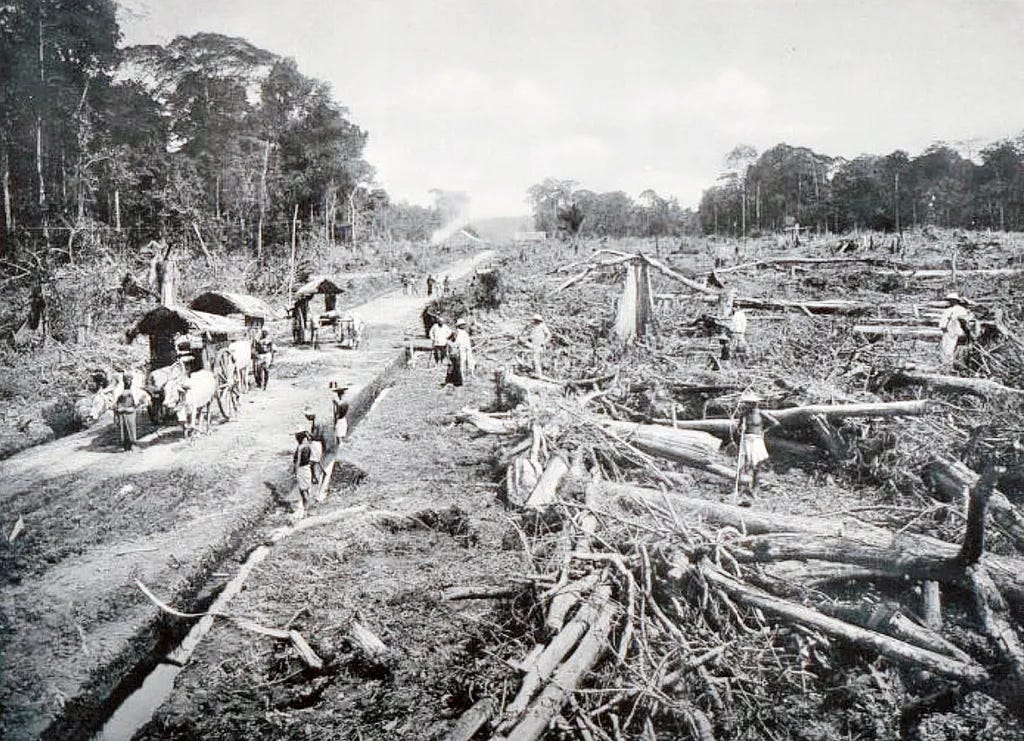
While colonialism was the physical act of occupying foreign lands, subjugating the indigenous people and their land to exploitation, rendering them dependent on the occupier; imperialism is the systemic machinery behind this extraction, exploitation, and plundering. Imperialism survives colonialism.
For centuries, these imperial powers plundered natural resources from their colonies, slashed boundless patches of trees and forests, replaced native crops that kept the land fertile with cash crops, and emitted extensive amounts of carbon into the environment far away from their homes. This pattern was repeated in every colony that was occupied by imperial powers in Europe: Americas, almost all of Africa, South East Asia including India, Indonesia, Malaysia, Australia. In one of our earlier posts, we discussed how colonial exploitation in indigenous lands drove the land, nature, and its communities to desolation.
Climate Imperialism
Vladimir Lenin explained how the basic feature of imperialism was the capitalists, in both developed and developing countries, forming international monopolies to divide and share the entirety of the world and its resources among themselves. Using three contemporary examples, we can present how the imperial mode of production continues to survive in the postcolonial age.
Carbon Offsets
Capitalists in the Global North that release tonnes of carbon emission – one of the most major causes of climate crisis – buy carbon credits in Asia, Africa, or South America. However, these carbon credit projects once again recreate the cycle of colonial exploitation by becoming the newest means of land grabbing and exploiting local communities.
These projects can offset carbon emissions for capitalist corporations through various ways such as preservation of mangroves and rainforests, and afforestation. A 2024 report by GRAIN, an international NGO supporting local farmers, identified 279 large-scale tree and crop planting projects for carbon credits set up by corporations since 2016 in the global south. These projects covering more than 9.1 million hectares of land reveal a pattern of land grabbing. Under these new land deals, foreign companies acquire large tracts of lands that were used by local communities for farming, grazing, and their sustenance, and convert them into industrial plantations used solely for the purposes of big corporations.

While these contracts do not displace farmers from their land, the control over land usage is essentially taken over by corporations. These projects also encourage, sometimes even facilitate, a shift from collective forms of land management to more privatised forms. Further, these carbon offset projects rely on industrial tree plantations of fast growing, and in most cases non-native species like pine, bamboo, and eucalyptus which are disastrous for the local communities and their environment.
Take the case of Paris based private entity Livelihood Fund which is investing heavily in plantations in India. One such project in Araku Valley claims to train 14000 tribal farmers in “sustainable farming practices to enable them take good care of their trees and soil while preserving their fragile ecosystem”. However, ground investigation reveals that farmers were not made aware of carbon credits before signing a 20-year legally binding agreements accepting that the rights over the carbon credits that the project will issue are assigned exclusively to Livelihoods Fund.
Carbon offset programmes are on the rise, becoming another profitable business with several private entities controlling the market for it. Not only are the number of projects increasing, but the size of these projects is on rise as well. Several investigations have revealed that these projects use convenient faulty methodologies that are highly subjective in their definitions of how much carbon emissions are actually being captured/offset.
Waste Colonialism
Waste Colonialism refers to the phenomena of trans-boundary disposal of a variety of toxic and hazardous wastes, including textiles, plastics, electronic-waste, persistent organic pollutants, industrial waste, decommissioned ships, municipal solid waste, radioactive waste, and other toxic waste. Waste from across the global north is discarded, managed, and treated in the global south, thereby exposing these countries directly to the dangers of these practices. Every data reveals the same pattern – countries with a history of colonisation exporting their waste into their erstwhile colonies.
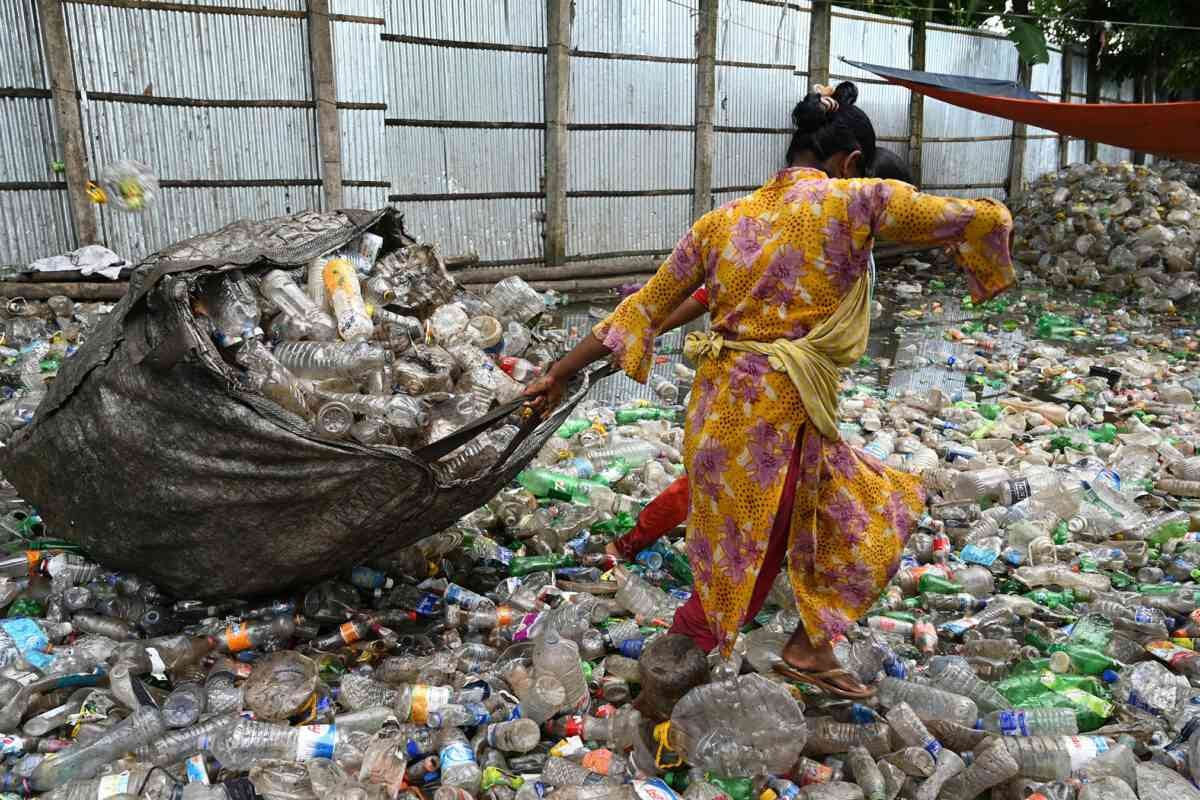
The premise that land’s only purpose is for extraction and dumping is inherently colonial. That land has no purpose besides profit making and is disposable for all profit making ventures. Developed countries continue to generate increasing amounts of waste and conveniently export them to developing and underdeveloped countries. These countries, then, are left with the responsibility to manage, treat, and recycle the waste of rich countries. A study from 2019 showed how moving high volumes of consumed plastic waste outside of a country (typically from high-income to low-income countries) encourages the consumption of plastics in “artificially cleaner” countries. Colonialism survives in the conviction of developed countries that they have control over land that does not belong to them.
Waste colonialism recreates conditions of earlier colonial period. Land is made unusable due to waste contamination, dispossessing local communities dependent on those lands. The locals, often left unemployed due to these factors, are then forced to work in the same waste disposal sites. These local communities not only face the threat to their health and livelihood, but to their local environment which gradually becomes inhospitable. Meanwhile the capitalist class continues to make its profit.
AI Data Centres
Despite the thoroughly documented environmental impact of AI data centres, companies in rich countries are increasingly pushing for setting up data centres in already climate vulnerable countries of the global south. These data centres consume threateningly high amounts of freshwater, ultimately polluting and disrupting water networks in their surrounding environment. Moreover, these data centres, too, create conditions of extraction and displacement of local communities.
In India alone, data centres consumed 150 billion litres of water in 2025, a number that is expected to double by 2030 – with government’s own data claiming that 600 million people are already facing high to extreme water stress. In addition to this, data centres also create extreme heat in their surroundings and require high amounts of energy for operations. A major investigation has shown how land belonging to Dalit community is being allocated for data centres. These patterns continue to reveal the underlying colonial modes of production inherent to climate imperialism.
Conclusion
Recently, scientists have strongly begun suggesting that we are living in the geological epoch of Anthropocene. Each epoch represents a distinct period of Earth’s lifetime. The shifting emphasis on Anthro (human) calls for acknowledging the role of human activities in changing Earth’s climate, ecology, and natural ecosystems. Parallelly, Indigenous scholars have also been pushing to locate the source of shift to this epoch within the history of imperialism and colonialism. They argue that it was the colonial modes of extraction and exchange that created the factors pushing climate crisis in the present.
Unless, the framework for climate crises is not shifted to imperialism and colonialism, it will be difficult to have any meaningful engagement with it. Climate Imperialism continues to exist in increasingly visible ways: (a) rich countries continue to produce and consume based on imperialist mode of living, generating greater carbon emissions than they take responsibility for; (b) persistent inequality in how climate change is framed and addressed whereby most affected and vulnerable countries are made more responsible for managing climate solutions; (c) colonial modes of accumulation, extraction, theft, and dispossession continue to operate in newer ways.
Further Readings:
Climate Imperialism in the Twenty-First Century
More than a metaphor: ‘climate colonialism’ in perspective
From land grabbers to carbon cowboys: a new scramble for community lands takes off
Dirty Data: The Cost of Data Center Infrastructures Powering AI and the People Paying the Price