Who was Karl Marx and What are his Contributions to the World?
Understanding the legacy of Marx through his critique of capitalism, theory of class struggle, and vision for social change.
Contents
Karl Marx
5 May 1818 - 14 March 1883
Revolutionary First, Philosopher Later
After the Russian Revolution, which firmly placed Marxism as a force to be reckoned with and showcased to the world the revolutionary theory of the proletariat, many revolutionaries worldwide adopted and applied it successfully for analyzing their own material conditions effectively to carry out their fight against their ruling classes and imperialists. Millions throughout history and across the globe were freed from the yoke of capitalist exploitation, after the establishment of the People’s Republic of China in 1949, roughly 750 million people lived in states which were on a path of socialist development (almost one-third of the global population at the time). For Revolutionary Wars across the world from India to the Philippines, Marxism remains as the ideological basis with its tools that allow for properly understanding and changing the socio-economic conditions.
A Revolutionary Life
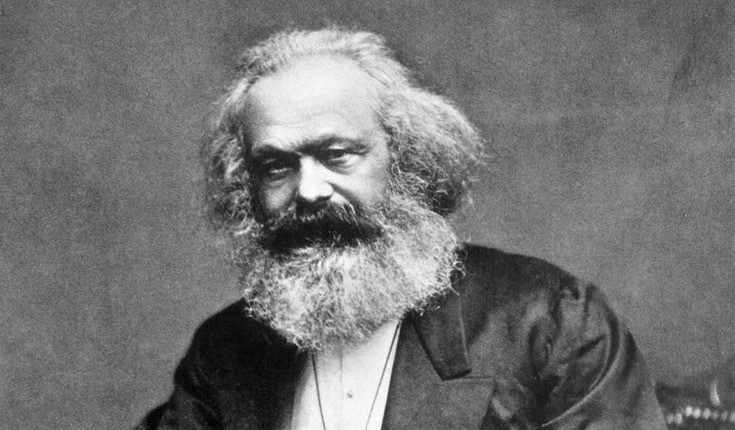
“Marx, Karl, was born on May 5, 1818, in the city of Trier. His father was a lawyer, a Jew, who in 1824 adopted Protestantism. The family was well-to-do, cultured, but not revolutionary. After graduating from a Gymnasium in Trier, Marx entered the university, first at Bonn and later in Berlin, where he read law, majoring in history and philosophy.”
“... Marx was a Hegelian idealist in his views. In Berlin, he belonged to the circle of “Left Hegelians” who sought to draw atheistic and revolutionary conclusions from Hegel’s philosophy.”
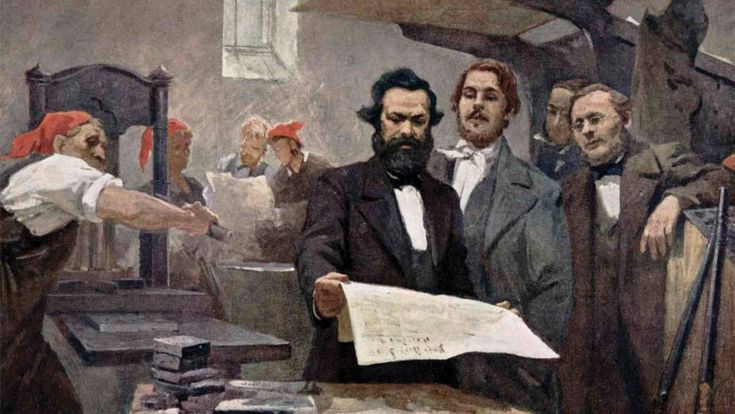
“Left Hegelian views were making rapid headway in Germany at the time. Feuerbach began to criticize theology, particularly after 1836, and turned to materialism, which in 1841 gained ascendancy in his philosophy … “We [the Left Hegelians, including Marx] all became at once Feuerbachians.” At that time, some radical bourgeois in the Rhineland, who were in touch with the Left Hegelians, founded, in Cologne, an opposition paper called Rheinische Zeitung (The first issue appeared on January 1, 1842). Marx and Bruno Bauer were invited to be the chief contributors, and in October 1842 Marx became editor-in-chief and moved from Bonn to Cologne. The newspaper’s revolutionary-democratic trend became more and more pronounced under Marx’s editorship, and the government first imposed double and triple censorship on the paper, and then on January 1, 1843 decided to suppress it. Marx had to resign the editorship before that date, but his resignation did not save the paper, which suspended publication in March 1843. … Marx’s journalistic activities convinced him that he was insufficiently acquainted with political economy, and he zealously set out to study it.”
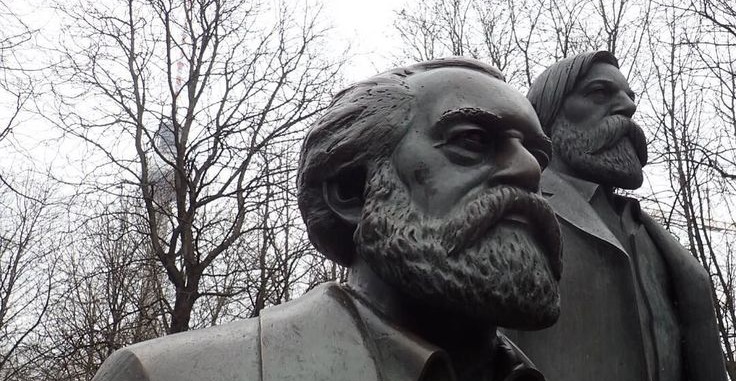
“In 1844, Frederick Engels came to Paris for a few days, and from that time on became Marx’s closest friend. They both took a most active part in the then seething life of the revolutionary groups in Paris …waging a vigorous struggle against the various doctrines of petty-bourgeois socialism, they worked out the theory and tactics of revolutionary proletarian socialism, or communism (Marxism). … At the insistent request of the Prussian government, Marx was banished from Paris in 1845, as a dangerous revolutionary. He went to Brussels. In the spring of 1847, Marx and Engels joined a secret propaganda society called the Communist League; they took a prominent part in the League’s Second Congress (London, November 1847), at whose request they drew up the celebrated Communist Manifesto, which appeared in February 1848.”
“On the outbreak of the Revolution of February 1848, Marx was banished from Belgium. He returned to Paris, whence, after the March Revolution, he went to Cologne, Germany, where Neue Rheinische Zeitung was published from June 1, 1848, to May 19, 1849, with Marx as editor-in-chief. The new theory was splendidly confirmed by the course of the revolutionary events of 1848-49, just as it has been subsequently confirmed by all proletarian and democratic movements in all countries of the world.”
“The revival of the democratic movements in the late fifties and in the sixties recalled Marx to practical activity. In 1864 (September 28) the International Working Men’s Association—the celebrated First International—was founded in London … In uniting the labor movement of various forms of non-proletarian, pre-Marxist socialism … and in combating the theories of all these sects and schools, Marx hammered out a uniform tactic for the proletarian struggle of the working in the various countries.”
“His wife died on December 2, 1881, and on March 14, 1883, Marx passed away peacefully in his armchair. He lies buried next to his wife at Highgate Cemetery in London.”
Dialectical Materialism
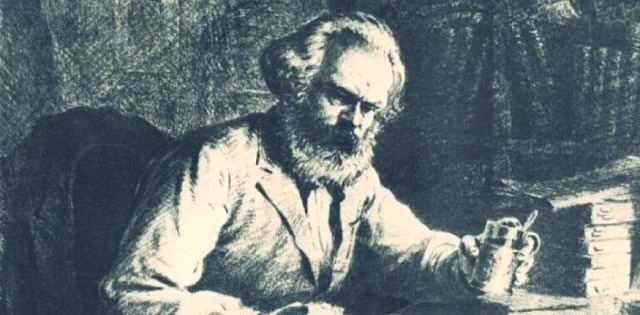
“Beginning with the years 1844–45, when his views took shape, Marx was a materialist and especially a follower of Ludwig Feuerbach, whose weak point he subsequently saw only in his materialism being insufficiently consistent and comprehensive. To Marx, Feuerbach’s historic and “epoch-making” significance lay in his having resolutely broken with Hegel’s idealism and in his proclamation of materialism, which already “in the 18th century, particularly French materialism, was not only a struggle against the existing political institutions and against... religion and theology, but also... against all metaphysics” (The Holy Family, in Literarischer Nachlass)
“... the ideal is nothing else than the material world reflected by the human mind, and translated into forms of thought.” (Capital, Vol. I, Afterword to the Second Edition.)
“Engels writes, “that the world is not to be comprehended as a complex of ready-made things, but as a complex of processes, in which the things apparently stable no less than their mind images in our heads, the concepts, go through an uninterrupted change of coming into being and passing away … But to acknowledge this fundamental thought in words and to apply it in reality in detail to each domain of investigation are two different things.... For dialectical philosophy nothing is final, absolute, sacred. It reveals the transitory character of everything and in everything; nothing can endure before it except the uninterrupted process of becoming and of passing away, of endless ascendancy from the lower to the higher. And dialectical philosophy itself is nothing more than the mere reflection of this process in the thinking brain.” Thus, according to Marx, dialectics is “the science of the general laws of motion, both of the external world and of human thought.”
Materialist Conception of History
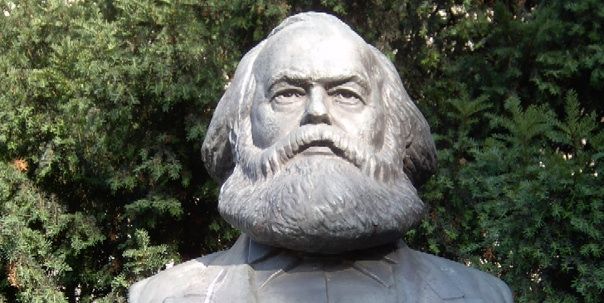
“In the preface to his Contribution to the Critique of Political Economy, Marx gives an integral formulation of the fundamental principles of materialism as applied to human society and its history, in the following words:
“In the social production of their life, men enter into definite relations that are indispensable and independent of their will, relations of production which correspond to a definite stage of development of their material productive forces.
“The sum total of these relations of production constitutes the economic structure of society, the real foundation, on which rises a legal and political superstructure and to which correspond definite forms of social consciousness. The mode of production of material life conditions the social, political, and intellectual life process in general. It is not the consciousness of men that determines their being, but, on the contrary, their social being that determines their consciousness. At a certain stage of their development, the material productive forces of society come in conflict with the existing relations of production, or—what is but a legal expression for the same thing—with the property relations within which they have been at work hitherto. From forms of development of the productive forces, these relations turn into their fetters. Then begins an epoch of social revolution. With the change of the economic foundation, the entire immense superstructure is more or less rapidly transformed. In considering such transformations, a distinction should always be made between the material transformation of the economic conditions of production, which can be determined with the precision of natural science, and the legal, political, religious, aesthetic, or philosophic—in short, ideological forms in which men become conscious of this conflict and fight it out.”
Marx’s Economic Doctrine: Value and Surplus Value
“The production of commodities is a system of social relations in which individual producers create diverse products (the social division of labor), and in which all these products are equated with one another in the process of exchange. Consequently, what is common to all commodities is not the concrete labor of a definite branch of production, not labor of one particular kind, but abstract human labor—human labor in general. All the labor power of a given society, as represented in the sum total of the values of all commodities, is one and the same human labor power. Thousands upon thousands of millions of acts of exchange prove this. Consequently, each particular commodity represents only a certain share of the socially necessary labor time. The magnitude of value is determined by the amount of socially necessary labor, or by the labor time that is socially necessary for the production of a given commodity, of a given use-value.”
“ “As values, all commodities are only definite masses of congealed labor time.” [A Contribution to the Critique of Political Economy].”
“...The formula of commodity circulation was C-M-C (commodity—money—commodity)—i.e., the sale of one commodity for the purpose of buying another. The general formula of capital, on the contrary, is M-C-M— i.e., the purchase for the purpose of selling (at a profit). The increase over the original value of the money that is put into circulation is called by Marx, surplus value.”
“Surplus value cannot arise out of commodity circulation, for the latter knows only the exchange of equivalents; neither can it arise out of price increases, for the mutual losses and gains of buyers and sellers would equalize one another, whereas what we have here is not an individual phenomenon but a mass, average and social phenomenon. To obtain surplus value, the owner of money “must ... find... in the market a commodity, whose use-value possesses the peculiar property of being a source of value” [Capital]—a commodity whose process of consumption is at the same time a process of the creation of value. Such a commodity exists—human labor power. Its consumption is labor, and labor creates value.”
Marx’s Economic Doctrine: Accumulation and the Contradictions of Capitalism
New and important in the highest degree is Marx’s analysis of the accumulation of capital—i.e., the transformation of a part of surplus value into capital, and its use, not for satisfying the personal needs or whims of the capitalist, but for new production. By speeding up the supplanting of workers by machinery and by creating wealth at one extreme and poverty at the other, the accumulation of capital also gives rise to what is called the “reserve army of labor,” to the “relative surplus” of workers, or “capitalist overpopulation,” which assumes the most diverse forms and enables capital to expand production extremely rapidly. In conjunction with credit facilities and the accumulation of capital in the form of means of production, this incidentally is the key to an understanding of the crises of overproduction which occur periodically in capitalist countries—at first at an average of every 10 years, and later at more lengthy and less definite intervals. From the accumulation of capital under capitalism, we should distinguish what is known as primitive accumulation: the forcible divorcement of the worker from the means of production, the driving of the peasant off the land, the stealing of communal lands, the system of colonies and national debts, protective tariffs, and the like. “Primitive accumulation” creates the “free” proletarian at one extreme, and the owner of money, the capitalist, at the other.
Socialism: The Historic Necessity
From the foregoing, it is evident that Marx deduces the inevitability of the transformation of capitalist society into socialist society and wholly and exclusively from the economic law of the development of contemporary society. The socialization of labor, which is advancing ever more rapidly in thousands of forms and has manifested itself very strikingly in the growth of large-scale production, capitalist cartels, syndicates, and trusts, as well as in the gigantic increase in the dimensions and power of finance capital, provides the principal material foundation for the inevitable advent of socialism.
The intellectual and moral motive force and the physical executor of this transformation is the proletariat, which has been trained by capitalism itself. The proletariat’s struggle against the bourgeoisie, which finds expression in a variety of forms ever richer in content, inevitably becomes a political struggle directed towards the conquest of political power by the proletariat (“the dictatorship of the proletariat”). The socialization of production cannot but lead to the means of production becoming the property of society, to the “expropriation of the expropriators.” A tremendous rise in labor productivity, a shorter working day, and the replacement of the remnants, the ruins, of small-scale, primitive and disunited production by collective and improved labor—such are the direct consequences of this transformation.
Capitalism breaks for all time the ties between agriculture and industry, but at the same time, through its highest development, it prepares new elements of those ties, a union between industry and agriculture based on the conscious application of science and the concentration of collective labor, and on a redistribution of the human population (thus putting an end both to rural backwardness, isolation, and barbarism, and to the unnatural concentration of vast masses of people in big cities). A new form of family, new conditions in the status of women and in the upbringing of the younger generation are prepared by the highest forms of present-day capitalism: the labor of women and children and the break-up of the patriarchal family by capitalism inevitably assume the most terrible, disastrous, and repulsive forms in modern society.
Tactics of the Proletariat - Class Struggle
“The history of all hitherto existing society is the history of class struggles,” Marx wrote in the Communist Manifesto (with the exception of the history of the primitive community, Engels added subsequently). “Freeman and slave, patrician and plebeian, lord and serf, guild-master and journeyman, in a word, oppressor and oppressed, stood in constant opposition to one another, carried on an uninterrupted, now hidden, now open fight, a fight that each time ended, either in a revolutionary reconstruction of society at large, or in the common ruin of the contending classes.... The modern bourgeois society that has sprouted from the ruins of feudal society has not done away with class antagonisms. It has but established new classes, new conditions of oppression, new forms of struggle in place of the old ones. Our epoch, the epoch of the bourgeoisie, possesses, however, this distinctive feature: it has simplified class antagonisms. Society as a whole is more and more splitting up into two great hostile camps, into two great classes directly facing each other: Bourgeoisie and Proletariat.” (The Marxist Doctrine, Lenin’s Karl Marx)
“Large-scale industry concentrates in one place a crowd of people unknown to one another. Competition divides their interests. But the maintenance of wages, this common interest which they have against their boss, unites them in a common thought of resistance—combination.... Combinations, at first isolated, constitute themselves into groups ... and in face of always united capital, the maintenance of the association becomes more necessary to them [i.e., the workers] than that of wages.... In this struggle—a veritable civil war—all the elements necessary for the coming battle unite and develop. Once it has reached this point, association takes on a political character. (Marx, The Poverty of Philosophy, 1847)
“The Communists fight for the attainment of the immediate aims, for the enforcement of the momentary interests of the working class; but in the movement of the present, they also represent and take care of the future of that movement.” (The Communist Manifesto)
“From this moment, science, produced by the historical movement and associating itself with it in full recognition of its cause, has ceased to be doctrinaire and has become revolutionary.”
Marx, The Poverty of Philosophy (1847)
Marx’s life and contributions must also be looked at through the philosophy he himself developed. The birth of Marxism itself was based on the historical development and critique of the philosophies of Feuerbachian Materialism, Hegelian Dialectics, British Economics, and Utopian Socialists (such as Proudhon, Robert Owen) on one hand, which were interconnected with the Bourgeois democratic revolutions, the Industrial Revolution, and emerging class consciousness, the first worker uprisings across Europe, on the other hand. It was in these socio-economic conditions of the time in which Marx and Engels developed Marxism. That is to say, the emergence of the proletariat as a class meant that theories representing it also came into existence, but among them all, Marxism emerged as the true theory of the proletariat. It has given us the tools required to understand the world as it actually is and hence change it.
Read next

Online Reading and Screening| To Vote Is Not A Choice
Join us as we read, discuss, and collectively build clarity.

Online Reading and Screening| To Vote Is Not A Choice
Join us as we read, discuss, and collectively build clarity.

“Vote Chori”, SIR and Current Outburst
Where is the Movement Headed and What Must We Do?