What is AFSPA and Why is it Called a “Lawless Law”?
A deeper look into one of the most criticised laws in India
Contents
India attained formal independence from the British in 1947, however, with a cost of partition- which divided the subcontinent into two dominions: India and Pakistan. Even after partition, India remained largely a fragmented land ruled by a number of feudal families. The task remained to keep as much as land possible within its boundaries.
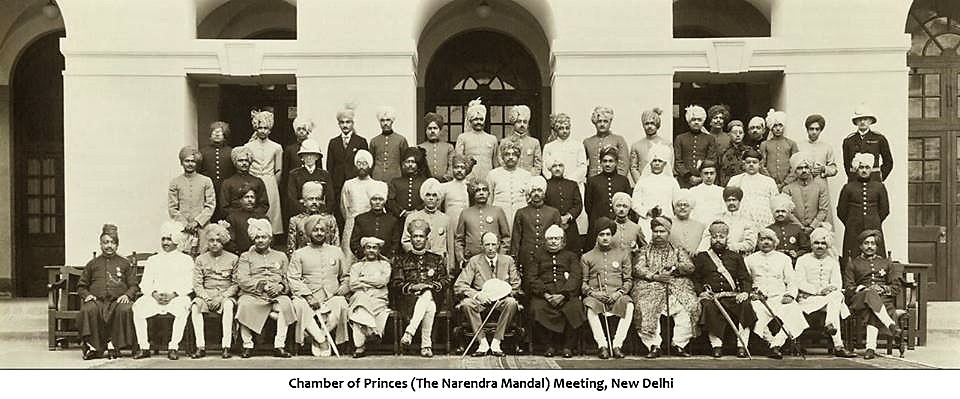
While it is often said that the princes "acceded" to India through peaceful negotiations, that was not true in every case. And even when consent of the rulers was sought, the consent of the common masses remained out of question. Some regions acceded quickly while there were others that resisted. And even till this date, we have these regions that are often referred to as “disturbed”.
To maintain control, the Indian state has employed various measures: some cultural, aimed at assimilating and erasing local identities; others more direct, involving armed control and surveillance.
One of the major laws that help this cause is known as Armed Forces Special Powers Act (AFSPA), a law that has been termed as “draconian” for decades by human rights organisations and activists.
Colonial Roots of AFSPA
To understand AFSPA, we will have to go through its colonial roots. In 1942 a British ordinance was issued with an intention to suppress the Indian independence movement at a time when the Second World War was in full force. Later, the same ordinance would give birth to the Armed Forces (Special Powers) Act, 1958 in the form of a new ordinance which was adopted by the government of India in May 1958, endorsed by the Indian parliament in August 1958, which later received the presidential assent on September 11, 1958.
The purpose of the Act was described as to bring an end to civilian militancy in the Northeastern states of India, particularly in Manipur and Assam.
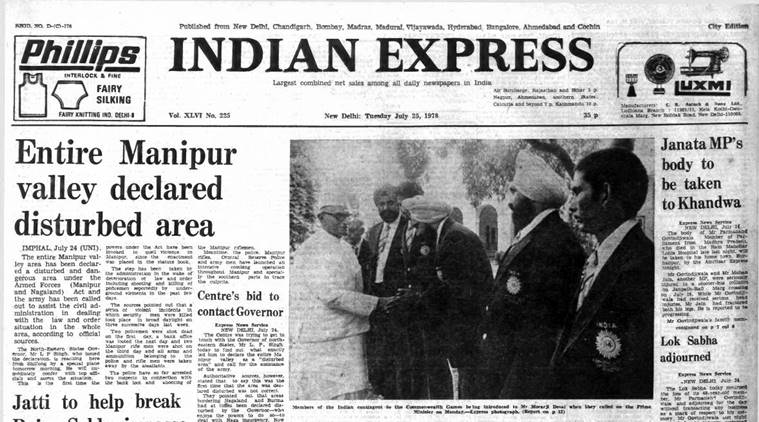
Later in 1972 the Act was amended in order to extend it to all the states lying in the Northeastern region of India. It was briefly applied to Punjab as well. At present the act remains in force in the Northeastern states and the union territory of Jammu and Kashmir.
Even when the bill was tabled, several legislators, such as Laishram Achaw Singh, termed it as a ‘lawless law’ and raised that it would only ‘harass innocent folk and deteriorate the situation.’
What Makes AFSPA a “Lawless Law”?
Let us understand what makes AFSPA a lawless law and why it is criticised by those concerned with the protection of human rights.
First, the Act allows the Governor (or the Central Government) to declare any area "disturbed" without consulting the elected Chief Minister, simply through a notification in the Official Gazette.
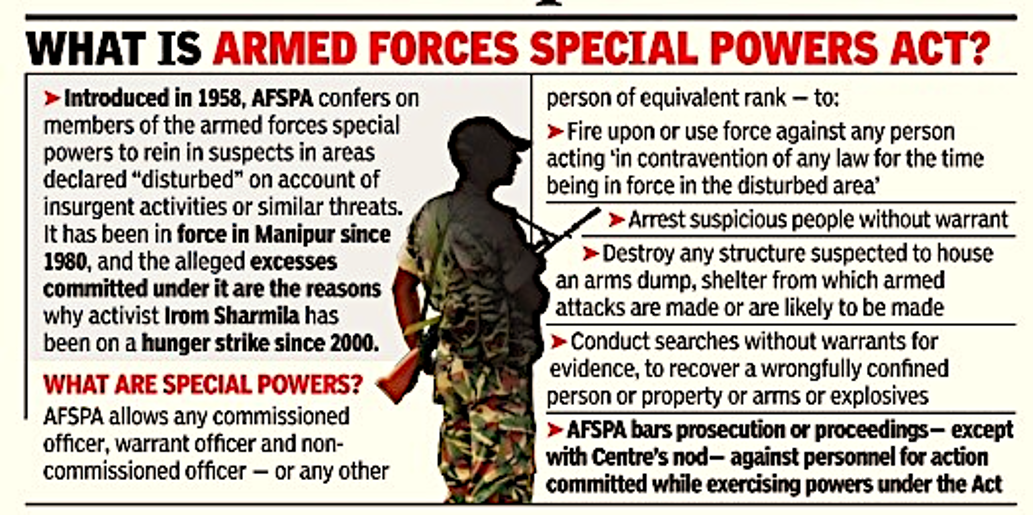
Once an area is declared disturbed, Section 4 of the Act empowers any commissioned, warrant, or non-commissioned officer to act based on their “opinion”.
They can fire or use force, even causing death, after giving whatever warning they “consider necessary”.
They can arrest without a warrant anyone “suspected” of committing a cognizable offence, using necessary force.
They can destroy shelters “believed” to be used by armed groups, and enter and search premises without a warrant.
In this way, the Act places extraordinary and vague discretionary powers both in the hands of the Governor and the armed forces.
In Kashmir, the version of AFSPA enacted in 1990 goes even further than the original 1958 Act in its width.
An area can be declared “disturbed” not just for acts of violence, but for any activities believed to be anti-Government, for creating disharmony among people, or for striking terror.
It also covers any actions that question or disrupt India's sovereignty and territorial integrity, or insult the national flag, anthem, or Constitution.
Immunity Under AFSPA
Further, one of the most draconian features of the Act is the freedom it guarantees to the armed forces members for their discretion and conduct. Section 6 (similar to Section 7 in AFSPA J&K 1990) of the Act protects “persons acting under the Act” from any prosecution, suit or other legal proceeding without a sanction from the Central Government.
Reports show that the central government often refuses to allow legal action against army or paramilitary members under section 6 of the law, and sometimes delays decisions for years. The approval process is also not clear or open.
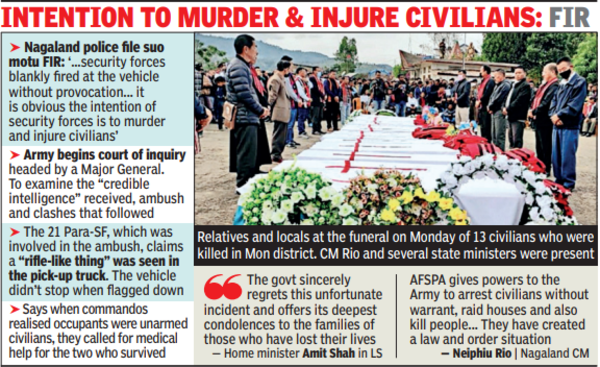
A recent case from 2021 in Nagaland, where personnel of the 21 Para (SF), a unit of the Indian Army killed about 14 civilians during a botched anti-insurgency operation. A Special Investigation Team of the Nagaland Police recommended criminal prosecution of 30 army personnel involved. The Union Government, however, refused sanction to prosecute them. In 2024, the Supreme Court closed the proceedings while citing “the case may be taken to its logical end if the Union government sanctions their prosecution”.
Impunity in Action
In 2000, after the Chattisinghpora massacre, five Kashmiri villagers were killed in Pathribal and falsely portrayed as Pakistan-based militants. The CBI later found army officers responsible for the killings. Yet, citing immunity under AFSPA, the army refused to allow prosecution, and the soldiers escaped accountability.
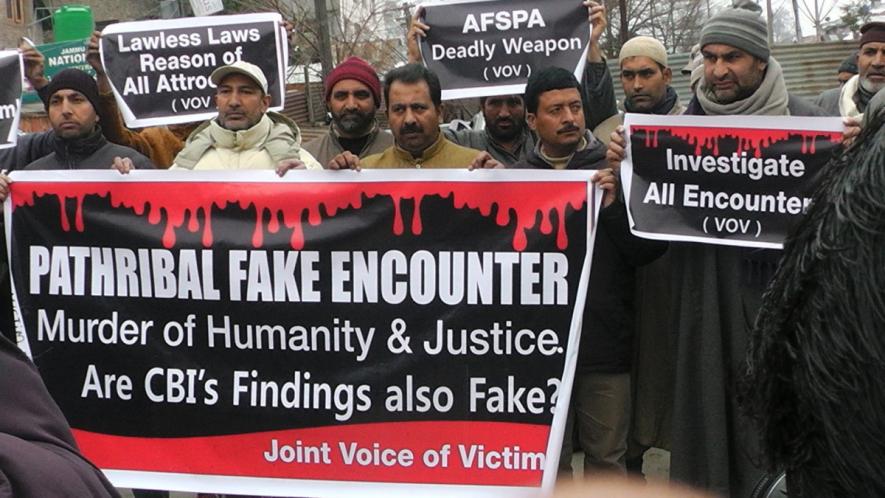
As per the OHCHR Report on the Human Rights Situation in Kashmir, the central government had not approved a single case of prosecution of the armed forces ever since the operation of AFSPA. Further the army has rejected over 96% of the human rights complaints against its soldiers in Jammu & Kashmir, calling them "false or baseless."
Thus, AFSPA effectively gives the State and armed forces a free hand in "disturbed areas." Its provisions make it nearly impossible to hold personnel accountable for human rights violations committed during operations.
Sexual Violence as a Weapon
One of the gravest consequences of the unchecked power of this Act is the use of sexual violence as a weapon of domination — not just to violate women, but to humiliate entire communities into submission.
The horrifying case from 2004 Manipur is a testament to it. A 32 year old woman in Manipur, Manorama, was dragged out of her house, at night, tortured and killed by "at least 13 members of the Indian security forces." A report also suggested that she was raped. The whole inquiry was made on the basis of a claim that Manorama was part of the banned People’s Liberation Army, a link that was never proven.
In protest, Manorama’s family refused to accept her body for cremation and demanded justice and the withdrawal of AFSPA from Manipur. Paying no heed to the demands of the family, the Manipur government ordered the police to cremate the body.
Days later, a group of elderly women staged a powerful protest in front of the 17th Assam Rifles headquarters — stripping naked and holding banners that read: "Indian Army, Rape Us Too!"
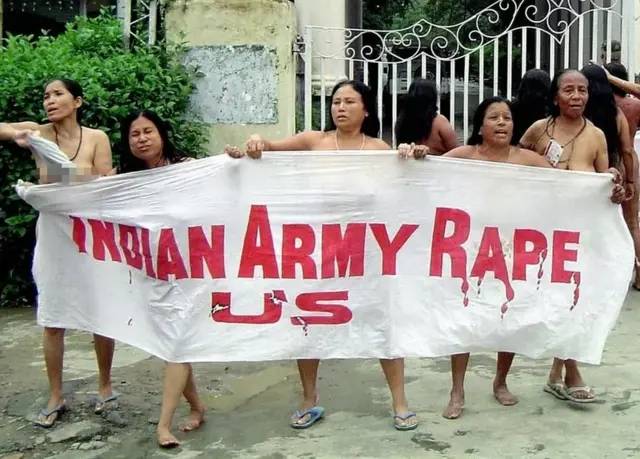
Similar stories come from Kashmir. The mass rapes in Kunan Poshpora (1991), Haran (1992), and Gurihakhar (1992) reveal the constant threat faced by women in militarised regions. The case of Razina Begum, who was sexually assaulted in illegal custody, shows how the State has consistently blocked justice — despite the victim's efforts.
Verma Committee constituted to review AFSPA noted that “impunity for systematic or isolated sexual violence in the process of internal security duties is being legitimised by the AFSPA”
The Nationalist Defense
The Act has its critics but even more supporters, the nationalists who are quick to defend the provisions, however draconian and however misused, in the name of national safety and integrity. But such conclusions, at first, come from the place of privilege, from those whose lives remain untouched by the daily repression in these regions. Further, it comes out of an incorrect and insensitive approach towards the very question of what constitutes a “nation”.
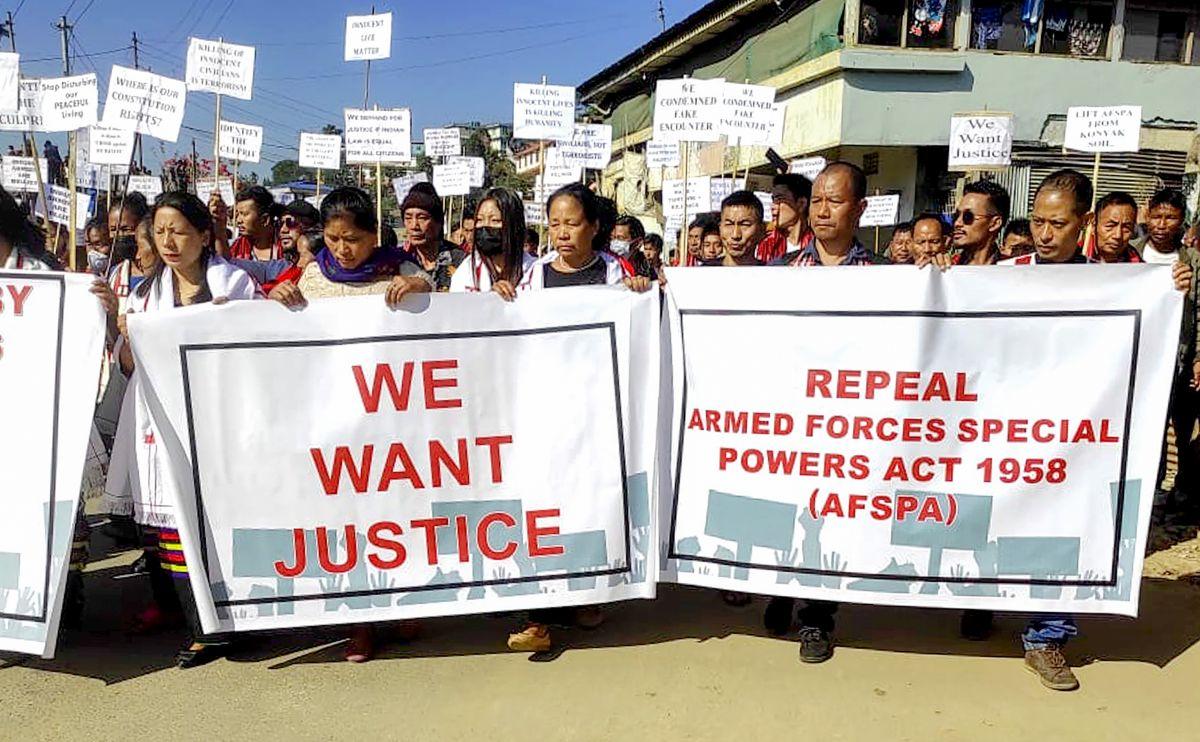
If a nation is about a feeling of oneness, as we are taught, why is it unacceptable for us to acknowledge that there are sections, populations, and regions that do not feel this standardised version of oneness? If a nation is more than just a piece of land and resources, if it is made by its people, then it is the people who must be heard — not forced into silence.
The Indian State once spoke of the right to national self-determination on the global stage. Yet at home, it has denied this right to many.
Many official committees that have reviewed AFSPA have recommended its repeal — but even in doing so, they have only considered the legal aspects but little attention has been made over the political aspirations of the people.
The Legality Question
The mere legality of something does not make it just, because by that logic, even British colonial rule was legal.
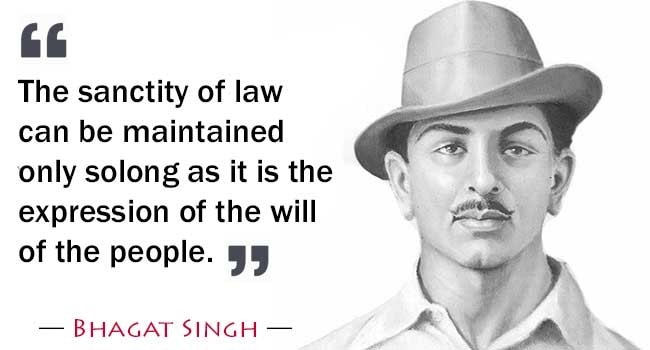
To recall the words of Bhagat Singh:
“The sanctity of law can be maintained only so long as it is the expression of the will of the people. When it becomes a mere instrument in the hands of an oppressing class, it loses its sanctity and significance, for the fundamental preliminary condition for administration of justice is the elimination of every interest”.
As he further warned:
“As soon as the law ceases to correspond to the popular social needs, it becomes the means for perpetration of injustice and tyranny. The maintaining of such a law is nothing but a hypocritical assertion of a special interest against the common interest”.
Repeal AFSPA!
Acts like AFSPA are a blot on India's claim of being a democracy. Once having seen the wrath of colonialism, the Indian State merely learned how to continue it from its predecessors. In the transfer of power between the rich white and the rich brown, India imported the capitalist system — a system ruled by a minority of the rich.
Today, the horrors we witness, the suppression that surrounds us, are a direct reflection of the policies made by the Indian State in service to this minority capitalist and imperialist class. Its control over land, resources, and people — despite their resistance and concerns — using every force possible, whether of arms, of law, or of culture, serves only to protect this class’s interest.
To oppose laws like AFSPA is not to oppose the nation. It is to stand with the people. It is to resist the rule of a minority class that is willing to crush the majority for its own profit.
The Young Political Workers is fighting the capitalist propaganda through revolutionary political education. As platforms like Instagram suppress political content, we are moving to Substack to share unfiltered ideas. Subscribe to The Revolutionary Youth Bulletin. Your financial support will help us expand into physical spaces and publications, continuing the fight against caste oppression and systemic injustice.
Read next

Online Reading and Screening| To Vote Is Not A Choice
Join us as we read, discuss, and collectively build clarity.

Online Reading and Screening| To Vote Is Not A Choice
Join us as we read, discuss, and collectively build clarity.
“Vote Chori”, SIR and Current Outburst
Where is the Movement Headed and What Must We Do?