Remembering Ambedkar As He Must Be
His Struggle. His Warnings. Our Action.
Contents
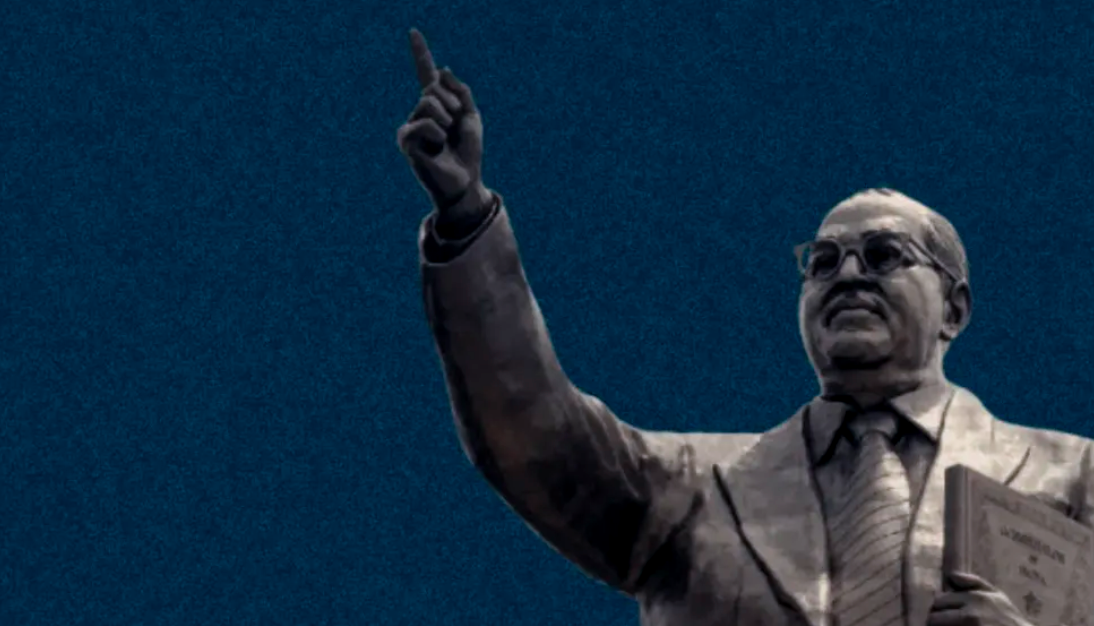
The name of Dr. B.R. Ambedkar has been etched in our consciousness as the “architect of the Constitution.” But was this his most significant feat—the towering achievement for which he would want to be remembered?
Ambedkar was a visionary philosopher, writer, activist for the downtrodden, and most prominently, a fierce critic of the social and political structure that exists in the country.
He stood against the caste system, a structure deeply embedded in the fabric of the country for centuries. His anti-caste struggle first gained prominence with the Mahad Satyagraha he led in 1927, fighting for the right of Dalits to access a public water tank.
He minced no words in his critique of caste as an essential feature of Hinduism when he said:
“Hindu society as such does not exist. It is only a collection of castes. (...) There is no Hindu consciousness of any kind.”
Today, the times we are living in echo the warnings Ambedkar issued about the threat of Hindu majoritarianism, which is plunging the country into a fire of religious hatred. At a stage where the global imperialist crisis is peaking and the State has taken up the task of covering up the largely failing economy by feeding the opium of religion to the majority, we inch towards a more and more divided society each day.
Dalits, Muslims, and other marginalised groups remain at the mercy of the Brahmanical State—whether it be students in public universities subjected to shocking indignities, or Hindu vigilante groups attacking a person on the suspicion of carrying beef.
Institutions like the judiciary, once regarded as the protector of rights and a check on executive power, today tilt towards satisfying the “collective conscience of the society” (read: majority), reflecting their caste and class character.
While Ambedkar is hailed as the “architect of the Constitution,” seeing even the most basic principles of liberal democracy and the republican Constitution fail today would provoke his most scathing critique.
The flaws of the Constitution and its probable inability to work under the structure of this country was no unforeseeable event for him. In his later years, he came out openly to say that the Constitution attributed to his name has many things that he did not support—and yet had to take forward against his will.
Although Ambedkar initially used the parliamentary path to push reforms from within, his experiences ultimately led him to acknowledge the failure of political democracy in India. He says:
“Democracy will not work (in India), for the simple reason we have got a social structure which is totally incompatible with parliamentary democracy,”
pressing how democracy can only work in a formal sense.
Despite being one of the most sharply opposed political figures of his time—especially by dominant upper-caste leaders—Ambedkar’s legacy today cannot be erased. In such cases where a leader cannot be erased or opposed, they are co-opted and their ideas are distorted.
Today, be it Congress or BJP, Ambedkar’s name is invoked in order to polarise the masses. As writer and activist Anand Teltumbde notes, Dalits constitute a majority of Hindus and thus become central to the Hindu nationalist agenda against Muslims.
The anti-caste struggle Ambedkar once ignited has today been diluted. Parties claiming to represent the marginalised collaborate with the same structures of capital and caste for electoral gains and political career building—abandoning his fierce struggle.
Ambedkar’s name has been reduced to a symbol—where he is found in the statues but not in the spirits. Ironically, despite his own warnings against hero worship, he is turned into an idol—worshipped for his great deeds but forgotten for his fight.
“There is no doubt that for Dalits, Ambedkar has been a messiah, and their gratitude for what he did for them is natural. It is one thing to revere a hero and quite another to approach him as pilgrims do god, particularly when the hero had curtly warned against his deification. The way Ambedkar is invoked by the political class, and even by Dalit intellectuals—whether stemming from sheer ignorance or to gain traction with the ruling classes—reduces him to an inert godhead, merely to be worshipped. Or worse, a reactionary identity icon blocking any further enlightenment. Cheaper still, a coin in the trade of careerist transactions, easing the ascent of cynical climbers.”
— Anand Teltumbde, Republic of Caste: Thinking Equality in the Time of Neoliberal Hindutva
Then, what should Ambedkar be remembered for—or as?
Ambedkar represented the masses; he fought tooth and nail for the rights of peasants, industrial workers, and landless labourers—for the upliftment of the downtrodden masses, the oppressed castes, and women.
While we can debate how successful he was in terms of actual results, one thing that is clear is that he fought relentlessly and unequivocally against the rotten social structure of this country.
His fight against the caste system, perhaps more cultural and social in nature, once dealt a significant blow to the structure that continues to stand tall and proud today. He brought the struggles of the masses into direct confrontation with the interests of the ruling class. And to this day, his legacy fuels the spirit of resistance.
Thus, it becomes important for us to draw from him and carry forward an uncompromising fight for the total annihilation of caste and the structure that sustains it. To keep Ambedkar alive—not merely in celebrations, but in our fighting spirit.
Read next

Online Reading and Screening| To Vote Is Not A Choice
Join us as we read, discuss, and collectively build clarity.

Online Reading and Screening| To Vote Is Not A Choice
Join us as we read, discuss, and collectively build clarity.
“Vote Chori”, SIR and Current Outburst
Where is the Movement Headed and What Must We Do?